
TL;DR: Building an HR tech roadmap for a growing SME means sequencing your systems over 18 to 24 months, not buying everything at once. Start with attendance and leave, add payroll once your time data is clean, then layer on performance and analytics. Sequence by headcount and pain, and budget per employee per month.
Building an HR tech roadmap for a growing SME is mostly a sequencing problem, not a shopping problem. The roadmap is a written plan that says which HR system you adopt in which quarter, why that order, and what has to be true before the next one starts. Most SMEs in Bangladesh fail here not because they pick bad software, but because they buy modules in the wrong order.
I sell HR systems to Bangladeshi companies for a living. The pattern I see every month is the same. A 60-person business buys full payroll software, discovers its attendance data is a WhatsApp group and three notebooks, and the payroll runs no better than before. The tool was fine. The order was wrong.
Key Stats
18–24 months
realistic full roadmap for a 30–200 person SME
25%
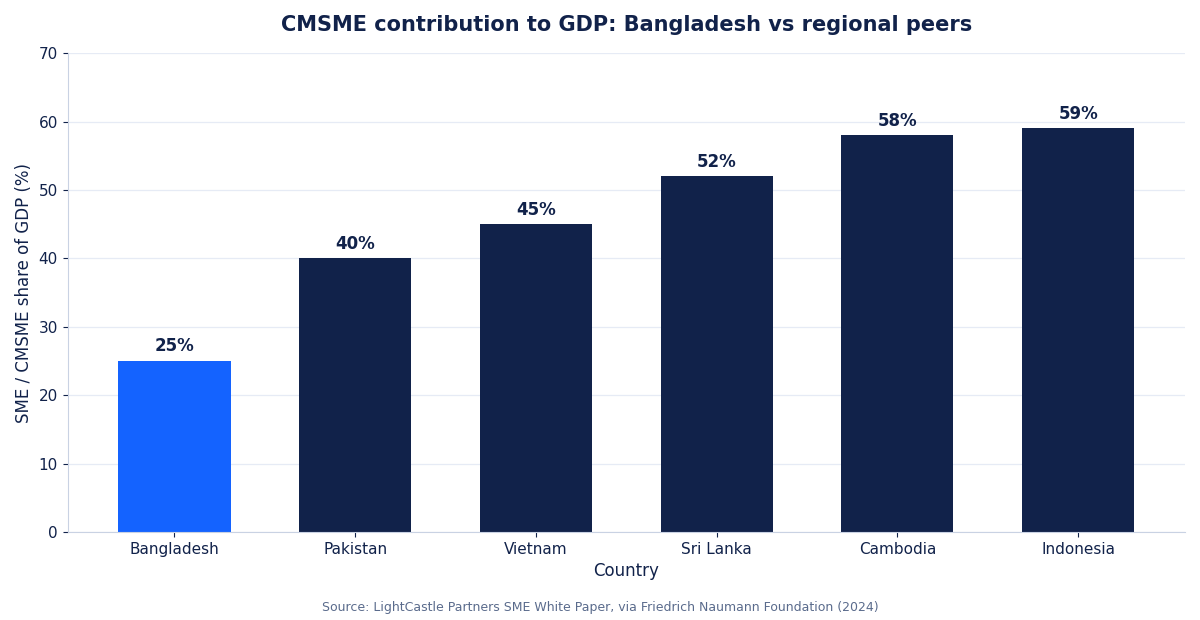
CMSME share of Bangladesh GDP, vs 52% in Sri Lanka
1.17 crore
economic units in Bangladesh, up 49.68% since 2013
What Does Building an HR Tech Roadmap for a Growing SME Actually Mean?
A roadmap is a dated, ordered list of HR systems tied to business triggers. It is not a wish list of features. Each stage names one system, one owner, one go-live quarter, and one measure of done.
The word that matters is growing. A static 20-person shop does not need a roadmap. A business adding people, sites, or shifts does, because every new hire multiplies the cost of a manual process. Your admin work grows faster than your headcount.
Three things belong in every roadmap document:
- The trigger. What business event starts this stage. Example: “we cross 50 staff” or “we open site two”.
- The prerequisite. What data or process must already work. Payroll needs clean attendance first.
- The proof. How you know the stage worked. Example: “monthly payroll closes in 2 days, not 9”.
Without those three, you have a budget line, not a roadmap.
Why Do So Many SME HR Tech Projects Stall?
Most stall because the organisation was not ready, not because the vendor was weak. Research on electronic HRM adoption in SMEs points to the same cluster of causes: cost pressure, thin internal skills, weak top-management sponsorship, and poor data readiness.[1]
A study of HRIS adoption decisions in a Bangladeshi context found that perceived usefulness, top-management support and IT infrastructure were the deciding factors, ahead of price.[2] That matches what I see in the field. The deals that succeed have an owner with authority. The deals that stall have a champion with none.
Four decades of e-HRM research make a blunter point. Adoption and consequences are different things, and organisations routinely achieve the first while missing the second.[3] You can install software and change nothing.
Software does not fix a process you have never written down. It just makes the mess run faster.
What Are the Four Stages of an HR Tech Roadmap?
The order below works because each stage produces the data the next stage needs. Skip a stage and the next one runs on guesswork.
Stage 1: Attendance and Leave (Months 1–3)
Start here because time data is the raw material for everything else. Payroll, overtime, compliance and productivity all read from it. Attendance is also the cheapest stage and the easiest to prove.
For most Bangladeshi SMEs this means biometric or app-based capture, an approval flow for leave, and a live balance every employee can see. If your sites lose internet, insist on an offline attendance system that syncs later. That is not an edge case here. It is a Tuesday.
Stage 2: Payroll and Compliance (Months 4–9)
Only automate payroll once attendance is clean for two full cycles. Payroll software inherits your time data, so bad input becomes wrong salaries at scale.
The Bangladesh Labour Act, 2006 requires employers to fix wage periods and maintain prescribed registers and wage records.[4] A payroll system that generates those records automatically turns a compliance chore into a by-product. Compare options on HR software pricing in Bangladesh before you commit to a per-user plan.
Stage 3: Core HR Records and Self-Service (Months 9–15)
This stage moves your employee files out of cabinets and Excel. One record per person, holding contract, salary history, documents and leave balance.
Self-service is the quiet win. When staff check their own leave balance, HR stops answering the same question 40 times a month. Decide your hosting model here too, because migrating later is painful. Our breakdown of cloud vs on-premise HR software covers the tradeoff for Bangladeshi companies.
Stage 4: Performance and Workforce Analytics (Months 15–24)
Analytics comes last because it needs 12 months of trustworthy history. Run it earlier and you will make confident decisions from thin data.
By this stage you can answer real questions. Which site has the worst absenteeism? What does overtime cost per department? Where is attrition concentrated? A workforce management system built for Bangladesh SMEs is where most companies land.
How Do the Four Stages Compare?
| Stage | System | Typical timing | Prerequisite | Proof it worked |
|---|---|---|---|---|
| 1 | Attendance & leave | Months 1–3 | None | Daily attendance visible without chasing |
| 2 | Payroll & compliance | Months 4–9 | 2 clean attendance cycles | Payroll closes in ~2 days; registers auto-generated |
| 3 | Core HR & self-service | Months 9–15 | Payroll running on system data | HR query volume drops; one record per employee |
| 4 | Performance & analytics | Months 15–24 | 12 months of clean history | Overtime and attrition reported by site |
How Do You Sequence the Roadmap by Headcount?
Headcount is the cleanest trigger for a growing SME because it tracks admin load closely. Use this as a starting grid, then adjust for shift complexity and number of sites.
| Headcount | What breaks first | What to adopt | What to skip for now |
|---|---|---|---|
| Under 25 | Nothing badly; Excel copes | Digital attendance only | Payroll software, analytics |
| 25–60 | Leave tracking and overtime math | Attendance + leave, then payroll | Performance modules |
| 60–150 | Payroll accuracy and audit trail | Payroll, core HR, self-service | Advanced analytics |
| 150+ | Visibility across sites | Full suite incl. analytics | Nothing; you need the stack |
Notice the last column. Knowing what not to buy this year is the most underrated part of building an HR tech roadmap for a growing SME.
Why Does This Matter More in Bangladesh Than Elsewhere?
Bangladeshi SMEs are scaling into an economy that is formalising fast. The Bangladesh Bureau of Statistics recorded 1,17,02,792 economic units in the Economic Census 2024, up 49.68% from 78,18,565 in 2013, with persons engaged rising 25.03% to 3,06,32,661.[5] More units, more workers, more records to keep.
Yet CMSMEs contribute only about 25% of Bangladesh’s GDP, against 52% in Sri Lanka and 59% in Indonesia.[6] The National SME Policy 2025 targets 35% by 2030.[7] Productivity gaps of that size are not closed by working harder. They close when businesses stop spending management time on manual admin.
What Should It Cost, and How Do You Budget It?
Budget per employee per month, not per project. That single change makes the roadmap defensible to a finance team, because cost scales with the thing driving it.
Two rules I give every client. First, never sign a three-year contract in Stage 1, because you do not yet know what you need in Stage 3. Second, price the exit. Ask how you export your data if you leave, in what format, and at what cost. A vendor who cannot answer that in one sentence is telling you something.
When you reach the shortlist, run a structured comparison rather than a demo beauty contest. Our guide on how to choose the right HR automation software gives a six-step scorecard, and HR software features every Bangladeshi business needs covers the local must-haves.
The Contrarian Bit: Do Not Start With Payroll
Almost every SME owner I meet wants payroll first. It is the loudest pain, so it feels like the right starting point. I think that instinct is wrong, and it is the single most expensive mistake in this space.
Payroll is a calculation layer. It consumes attendance, leave, and overtime data and turns it into money. If those inputs are unreliable, payroll software produces wrong numbers faster and with more authority than a human did. Now you have automated the error and added a licence fee.
Fix the input layer first. Payroll then becomes almost boring, which is exactly what payroll should be.
Where Tipsoi Fits
I will be direct, since I work here. Tipsoi is built for this sequence rather than against it.
- Stage 1 works standalone. You can run attendance and leave without buying payroll, so the roadmap starts small.
- It handles Bangladeshi realities. Offline sync, shift patterns, and local compliance records are built in, not bolted on.
- Modules unlock in order. Payroll reads the attendance data you already trust, so Stage 2 is a switch, not a migration.
- Pricing scales per employee. That keeps the budget conversation honest as you grow.
If a different vendor fits your sites better, the roadmap logic still holds. Sequence beats brand.
Key Takeaways
- Building an HR tech roadmap for a growing SME is about order, not features.
- Attendance first, payroll second, core HR third, analytics last.
- Every stage needs a trigger, a prerequisite, and a proof of done.
- Use headcount as your trigger, adjusted for sites and shift complexity.
- Do not automate payroll on top of dirty attendance data.
- Budget per employee per month, and price your exit before you sign.
- Projects stall on sponsorship and data readiness, rarely on the software.
Frequently Asked Questions
How long should an HR tech roadmap take for an SME?
Plan 18 to 24 months for a 30 to 200 person business. Each stage needs one quarter to go live and one quarter to settle. Compressing it below a year usually means training gets cut, which is where adoption dies.
Can a 30-person company skip straight to a full HR suite?
You can, but you will pay for modules you cannot feed with data. At 30 people, digital attendance plus leave solves most of the pain. Add payroll when overtime math or audit trails start costing you real management time.
What is the first HR system a Bangladeshi SME should buy?
Attendance and leave capture. It is the cheapest stage, the fastest to show results, and it produces the data every later stage depends on. It also works standalone, so a failed rollout costs you little.
Should the roadmap be cloud or on-premise?
Cloud suits most growing SMEs because it removes server maintenance and scales per employee. On-premise still makes sense where data residency rules or unreliable connectivity dominate. Decide before Stage 3, because migrating employee records later is expensive.
Who should own the HR tech roadmap?
One person with budget authority, not a committee. Research on HRIS adoption consistently finds top-management support to be a deciding factor.[2] A champion without authority cannot clear the process changes each stage requires.
How do we measure whether the roadmap is working?
Pick one number per stage before you start. Days to close payroll, hours HR spends on leave queries, or overtime cost per site all work. If you cannot name the number, you are not ready to buy that stage.
What if we already bought payroll first?
Do not rip it out. Add attendance capture underneath it and feed it clean data. Most SMEs in this position see the payroll tool start performing within two cycles, because the software was never the problem.
References
- Shah, N., Michael, F., & Chalu, H. (2020). Conceptualizing Challenges to Electronic Human Resource Management (e-HRM) Adoption: A case of Small and Medium Enterprises (SMEs) in Tanzania. Asian Journal of Business and Management. https://doi.org/10.24203/ajbm.v8i4.6066
- Alam, M. G. R., Masum, A. K. M., Beh, L.-S., & Hong, C. S. (2016). Critical Factors Influencing Decision to Adopt Human Resource Information System (HRIS) in Hospitals. PLoS ONE, 11(8). https://doi.org/10.1371/journal.pone.0160366
- Bondarouk, T., Parry, E., & Furtmueller, E. (2016). Electronic HRM: four decades of research on adoption and consequences. The International Journal of Human Resource Management, 28(1). https://doi.org/10.1080/09585192.2016.1245672
- Government of Bangladesh. Bangladesh Labour Act, 2006 (Chapter X, Wages and Payment). ILO NATLEX copy. https://www.ilo.org/media/43266/download
- Bangladesh Bureau of Statistics, Economic Census 2024 national report, released April 2026, as reported by United News of Bangladesh. https://unb.com.bd/
- Hossen, A., & Uddin, M. M. (2024). A Brief Overview of SMEs in Bangladesh: Challenges and the way forward. Friedrich Naumann Foundation, citing LightCastle Partners SME White Paper. https://www.freiheit.org/bangladesh/
- The Daily Star (2025). Govt preparing SME Policy 2025: SME Foundation chairperson. https://www.thedailystar.net/business/news/govt-preparing-sme-policy-2025-sme-foundation-chairperson-3805856