

Every business owner wants to know one thing: Are my employees actually productive? That is a fair question. But the honest answer is that you cannot track employee productivity accurately without the right systems in place.
Many businesses in Bangladesh still rely on paper registers and manual reports to track their workforce. The problem is that manual methods are slow, error-prone, and easy to manipulate. Without an attendance system and HRM software working together, you simply cannot get an accurate picture of how productive your team really is.
Employee productivity tracking is the process of measuring how efficiently and effectively your employees complete their work. When done right, it helps businesses reduce waste, improve performance, and make smarter decisions based on real data.
In this guide, you will learn everything about tracking employee productivity, from the basic concepts to the best tools and strategies available for businesses in Bangladesh today.
What Is Employee Productivity Tracking?
Employee productivity tracking is the practice of monitoring, measuring, and analyzing how much work employees complete within a given period and how well they complete it.
It is not just about counting hours worked. True productivity tracking looks at the quality of work, the outcomes delivered, and the efficiency of the process used to achieve those outcomes.
Productivity tracking can include:
- Measuring daily task completion rates
- Monitoring attendance and punctuality
- Tracking sales numbers, customer responses, or project milestones
- Analyzing the time spent on high-value versus low-value activities
- Reviewing output against pre-set goals and benchmarks
When businesses combine attendance data with performance data, they get a much clearer view of where productivity is strong and where it needs improvement.
Why Productivity Tracking Matters for Businesses
Without productivity tracking, businesses are making decisions in the dark. You might assume your team is performing well, but hidden issues could be quietly costing you money and growth.
Here are some real-world use cases that show why productivity tracking matters:
Late Attendance: When employees arrive late regularly, it directly affects team output. A sales team that starts its day 30 minutes late every day loses hundreds of working hours in a year. Without an attendance tracking system, managers may not even notice this pattern.
Absenteeism: Frequent unplanned absences disrupt workflows, delay projects, and put pressure on other employees. Productivity tracking helps you spot absenteeism trends early so you can address them before they become a bigger problem.
Payroll Errors: In businesses using manual timesheets or paper registers, payroll errors are common. Employees may report more hours than they worked, or the HR team may make calculation mistakes. Automated attendance systems eliminate most of these errors and ensure employees are paid accurately.
Field Employee Tracking: For businesses with field teams, such as sales representatives, delivery staff, or service technicians, it is nearly impossible to monitor productivity without a proper tracking system. GPS-based tools and mobile attendance apps make it possible to track field employees in real time, no matter where they are working.
Businesses that invest in proper employee productivity tracking consistently see better team performance, lower costs, and stronger business results.
Traditional vs Modern Productivity Tracking Methods
Understanding where productivity tracking has come from helps you appreciate why upgrading your system is so important.
Manual Tracking Methods (Registers and Excel)
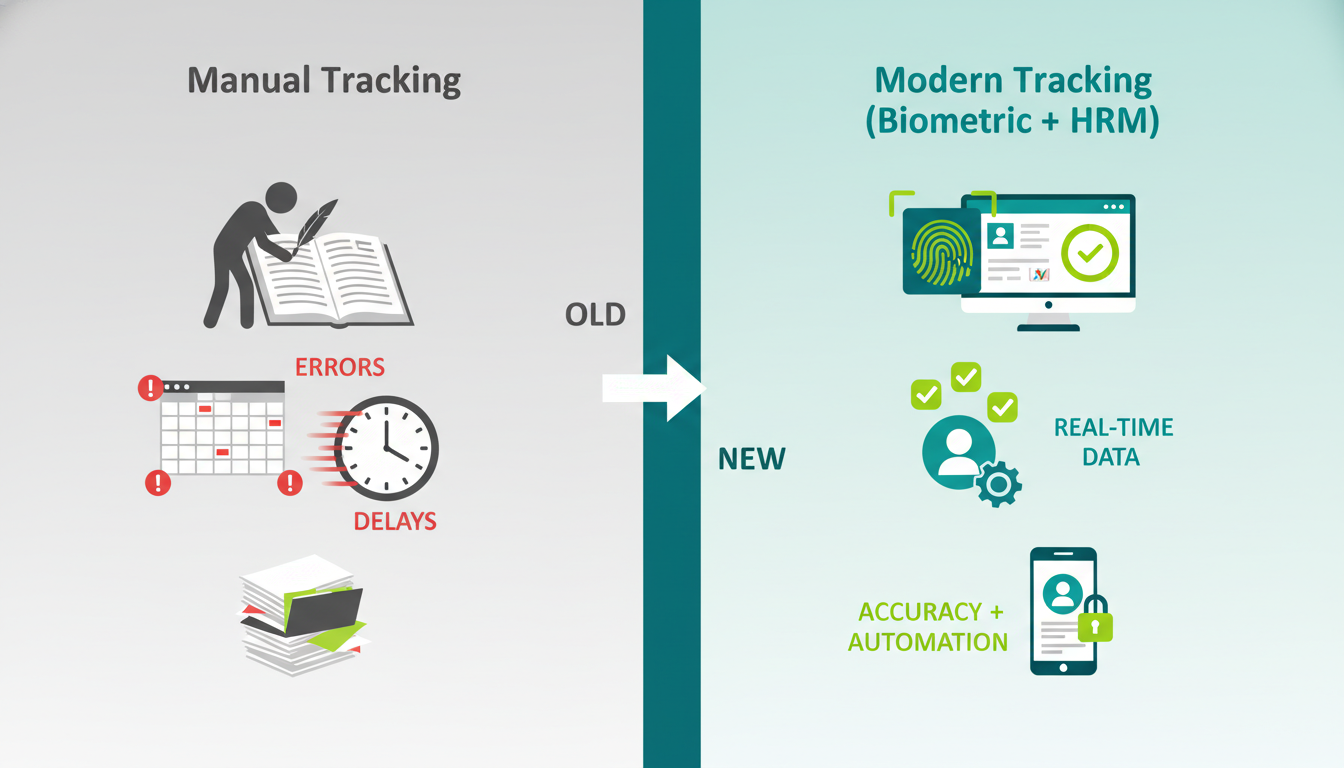
For a long time, businesses tracked employee attendance and work output using paper registers, notebooks, and Excel spreadsheets. A manager would note down arrival times, tasks completed, and hours worked manually.
The problems with this approach are clear:
- It takes a lot of time to manage and update
- Data entry errors happen frequently
- Employees can manipulate records
- Generating reports is slow and difficult
- There is no real-time visibility for management
Manual tracking made sense when it was the only option. Today, it is one of the biggest bottlenecks in workforce management.
Biometric Attendance Systems for Automated Tracking
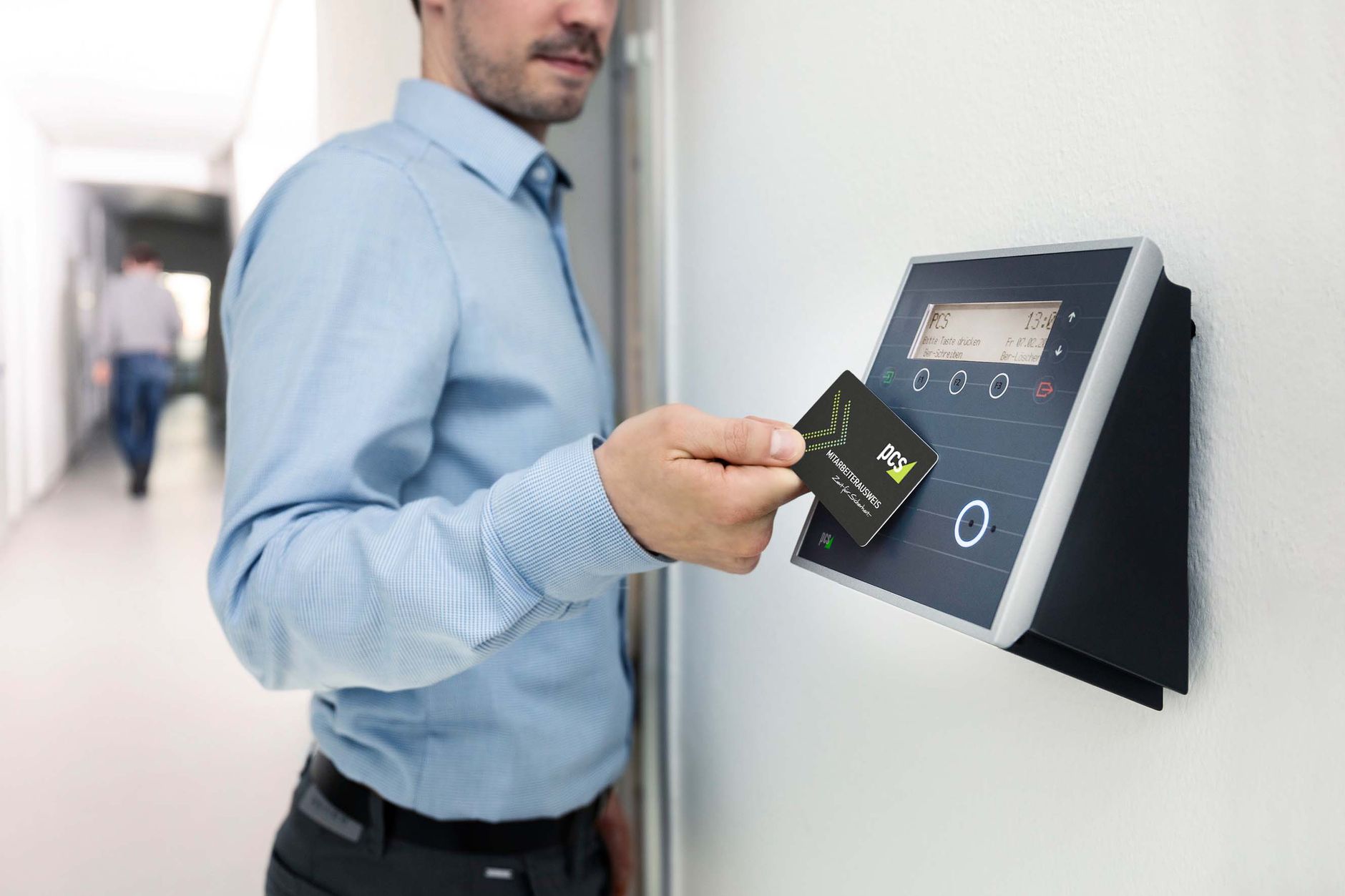
Biometric attendance systems use fingerprint, face recognition, or iris scanning to record when employees arrive and leave. This eliminates the possibility of proxy attendance, where one employee clocks in for another.
A biometric attendance system gives you:
- Accurate, tamper-proof attendance records
- Automatic calculation of work hours
- Real-time attendance data for managers
- Seamless integration with payroll software
For businesses in Bangladesh, biometric systems have become one of the most reliable and cost-effective ways to track workforce attendance.
HRM Software for Workforce Management
HRM (Human Resource Management) software brings all employee data together in one platform. It connects attendance records, leave management, payroll, performance tracking, and reporting into a single system.
With HRM software, businesses can:
- Automate payroll based on attendance data
- Manage leave requests and approvals digitally
- Generate productivity and performance reports instantly
- Set up rules for late arrivals, overtime, and deductions
This is where Tipsoi becomes the natural solution for businesses looking to move away from manual, fragmented systems. Combining a biometric attendance system with HRM software gives you end-to-end workforce management without the guesswork.
Core Strategies for Effective Employee Productivity Tracking
Tracking productivity is not just about installing software. You need the right strategies to make tracking meaningful and actionable.
Establish SMART Goals for Employees
SMART goals are Specific, Measurable, Achievable, Relevant, and Time-bound. When employees have clear SMART goals, it becomes much easier to track whether they are being productive.
For example, instead of telling a sales employee to “sell more,” set a goal like “close 20 new accounts in this quarter.” That goal is specific and measurable, which makes tracking straightforward.
SMART goals give employees direction and give managers a clear yardstick to measure performance.
Use Project Management Tools with HR Integration
Project management tools like Asana, Basecamp, and Trello help teams organize tasks, set deadlines, and track progress on projects. These platforms are useful for visibility into who is working on what and whether tasks are being completed on time.
However, these tools work best when integrated with attendance and HRM systems. Project data alone does not tell you whether an employee was even present, how many hours they worked, or whether their output aligns with their scheduled time. Combining project management data with attendance and HR data gives you the full picture.
Implement Attendance-Based Time Tracking Systems
Many businesses in Bangladesh track time using standalone tools like Toggl or Clockify. These tools have their uses, but they rely on employees manually logging their time, which introduces inaccuracies.
A better approach is to use automated attendance-based time tracking. This includes:
- Biometric attendance tracking: Employees clock in and out using their fingerprint or face. No manual input required, and the data is 100% accurate.
- Mobile attendance systems: Employees working remotely or in the field can mark attendance from their smartphones. A mobile attendance system captures location data along with the time stamp, so you always know where your employees are when they clock in.
This approach removes human error and gives managers reliable data to work with.
Balance Quantity with Quality of Work
Productivity is not just about how much someone produces. Quality matters just as much. An employee who completes 50 tasks but delivers poor results is not truly productive. A Gallup study on employee engagement found that highly engaged teams show 18% greater productivity and 23% higher profitability compared to disengaged teams. An employee who completes 50 tasks but delivers poor results is not truly productive.
Effective tracking balances both dimensions:
- Quantity metrics: Number of tasks completed, sales made, tickets resolved
- Quality metrics: Error rate, customer satisfaction score, revision requests, peer reviews
When you track both, you get a much more honest view of employee performance.
Focus on Outcomes Over Activities
A common mistake in productivity tracking is measuring activity instead of outcomes. Tracking how many emails an employee sends or how many hours they sit at their desk does not tell you whether they are delivering value.
Instead, focus on outcomes:
- Did the project get delivered on time?
- Did the customer issue get resolved?
- Did the sales target get met?
Outcome-based tracking motivates employees to focus on results, not just on looking busy.
Identify Trends Using Attendance and HR Data
One of the most powerful ways to improve productivity is to look at trends over time. Attendance and HR data collected through your tracking system can reveal patterns that are not visible from day-to-day observation.
For example, you might notice that productivity dips every Monday, that absenteeism is higher in a particular team, or that certain employees consistently perform above expectations. These insights allow you to make data-driven decisions about scheduling, workload distribution, training needs, and resource planning.
Reporting tools built into your HRM software make it easy to spot these trends without spending hours digging through spreadsheets.
Essential Metrics for Measuring Employee Productivity
Knowing which metrics to track is just as important as having the right tools to track them.
Attendance and Absenteeism Rate
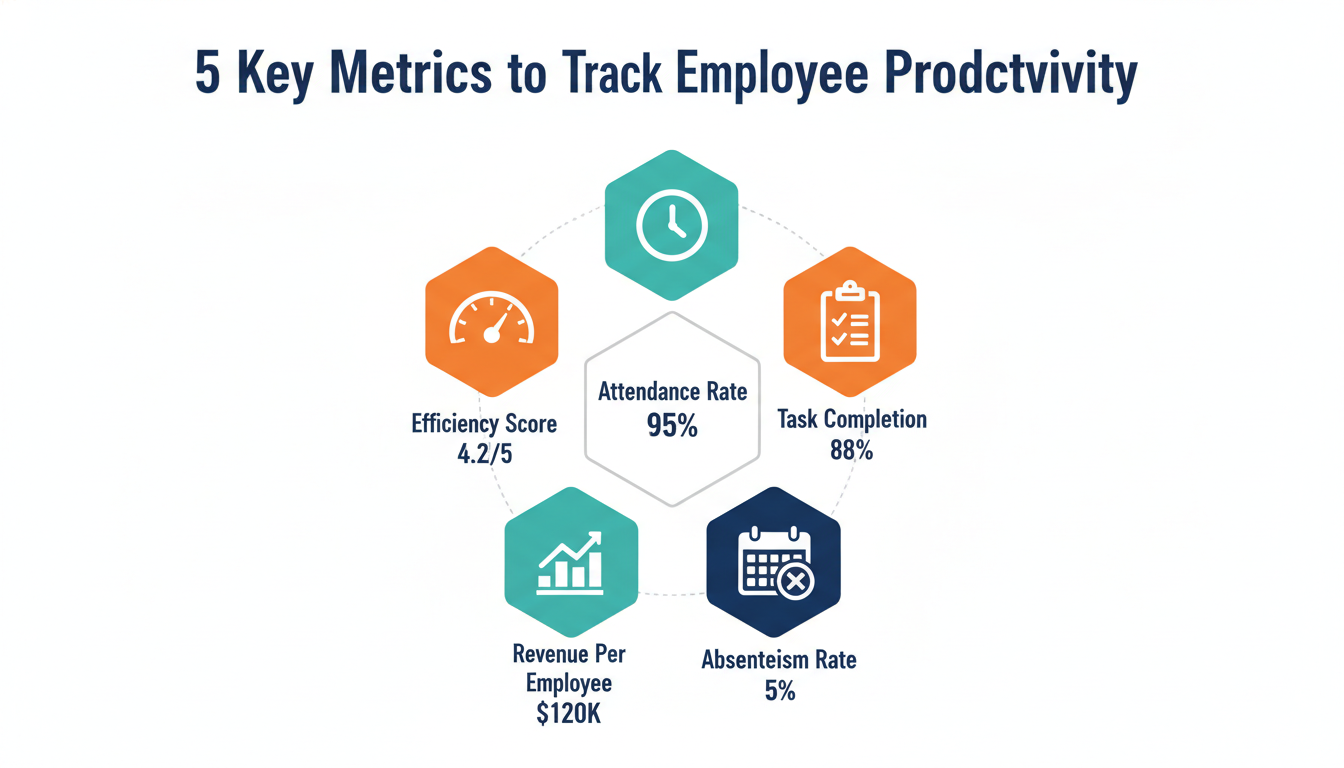
Attendance is the foundation of productivity tracking. If an employee is not present, nothing else matters.
Key attendance metrics include:
- Attendance rate: The percentage of scheduled days an employee was present
- Absenteeism rate: The percentage of working days lost due to unplanned absence
- Late arrival rate: How often employees arrive after their scheduled start time
- Early departure rate: How often employees leave before their shift ends
A biometric attendance system automatically captures all of this data in real time, so your HR team does not need to chase paper records or manually compile reports.
High absenteeism and frequent late arrivals are often the first signs of low employee engagement or deeper workforce problems.
Output Metrics for Performance Evaluation
Output metrics measure the actual work produced by employees. Common examples include:
- Task completion rate: The percentage of assigned tasks completed within the deadline
- Sales numbers: Total revenue generated, number of deals closed, or leads converted
- Deliverables produced: Reports submitted, articles written, products manufactured, or customer cases resolved
Output metrics are most useful when they are tied to the SMART goals set for each employee or team.
Efficiency Metrics for Time and Cost Optimization
Efficiency metrics show how well employees use their time and resources to produce output.
Important efficiency metrics include:
- Planned vs actual time: How long a task was estimated to take versus how long it actually took
- Cost per task: The total cost of labor and resources used to complete one unit of work
- Revenue per employee: Total revenue divided by the number of employees
These metrics help businesses identify bottlenecks, reduce waste, and improve how work gets done.
Resource Capacity Utilization
Resource capacity utilization measures how much of an employee’s available time is being used on productive work. If an employee is scheduled for 8 hours but only 5 hours are spent on productive tasks, utilization is at 62.5%.
Low utilization can mean poor task allocation, too many meetings, or inefficient workflows. High utilization without corresponding output can signal overwork or quality problems. The goal is to find the right balance.
Workforce Monitoring Systems and Dashboards
Modern workforce monitoring goes beyond spreadsheets. Businesses today use real-time dashboards to see attendance, activity, and performance data in one place.
Instead of generic monitoring tools, the best systems for productivity tracking include:
- Biometric attendance systems that record accurate clock-in and clock-out times
- HRM dashboards that consolidate attendance, leave, payroll, and performance data
- GPS tracking tools for field employees who work outside the office
Tipsoi offers tools for all three areas, including a field visit tracking system for mobile teams and a live centralized attendance dashboard for real-time workforce visibility.
Employee Productivity KPIs by Department
Different departments need different KPIs to measure productivity accurately.
Sales Team Productivity Metrics
- Number of calls made per day
- Leads generated and qualified
- Deals closed per month
- Revenue generated per salesperson
- Average deal size and sales cycle length
Marketing and Content Team Metrics
- Number of campaigns launched
- Content pieces published per week
- Website traffic and lead generation from marketing
- Social media engagement rates
- Cost per lead from marketing activities
Customer Support Performance Metrics
- Average response time to customer queries
- First contact resolution rate
- Customer satisfaction score (CSAT)
- Number of tickets resolved per agent per day
- Escalation rate
Software Development Productivity Metrics
- Number of user stories or tasks completed per sprint
- Bug rate and rework percentage
- Code review turnaround time
- Deployment frequency
- On-time delivery rate for project milestones
How to Implement an Employee Productivity Tracking System
Getting started with productivity tracking can feel overwhelming, but a structured approach makes it manageable.
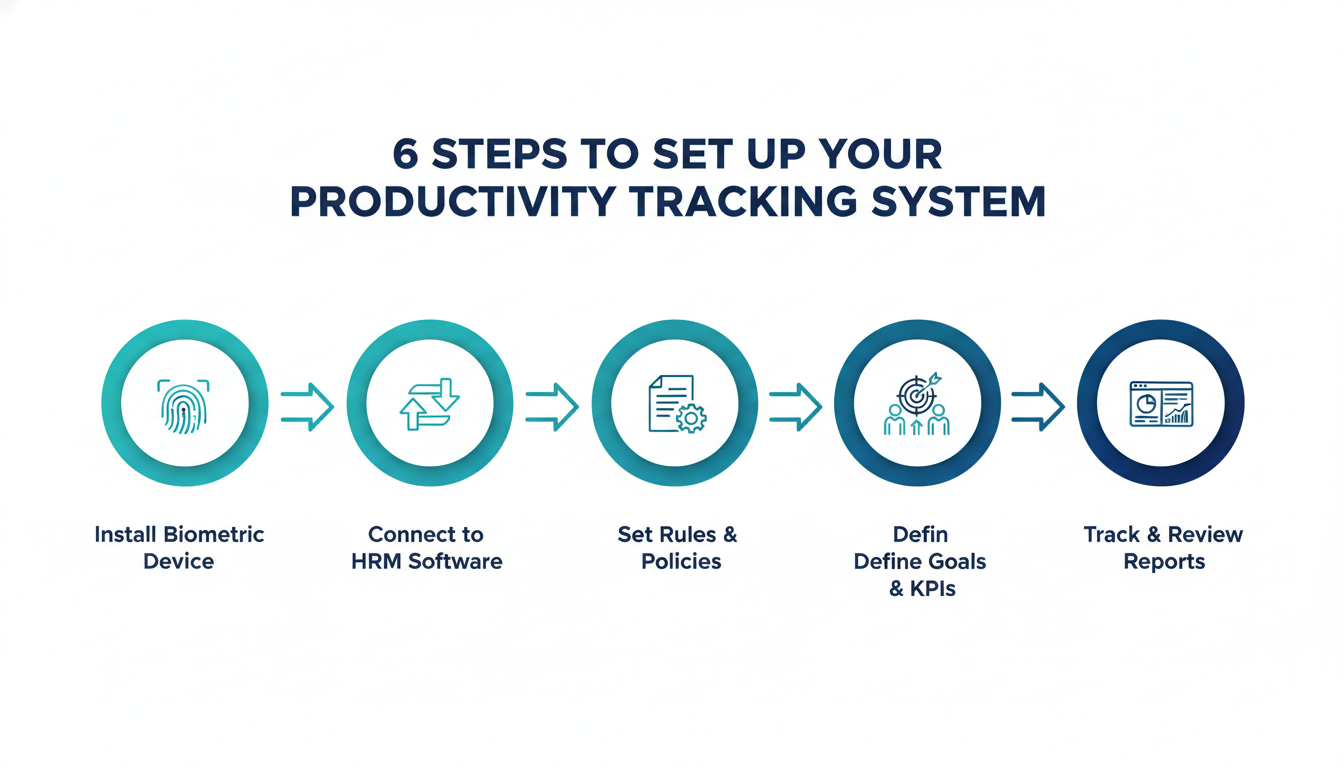
Step-by-Step Implementation Process
Follow these steps to set up a productivity tracking system in your business:
- Install a biometric attendance device at your office entrance or use a mobile attendance app for remote teams. This becomes your source of accurate attendance data.
- Connect the attendance system to your HRM software. This ensures attendance records automatically feed into payroll, leave management, and HR reports.
- Set employee rules and policies such as shift timings, overtime rules, late arrival penalties, and leave entitlements. Configure these settings in your HRM software.
- Define productivity goals and KPIs for each team and individual role. Make sure these are aligned with overall business objectives.
- Train employees on how the system works and what is expected of them.
- Track and review reports on a daily, weekly, and monthly basis. Use the data to identify issues and make improvements.
Choosing the Right Tracking System for Your Business Size
Not every business needs the same solution. Here is a simple guide based on company size:
- Small businesses (under 20 employees): A mobile attendance system is a cost-effective starting point. Employees can clock in from their smartphones, and managers can view reports online.
- Medium businesses (20 to 200 employees): A combination of biometric attendance and HRM software is ideal. This gives you accurate data and automates most HR tasks.
- Large businesses (200+ employees): A centralized attendance and HRM system that covers multiple locations and departments is necessary. Real-time dashboards and advanced reporting become critical at this scale.
Tipsoi provides solutions for all three categories, making it easy for businesses in Bangladesh to start with the right system and scale as they grow.
Setting Productivity Benchmarks and Baselines
Before you can measure improvement, you need to know where you are starting from. Spend the first few weeks of implementation collecting baseline data: average attendance rates, task completion rates, and output numbers.
Once you have a baseline, set realistic benchmarks. For example, if your current average attendance rate is 85%, set a target of 92% for the next quarter. Benchmarks give your team something to work toward and give management a way to measure progress.
Training Employees on Systems and Expectations
The best tracking system in the world will not work if employees do not understand it or trust it. Take time to:
- Explain why the tracking system is being implemented
- Show employees how to use the attendance tools
- Clarify what metrics will be tracked and how they relate to performance reviews
- Answer questions and address concerns honestly
When employees understand the purpose and feel that tracking is fair and transparent, they are far more likely to engage positively with the system.
Continuous Monitoring and Performance Management
Implementing a tracking system is not a one-time event. Continuous monitoring is what makes the difference between average and high-performing organizations.
Daily, Weekly, and Monthly Performance Tracking
- Daily: Review attendance logs, flag late arrivals or absences, and check task progress.
- Weekly: Analyze output metrics, review team performance against weekly goals, and address any emerging issues.
- Monthly: Conduct a full performance review using HR reports. Compare actual results against benchmarks and identify trends.
A real-time dashboard, such as Tipsoi’s live centralized attendance dashboard, gives managers visibility at all levels without having to request reports manually.
One-on-One Reviews and Feedback Sessions
Data is most powerful when combined with conversation. Schedule regular one-on-one meetings between managers and employees to discuss performance data, set new goals, and provide constructive feedback.
One-on-ones create a space for employees to raise concerns, ask for support, and feel seen as individuals rather than just data points.
Maintaining Employee Performance Records
Every performance review, attendance record, disciplinary note, and goal-setting session should be documented in your HRM system. These records are valuable for:
- Annual performance appraisals
- Promotion and salary review decisions
- Identifying training needs
- Managing performance improvement plans
Using Real-Time Data for Decision Making
Real-time data removes the guesswork from management decisions. Instead of waiting for a monthly report, managers can see attendance trends, identify performance gaps, and make adjustments on the fly.
When your attendance system feeds directly into your HRM software and dashboard, this level of visibility becomes easy to maintain without adding extra work to your HR team.
Identifying Productive vs Unproductive Work Activities
Not all work is created equal. Some activities drive business results directly, while others consume time without adding real value.
Defining High-Value Tasks
High-value tasks are activities that directly contribute to business goals. These are the tasks that, if done well and consistently, drive revenue, improve customer satisfaction, or build competitive advantage.
Examples include:
- Client meetings and follow-ups for the sales team
- Core development work for software engineers
- Content creation and campaign execution for the marketing team
Eliminating Time-Wasting Activities
Low-value activities are those that consume time without contributing meaningfully to business outcomes. These often include:
- Unnecessary meetings that could have been emails
- Repetitive manual data entry that could be automated
- Disorganized communication leading to rework
Use attendance logs and activity data to identify where time is being lost. If a team consistently falls short of output targets despite good attendance, it is worth investigating how their time is being spent during working hours.
Using Attendance and Activity Data to Optimize Workflows
When you combine attendance logs with task completion data and output reports, you can identify patterns that point to workflow inefficiencies. For instance, if a team shows high attendance but low output on certain days, there may be a scheduling or workload distribution issue worth addressing.
Using OKRs and KPIs to Track Employee Productivity
Understanding Objectives and Key Results (OKRs)
OKRs are a goal-setting framework used by many successful organizations. Each Objective is a clear, ambitious goal. The Key Results are specific, measurable outcomes that indicate the objective has been achieved.
For example:
- Objective: Improve customer support response time
- Key Result 1: Reduce average first response time to under 2 hours
- Key Result 2: Achieve a CSAT score of 90% or above
OKRs help teams stay focused on what matters most.
Aligning KPIs with Business Goals
KPIs (Key Performance Indicators) should always connect directly to your broader business goals. If your company’s goal is to grow revenue by 30% this year, your sales team’s KPIs should reflect activities that drive revenue.
Misaligned KPIs lead to employees working hard on the wrong things, which hurts both morale and results.
Setting Realistic Productivity Benchmarks
Good benchmarks are based on real data, not guesswork. Use your baseline data from the first weeks of tracking to set targets that are challenging but achievable. Benchmarks should be reviewed regularly and updated as the team improves.
Measuring Deep Work and Focus Time
Deep work refers to high-concentration tasks that require sustained attention and produce significant output. Tracking deep work time helps businesses understand how much high-value work is actually happening versus surface-level activity.
Encourage employees to block time in their schedule for deep work and minimize interruptions during those periods.
Tracking Productivity in Remote and Field Teams
Managing remote and field employees presents unique challenges that standard office-based tracking tools are not designed to handle.
Challenges in Remote Employee Monitoring
Remote employees are harder to monitor because managers cannot directly observe their work environment or hours. Common challenges include:
- No way to verify physical presence
- Difficulty tracking actual working hours
- Communication delays across different locations
- Risk of distractions in home environments
GPS-Based Field Employee Tracking Systems
For businesses with field teams, GPS tracking is essential. A field employee tracking system lets managers see where field employees are in real time, track the routes they have taken, and verify that client visits are actually happening.
This kind of transparency protects both the business and the employee. Employees have a clear record of their work, and managers have the data they need to plan routes, optimize schedules, and evaluate field team productivity.
Mobile Attendance Systems for Remote Teams
A mobile attendance system allows remote employees to clock in and out from their smartphones. Most mobile attendance tools use location verification, so the system can confirm the employee is at the correct location when marking attendance.
This is a practical solution for businesses in Bangladesh with field sales teams, delivery staff, or employees working from multiple locations.
Managing Distributed Teams Efficiently
Effective management of distributed teams requires clear communication, defined goals, and the right tools. Set clear expectations about working hours, attendance, and deliverables. Use your HRM software to track performance data centrally, so all teams are managed consistently regardless of where they are located.
Employee Productivity Tracking in Bangladesh
Bangladesh is home to a rapidly growing business sector. However, many local businesses face specific workforce management challenges that affect productivity.
Common Workplace Challenges in Bangladesh
Businesses in Bangladesh frequently deal with:
- Late attendance: Inconsistent punctuality is a widespread issue across many industries. Without an automated tracking system, late arrivals often go unnoticed or unaddressed.
- Manual record-keeping: Many businesses, particularly small and medium enterprises, still rely on paper registers or basic spreadsheets. These systems are slow, inaccurate, and nearly impossible to analyze at scale.
- Payroll fraud: Manual timesheets and attendance records create opportunities for manipulation. Employees may inflate hours, or managers may make biased decisions about overtime payments.
- Lack of field employee visibility: For businesses with delivery staff, sales representatives, or service teams, there is often no reliable way to confirm where field employees are during working hours.
Importance of Attendance Systems for Local Businesses
Given these challenges, automated attendance systems are not a luxury for Bangladeshi businesses. They are a necessity.
A biometric attendance system eliminates proxy attendance, removes manual data entry errors, and gives HR teams accurate data for payroll. For businesses that have been losing money to attendance fraud or payroll errors, the return on investment from installing a proper system can be significant.
Beyond the financial benefits, attendance systems bring accountability and structure to the workplace. When employees know that their attendance is being tracked accurately, punctuality improves naturally.
Legal and Ethical Considerations in Employee Monitoring
In Bangladesh, employee monitoring must be conducted within the boundaries of labor law and organizational policy. Businesses should:
- Inform employees clearly about what is being tracked and why
- Use data only for legitimate HR and business purposes
- Store employee data securely and limit access to authorized personnel
- Avoid invasive monitoring that goes beyond attendance and productivity measurement
Ethical tracking builds trust between employers and employees, which ultimately leads to better workplace culture and stronger productivity.
Popular Productivity Tracking Methods in Bangladesh
The most commonly used methods among businesses in Bangladesh today include:
- Biometric attendance systems for attendance and time tracking
- HRM software for payroll, leave management, and performance records
- Mobile attendance apps for remote and field employees
- GPS-based tracking for delivery and sales teams
Tipsoi is one of the leading providers of these solutions for businesses across Bangladesh.
Best Employee Productivity Tracking Tools and Systems
All-in-One HRM and Attendance Systems (Best Option)
For most businesses, an integrated HRM and attendance system is the best investment. Instead of managing multiple disconnected tools, an all-in-one platform brings together attendance, payroll, leave management, performance tracking, and reporting in a single dashboard.
Tipsoi is designed exactly for this purpose. With Tipsoi, Bangladeshi businesses can:
- Install biometric attendance devices and connect them directly to HRM software
- Automate payroll based on verified attendance data
- Track field employees using GPS tools
- Access real-time reports and dashboards for workforce visibility
This integrated approach eliminates data silos, reduces manual work, and gives management the information they need to make confident decisions.
Standalone Productivity Tracking Tools
Standalone tools like Toggl (time tracking), Trello (task management), and Clockify (time logging) are popular among freelancers and small teams. They are easy to set up and useful for tracking specific activities.
However, they have clear limitations:
- Employees must manually log their time, which is prone to inaccuracy
- There is no connection to attendance or payroll systems
- They do not capture field employee locations
- Generating comprehensive HR reports requires manual work
Comparing Integrated Systems vs Standalone Tools
| Feature | Standalone Tools | Integrated HRM + Attendance System |
|---|---|---|
| Attendance tracking | Manual | Automated (biometric/mobile) |
| Payroll integration | No | Yes |
| Field employee tracking | No | Yes (GPS) |
| Real-time dashboards | Limited | Full |
| Data accuracy | Moderate | High |
| Scalability | Low | High |
For businesses in Bangladesh looking to scale and reduce HR workload, an integrated system like Tipsoi is the clear choice.
Key Features to Look for in Productivity Tracking Software
When evaluating any employee productivity tracking solution, look for:
- Accurate, tamper-proof attendance recording
- Integration between attendance data and payroll
- Real-time reporting and dashboards
- Mobile access for remote and field employees
- GPS location tracking for field teams
- Easy setup and employee-friendly interface
- Local support and reliability for Bangladesh operations
Challenges in Measuring Employee Productivity
Even with good systems in place, measuring productivity is not always straightforward.
Difficulty in Measuring Knowledge-Based Work
For employees doing creative, analytical, or strategic work, output is not always easy to quantify. A graphic designer’s value is not measured in the number of files created, and a strategy consultant’s impact may take months to show results.
For knowledge workers, focus on outcomes and quality indicators rather than raw output numbers.
Overcoming Bias in Performance Evaluation
Managers can sometimes unconsciously favor employees they like or who are more visible, even if the data tells a different story. Using objective data from your HRM and attendance system helps reduce bias in performance evaluations.
Build your review process around data first, then add qualitative assessment on top of it.
Balancing Monitoring with Employee Trust
Too much surveillance can damage morale and trust. Employees who feel constantly watched are likely to feel stressed and disengaged, which actually hurts productivity.
The goal of tracking is to support employees, not to catch them out. Communicate this clearly and make sure your tracking practices are proportionate to the actual needs of your business.
Data Accuracy and Misinterpretation Issues
Poor quality data leads to poor decisions. If your attendance system is inaccurate or if managers misinterpret what the metrics mean, the whole tracking effort can be counterproductive.
Invest in reliable systems, train your managers to read and use data correctly, and review your metrics regularly to make sure they are still relevant.
Common Mistakes to Avoid in Productivity Tracking
Over-Reliance on Time Tracking Alone
Tracking hours worked is a starting point, but it is not enough on its own. A person who sits at their desk for 10 hours but produces little output is not more productive than someone who works 6 focused, high-output hours. Always pair time data with output and outcome data.
Ignoring Employee Feedback
Employees are closest to the day-to-day work. They often know where the bottlenecks are, what is slowing them down, and what support they need. If you track productivity but never ask employees for their perspective, you are missing valuable insight.
Make employee feedback a regular part of your performance management process.
Tracking Too Many Metrics
More data is not always better. Tracking too many metrics creates noise, confuses priorities, and wastes time. Focus on 3 to 5 key metrics that directly reflect your most important business goals.
Lack of Clear Productivity Goals
Tracking without goals is pointless. Before you start measuring anything, define what good performance looks like for each role and department. Without clear goals, employees do not know what they are working toward, and managers do not know what they are measuring against.
Not Using Automated Attendance Systems
Relying on manual attendance records is one of the most common and costly mistakes businesses make. Manual systems create opportunities for fraud, introduce errors, and consume HR time that could be spent on more valuable activities.
Switching to an automated biometric or mobile attendance system immediately improves the accuracy and reliability of your workforce data, and it is the foundation on which everything else in your productivity tracking system should be built.
Best Practices for Ethical Employee Monitoring
Maintaining Transparency with Employees
Always tell employees what is being tracked, why it is being tracked, and how the data will be used. Transparency builds trust and reduces resistance to new tracking systems.
Avoiding Micromanagement
Tracking systems should give managers insight, not become a tool for constant surveillance. Use the data to spot trends and support employees, not to watch their every move. Micromanagement kills creativity and motivation.
Encouraging Self-Tracking and Accountability
When employees have access to their own productivity data, they can take ownership of their performance. Many HRM systems allow employees to see their own attendance records, task completion rates, and goal progress. This transparency encourages self-management and reduces the need for heavy oversight.
Protecting Employee Privacy and Data
Handle employee data with care. Store it securely, limit access to authorized personnel, and never use tracking data for purposes beyond legitimate HR management. Establish a clear data policy and share it with all employees.
Recognizing and Rewarding Performance
Tracking should not just be used to identify underperformers. Use your productivity data to recognize and reward employees who consistently meet or exceed expectations. Recognition motivates high performers and sets a positive example for the rest of the team.
Benefits of Effective Employee Productivity Tracking
When done right, productivity tracking delivers measurable benefits across the entire organization.
Improved Workforce Efficiency and Output
When employees have clear goals, managers have real-time data, and systems are automated, the overall efficiency of the workforce improves. Work gets done faster, with fewer errors and less rework.
Better Resource Allocation and Planning
Productivity data helps managers understand who is overloaded and who has capacity. This makes it easier to distribute work fairly, plan staffing levels, and allocate budgets where they are most needed.
Increased Accountability and Transparency
When everyone knows their performance is being tracked fairly and consistently, accountability increases naturally. Employees take their responsibilities more seriously when they know that results are visible and valued.
Data-Driven Business Decision Making
Productivity tracking transforms HR from a reactive function into a strategic one. With solid data, businesses can make confident decisions about hiring, training, promotions, and operational improvements.
Accurate Payroll and Attendance Management
Automated attendance systems feed directly into payroll, reducing errors and ensuring every employee is paid correctly for the hours they worked. This protects the business from overpayments and protects employees from being underpaid due to record-keeping mistakes.
Reduced Absenteeism Through Early Detection
When attendance data is tracked consistently, managers can identify absenteeism trends early and address them before they become serious problems. This proactive approach reduces the overall rate of unplanned absences across the organization.
Real-Time Monitoring for Faster Response
Real-time dashboards give management the ability to respond to attendance issues, productivity gaps, or workflow problems on the same day they occur, rather than discovering them at the end of the month.
How Tipsoi Helps Track Employee Productivity
Tipsoi is a comprehensive workforce management platform built for businesses in Bangladesh. It combines the tools you need to track employee productivity accurately, ethically, and efficiently.
Biometric Attendance System Integration
Tipsoi’s biometric attendance system uses fingerprint and face recognition technology to automatically record when employees clock in and out. This eliminates manual entry, prevents proxy attendance, and gives HR teams accurate data from day one.
The system works across multiple office locations, making it ideal for businesses with more than one site.
HRM Software for Workforce Automation
Tipsoi’s HRM software connects all of your employee data in one place. Attendance records automatically feed into payroll calculations, leave balances update in real time, and performance records are stored and accessible whenever you need them.
HR teams spend less time on manual admin work and more time on activities that actually make a difference for the business.
Field Employee Tracking with GPS
For businesses with mobile teams, Tipsoi’s field visit tracking system provides real-time GPS tracking of field employees. Managers can see where employees are, verify that client visits are happening, and plan routes more efficiently.
This is particularly valuable for sales teams, delivery staff, and service technicians working across Bangladesh.
Real-Time Reporting and Analytics Dashboard
Tipsoi’s centralized dashboard gives management a live view of attendance, productivity, and workforce data. Reports can be generated instantly for any time period, department, or individual employee.
No more waiting for the end of the month to see how your team is performing. With Tipsoi, you always have the information you need to make fast, informed decisions.
Scalable Solutions for Businesses in Bangladesh
Whether you are a small business with 10 employees or a large organization with thousands of staff spread across multiple locations, Tipsoi has a solution that fits your needs. The platform is designed to grow with your business, so you can start simple and add features as your requirements evolve.
Automate your employee productivity tracking with Tipsoi and give your business the visibility, accuracy, and efficiency it needs to compete and grow.
Conclusion
Key Takeaways
- Employee productivity tracking is the foundation of a well-managed, high-performing workforce.
- Manual tracking methods are no longer enough. Automated attendance systems and HRM software are essential for accurate, reliable data.
- The right metrics vary by department, but attendance, output, and efficiency should always be part of the picture.
- Ethical tracking built on transparency and trust leads to better outcomes for both businesses and employees.
- Businesses in Bangladesh face specific challenges, including late attendance, payroll fraud, and limited field employee visibility, that the right tools can solve.
- Tipsoi provides an integrated solution that covers biometric attendance, HRM software, field tracking, and real-time reporting, all built for the Bangladeshi market.
Final Thoughts on Employee Productivity Tracking
Tracking employee productivity is not about watching employees. It is about understanding your workforce well enough to support them, remove obstacles, and help them do their best work.
When businesses invest in the right systems, set clear goals, and use data to make informed decisions, productivity improves naturally. Employees perform better when expectations are clear, feedback is consistent, and recognition is earned through fair measurement.
If your business is still relying on paper registers, Excel sheets, or disconnected tools to track employee performance, now is the time to make a change. Start with a reliable attendance system, connect it to your HRM software, and build from there.
Tipsoi is ready to help you every step of the way.