

Strategic management is the ongoing process of setting goals, analyzing your business environment, making decisions, and allocating resources to achieve long-term success. It is not a one-time activity. It is a continuous cycle that keeps your organization moving in the right direction, no matter how the market changes around you.
Think of it this way. A company without strategic management is like a ship without a compass. The crew might be working hard, but no one knows where they are going. Strategic management gives the ship a compass, a map, and a captain who actually knows how to read both.
In this guide, you will learn what strategic management really means, how the process works step by step, which frameworks actually get results, and how it connects to the people side of your business. Whether you are a student, a manager, or a business owner, this guide is written in plain language so you can understand and apply everything here.
What Is Strategic Management?
Strategic management is a systematic approach that organizations use to plan, implement, and evaluate decisions that affect long-term performance. The goal is to align what your organization can do with what the market needs, so you stay ahead of competitors over time.
Michael Porter, one of the most respected thinkers in this field, described strategy as figuring out how a business will compete, what its goals should be, and what policies it needs to get there. That definition still holds up today.
But strategic management goes beyond just having a plan. It includes actually executing that plan, measuring whether it is working, and making adjustments when it is not.
Here is a simple way to understand it. Strategic management asks and answers three questions:
Where are we right now? This means understanding your current strengths, weaknesses, and position in the market.
Where do we want to go? This means defining a clear vision, mission, and long-term goals.
How do we get there? This means building a roadmap with specific strategies, responsibilities, and timelines.
Strategic Management vs. Regular Management
People often confuse strategic management with general or operational management. They are related, but they are not the same thing.
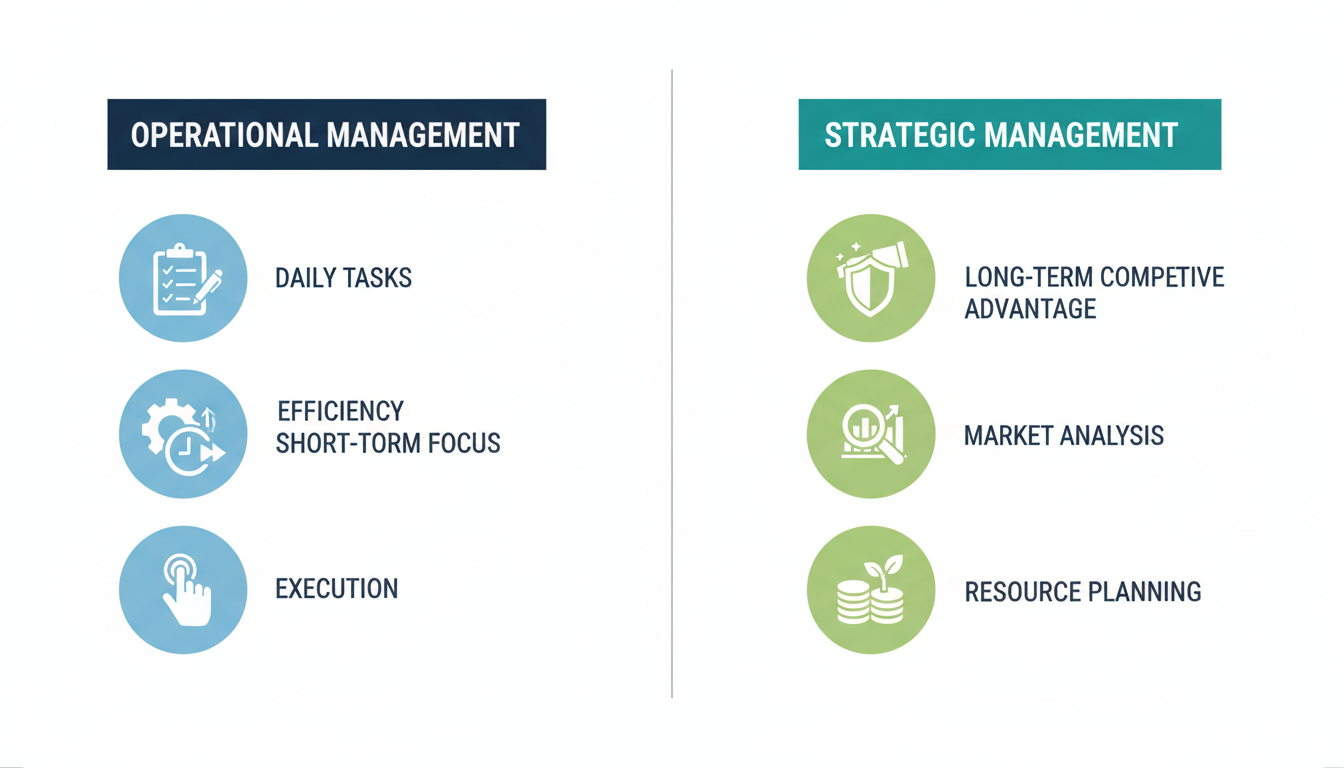
Regular management focuses on day-to-day operations. It is about getting things done efficiently within the rules and structure that already exist. A manager scheduling shifts, approving timesheets, or resolving a customer complaint is doing operational management.
Strategic management focuses on the bigger picture. It is about deciding which direction the organization should move in, which markets to enter, and how to build a lasting competitive advantage.
One simple way to remember the difference: operational management is about doing things right. Strategic management is about doing the right things.
Why Strategic Management Matters
Here is a sobering fact. According to research by Quantive, 67% of well-formulated strategies fail because of poor execution. That means most organizations that have a strategy still cannot make it work. The gap between planning and doing is where most businesses lose.
Organizations that master strategic management consistently outperform their competitors. They adapt to change faster, attract better talent, and make smarter decisions about where to invest resources.
Some of the key benefits include:
Clear direction. When everyone from leadership to frontline employees understands the strategy, they can make better day-to-day decisions without needing constant guidance.
Competitive advantage. By continuously analyzing the market, companies can spot opportunities and threats before competitors do. This lets them act proactively instead of just reacting.
Resource optimization. Strategic management ensures that money, time, and people are invested in the right places, not wasted on activities that do not contribute to the mission.
Sustainable growth. Companies that plan strategically are better equipped to handle disruptions, whether that is a market shift, a new competitor, or a global event.
Team alignment. When the whole organization understands the strategy, departments stop working in silos and start pulling in the same direction.
The Netflix example is one of the clearest illustrations of strategic management in action. Netflix started as a DVD-by-mail service. When they saw that streaming was the future, they did not just add it as a feature. They completely realigned their resources, shifted their business model, and eventually moved into original content. Each of those moves was driven by deliberate strategic analysis and planning, not guesswork.
The 5-Step Strategic Management Process
The strategic management process is a structured approach that helps organizations move from where they are to where they want to be. Most experts break it down into five clear stages.
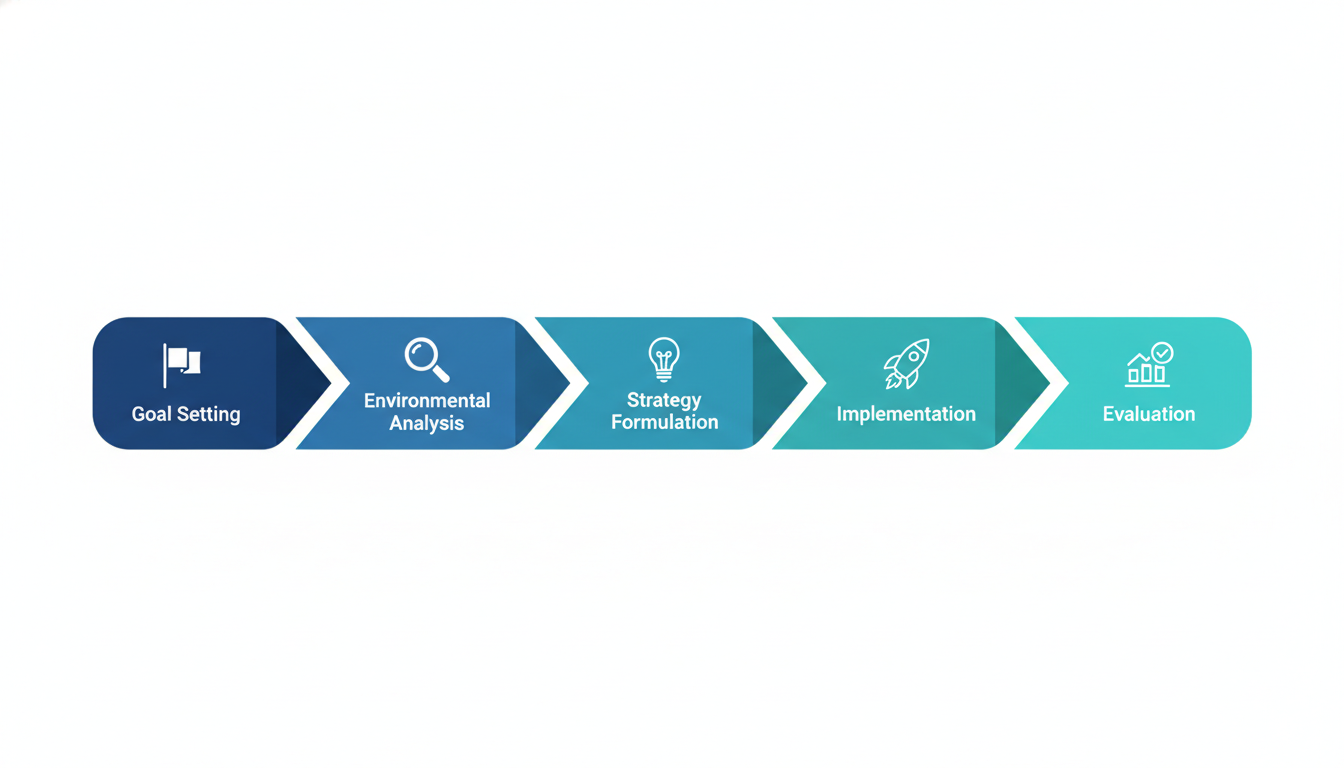
Step 1: Goal Setting and Identifying Your Mission
Everything in strategic management starts with clarity about purpose. In this first step, organizations define their mission (why they exist), their vision (what they want to become), and their strategic objectives (the specific goals they want to achieve).
A strong mission statement is not just a motivational poster on the wall. It is a practical guide for decision-making. When your team faces a difficult choice, the mission helps them figure out which option is actually right for the organization.
During this stage, you set both long-term goals (where you want to be in three to five years) and short-term targets (what you need to achieve in the next six to twelve months). The best goals are specific, measurable, and tied directly to the mission.
Step 2: Environmental Analysis
Once you know what you want to achieve, you need to understand the environment you are operating in. This means looking both inside and outside the organization.
Internally, you assess your strengths and weaknesses. What does your team do well? Where are the skill gaps? What resources do you have, and what do you lack?
Externally, you look at the market, competitors, regulations, technology trends, and economic conditions. What opportunities can you take advantage of? What threats could derail your plans?
The most common tools used in this step are SWOT analysis (Strengths, Weaknesses, Opportunities, Threats) and PESTLE analysis (Political, Economic, Social, Technological, Legal, Environmental). Together, these frameworks give you a clear picture of your current situation before you start making decisions.
Step 3: Strategy Formulation
Now you take everything you learned in the analysis stage and use it to build your actual strategy. This is where you decide how you are going to compete.
Strategy formulation happens at three levels:
Corporate strategy covers the overall direction of the entire organization, including decisions about which industries or markets to compete in.
Business strategy focuses on how a specific business unit will compete in its particular market. This is where Porter’s Generic Strategies become useful. You can compete on cost (being the cheapest), differentiation (offering something unique), or focus (serving a specific niche very well).
Functional strategy covers how individual departments like marketing, HR, and finance will support the overall business strategy.
A common mistake organizations make is spending too much time on corporate and business strategy while ignoring functional strategy. But the truth is, even the best corporate strategy will fail if the marketing team, the HR team, and the operations team do not have their own aligned plans.
Step 4: Strategy Implementation
This is where most strategies break down. Implementation is the hardest part of strategic management because it involves real people, real budgets, and real organizational politics.
During implementation, you assign responsibilities, allocate resources, set timelines, and communicate the strategy to everyone who needs to execute it. You also need to address resistance to change, which is almost always present when organizations shift direction.
Effective implementation requires strong leadership, clear communication, and systems that support the new direction. This is also where your workforce management tools become critical. Knowing who is doing what, when, and how well they are performing is not just an HR concern. It is a strategic concern.
For example, if your strategy calls for faster customer response times, you need to look at staffing patterns, attendance data, and workload distribution. A good workforce management system can give you that visibility across your entire team, making it much easier to align your people operations with your strategic priorities.
Step 5: Evaluation and Control
Strategy is not a set-it-and-forget-it exercise. The final step in the process is monitoring whether the strategy is actually working and making adjustments when it is not.
This requires measuring performance against specific KPIs, reviewing progress regularly, and being willing to change course when the data tells you something is not right.
The Balanced Scorecard is one of the most widely used tools for this. It evaluates performance from four angles: financial results, customer satisfaction, internal processes, and employee learning and growth. Instead of just tracking revenue, it gives you a complete picture of whether the organization is healthy and moving in the right direction.
The key mindset here is that strategy evaluation is not about blaming people when things go wrong. It is about learning faster than competitors so you can adapt and improve.
Key Frameworks and Tools Used in Strategic Management
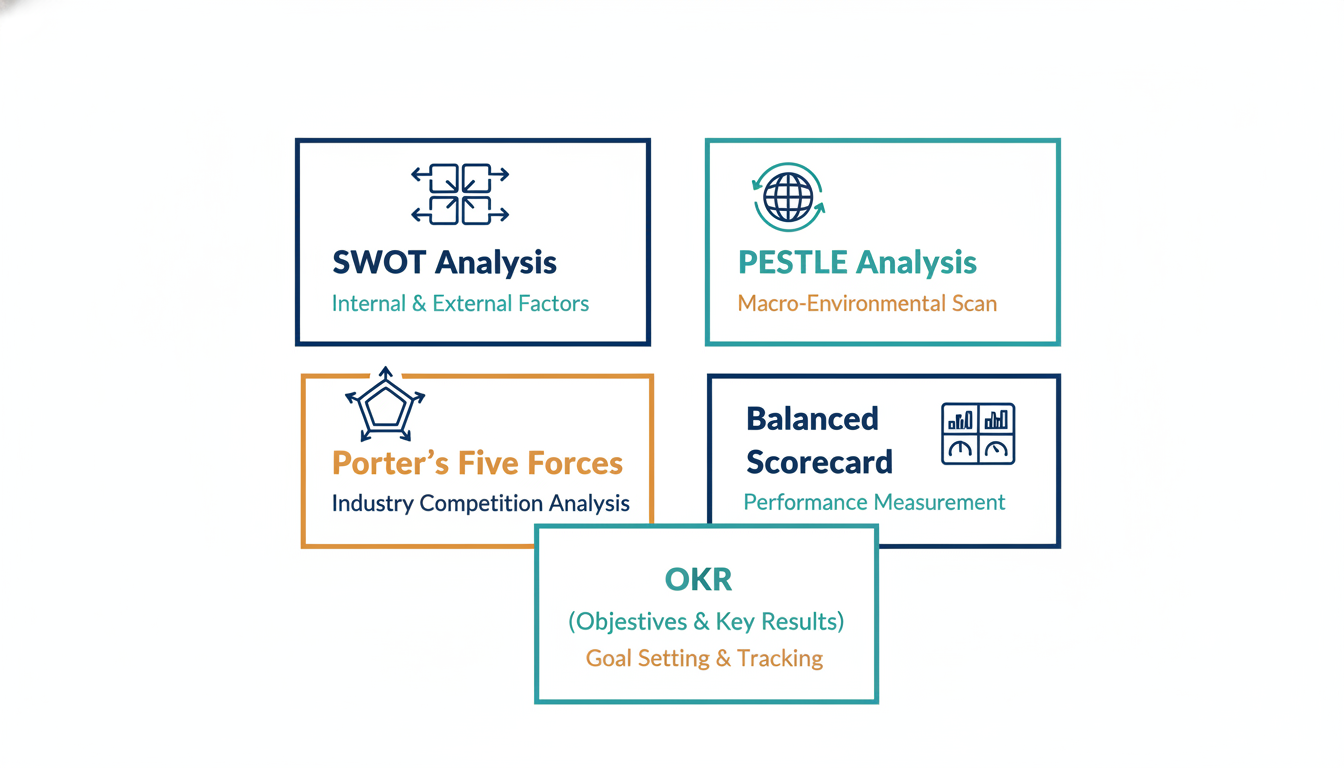
The right framework depends on what you are trying to figure out. Here are the most important ones and when to use them.
SWOT Analysis
SWOT stands for Strengths, Weaknesses, Opportunities, and Threats. It is one of the most commonly used tools in strategic planning because it is simple, flexible, and gives you a structured way to think about your current situation.
Use SWOT when you are starting a new planning cycle, evaluating a major decision, or trying to understand why performance has changed. It works at the organizational level, the business unit level, and even the team level.
PESTLE Analysis
PESTLE looks at the external macro-environment. It stands for Political, Economic, Social, Technological, Legal, and Environmental factors. This framework helps you identify changes in the broader environment that might affect your strategy, even if they are not directly related to your industry.
For example, a change in labor law is a Legal factor that affects how you manage employees. A new technology platform is a Technological factor that might disrupt how you deliver your product or service.
Porter’s Five Forces
This framework, developed by Michael Porter, helps you analyze the competitive dynamics of your industry. The five forces are competitive rivalry, supplier power, buyer power, the threat of substitutes, and the threat of new entrants.
Understanding these forces helps you figure out where your competitive advantage actually comes from and how sustainable it is. A company with strong buyer power, for example, needs a very different strategy than one where buyers have few alternatives.
The Balanced Scorecard
The Balanced Scorecard translates your strategic objectives into a set of performance metrics across four perspectives: financial, customer, internal processes, and learning and growth.
The advantage of this tool is that it prevents organizations from becoming overly focused on short-term financial results at the expense of long-term health. A company might be hitting its revenue targets but failing to develop its people or improve its processes, and the Balanced Scorecard will reveal that imbalance.
OKRs (Objectives and Key Results)
OKRs connect ambitious goals to specific, measurable outcomes. They have been used effectively by companies like Google, Intel, LinkedIn, and Spotify. The framework works by setting clear objectives at the company level and then breaking them down into measurable key results at the team and individual levels.
OKRs are particularly useful for keeping fast-growing organizations aligned as they scale, because they create a visible link between what each person is working on and what the organization is trying to achieve.
Ansoff Matrix
The Ansoff Matrix helps organizations think about growth strategy. It maps four options: market penetration (selling more of the same product to existing customers), market development (entering new markets), product development (creating new products for existing customers), and diversification (new products in new markets).
Each option carries a different level of risk. Market penetration is generally the safest. Diversification is the riskiest. Knowing where you are on the matrix helps you make more realistic decisions about growth.
Types of Strategic Management
Not all strategic management approaches look the same. Organizations choose different approaches depending on their industry, size, and goals.
Linear Strategic Management
This is the most traditional approach. You create a plan, implement it, and evaluate the results. It works well in stable industries where the market does not change rapidly. A manufacturing company expanding into a new city using a fixed rollout timeline is a good example.
Adaptive Strategic Management
In fast-moving industries like technology or e-commerce, linear planning is too slow. Adaptive strategy focuses on flexibility, continuous testing, and rapid adjustment. Instead of following a rigid plan, organizations constantly learn from the market and iterate.
A health-tech startup that updates its product features every month based on user feedback is using adaptive strategy.
Interpretive Strategic Management
This approach puts stakeholder perception and organizational values at the center of decision-making. Strategy is built around how the organization wants to be seen and what it stands for, not just what the numbers say.
Transcendent Strategic Management
The most sophisticated approach, this blends elements of linear, adaptive, and interpretive strategies. It is used by large, mature organizations that need to operate across multiple markets, cultures, and contexts simultaneously.
Strategic Management in Human Resources: The Connection That Most Businesses Miss
One area where strategic management has an enormous practical impact is human resource management. Yet this is also where many organizations fail to connect the dots.
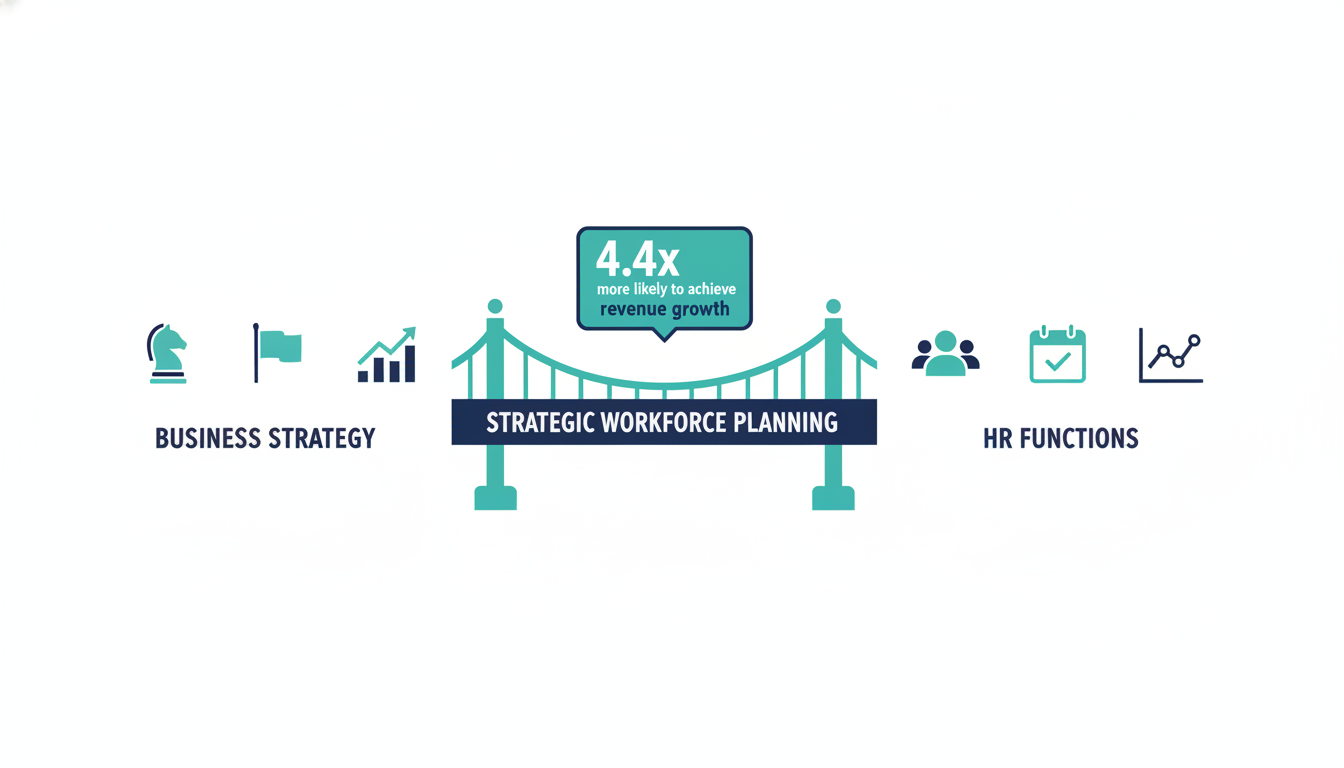
HR is not just about hiring and payroll. At the strategic level, it is about ensuring you have the right people with the right skills in the right roles at exactly the right time. This is called strategic workforce planning, and it is a core part of any serious strategic management effort.
Organizations that align workforce plans with business strategy are 4.4 times more likely to achieve strong revenue growth than those that treat HR as a separate function. That is a significant advantage.
Workforce Data as a Strategic Asset
Good strategy requires good data. When it comes to your workforce, that means having accurate, real-time information about attendance, performance, overtime, and capacity. Without this data, strategic decisions about staffing, growth, and resource allocation are based on assumptions rather than facts.
For example, if your strategic goal is to improve customer service response times, you need to know whether your team is consistently present and on time. An attendance management system with detailed reports gives you that visibility in a structured way, making it possible to connect workforce behavior to strategic outcomes.
Similarly, if your strategy involves managing labor costs while maintaining output quality, tracking employee overtime is not just an administrative task. It is a strategic data point. Consistently high overtime often signals that you are understaffed in a particular area, which has direct implications for your hiring strategy and budget.
Centralizing HR Data for Better Strategic Decisions
One of the most common obstacles to strategic HR management is fragmented data. When attendance records live in one system, performance data in another, and employee profiles in a spreadsheet, it becomes nearly impossible to see the full picture.
Centralized attendance and HR management solves this problem by bringing workforce data into one place. When leaders can see attendance trends, performance patterns, and capacity data together, they make better strategic decisions. They can spot problems earlier, respond faster, and plan more accurately.
This is especially important during the implementation phase of strategic management, where you need real-time feedback on whether your plans are actually being executed as intended.
Measuring Employee Sentiment as a Strategic Input
Strategy does not just live in spreadsheets and boardrooms. It lives in people. If your workforce is disengaged or demoralized, even the best strategy will underperform.
Research shows that only 29% of employees strongly agree that their performance is managed in a way that motivates outstanding work. That gap between what organizations want from their people and what their people actually experience is a strategic problem, not just an HR problem.
Understanding how to measure employee sentiment gives leaders a critical signal about whether the human side of strategy is working. Regular feedback loops, surveys, and engagement tracking are not soft HR activities. They are early warning systems that tell you whether your strategy is landing on the ground the way you intended.
Real-World Examples of Strategic Management
Netflix: Adaptive Strategy at Scale
Netflix is perhaps the clearest example of strategic management in action. The company started by mailing DVDs, pivoted to streaming when broadband internet made it possible, and then invested heavily in original content to differentiate itself from competitors who could replicate the streaming platform but not the original library.
Each of these moves required deep market analysis, bold resource reallocation, and a willingness to cannibalize their own business model before someone else did. That is strategic management working exactly as it should.
Apple: Differentiation and Ecosystem Lock-In
Apple’s strategy has consistently been built around differentiation. Rather than competing on price, they compete on design, user experience, and ecosystem integration. Every product Apple makes is designed to work better with other Apple products, creating a switching cost that keeps customers loyal.
From a strategic management perspective, Apple’s competitive advantage is not any single product. It is the ecosystem that makes leaving expensive and staying rewarding.
A Practical Small Business Example
Strategic management is not just for large corporations. Consider a small HR software company that identifies through SWOT analysis that their biggest weakness is slow customer onboarding. Their strategy might involve investing in better documentation, redesigning the onboarding workflow, and hiring a dedicated customer success manager. Each of these is a functional strategy that directly supports the broader business goal of improving customer retention. That is strategic management at a small scale, and it works the same way.
Strategic Management Trends in 2025–2026
The business environment keeps changing, and strategic management has to change with it. Here are the most important trends shaping how organizations plan and execute strategy right now.
AI-powered decision-making. According to Deloitte, 63% of companies already use AI tools for workforce management, and that number is growing fast. AI is being used to analyze market data, predict trends, and even recommend strategic moves. The organizations that use AI well will have a significant information advantage over those that do not.
Flexible strategy models. The traditional five-year strategic plan is largely obsolete. Organizations are shifting toward rolling strategies that are reviewed quarterly and updated based on what is actually happening in the market. In the volatile, uncertain, complex, and ambiguous business environment of 2025, rigid long-term plans are a liability, not an asset.
Sustainability as a core strategic pillar. Environmental, social, and governance (ESG) considerations are now part of mainstream strategic planning. Organizations that ignore sustainability are increasingly finding it harder to attract talent, investors, and customers.
Geopolitics and supply chain resilience. Global events have made supply chain fragility a top strategic concern. Leading organizations are now building supply chain resilience directly into their strategic plans, including diversifying suppliers, nearshoring production, and building inventory buffers.
Data-driven HR strategy. Only 18% of CHROs say their organization consistently uses data analytics to guide people decisions. This gap is both a challenge and a major opportunity. Organizations that invest in better workforce data now will have a meaningful strategic edge in the years ahead.
Common Reasons Strategies Fail
Understanding why strategies fail is just as important as knowing how to build them.
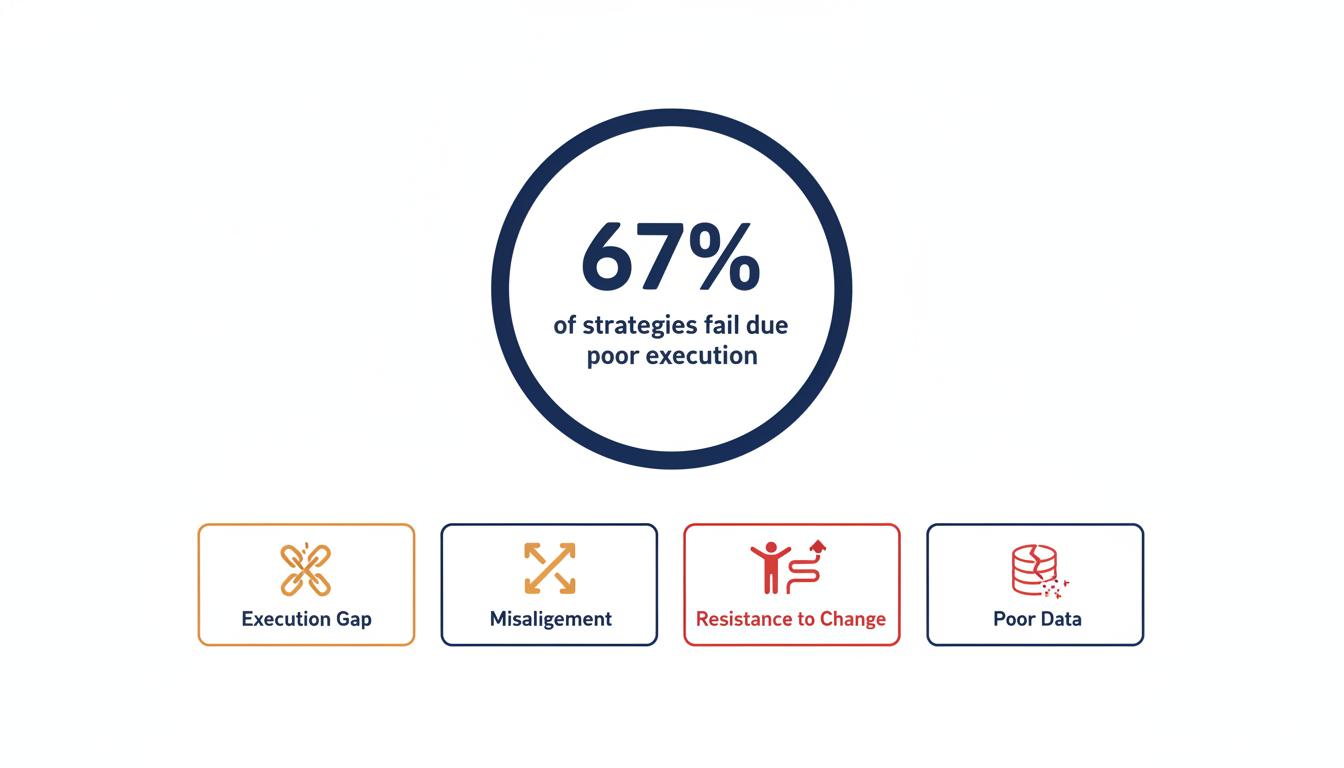
The execution gap. As mentioned earlier, 67% of strategies fail not because the strategy is wrong but because it is never properly executed. This usually happens when the strategy stays at the leadership level and never gets translated into clear actions for the teams who need to carry it out.
Lack of alignment. When different departments are working toward different goals, or when the strategy at the top does not match what people are being measured on at the bottom, the organization pulls in different directions and nothing moves forward.
Resistance to change. Every significant strategy involves change, and change is uncomfortable. Organizations that do not have a plan for managing resistance will find that their strategies get quietly ignored or actively undermined.
Poor data quality. Strategic decisions are only as good as the information they are based on. If your workforce data, financial data, or market data is inaccurate or incomplete, your strategy will be built on a shaky foundation.
No feedback loops. A strategy without regular review is a strategy that cannot adapt. Organizations that treat the annual strategic plan as a document to file rather than a living guide to revisit constantly will fall behind.
Frequently Asked Questions About Strategic Management
What is the main purpose of strategic management?
The main purpose of strategic management is to align an organization’s resources and activities with its long-term goals. It helps businesses make better decisions, adapt to change, and build a sustainable competitive advantage.
What are the 5 steps of the strategic management process?
The five steps are goal setting and mission identification, environmental analysis, strategy formulation, strategy implementation, and evaluation and control. Each step builds on the previous one, and the process is designed to repeat continuously.
What is the difference between strategic management and operational management?
Strategic management focuses on long-term direction and competitive positioning. Operational management focuses on day-to-day efficiency and execution within the existing strategy. Both are necessary, but they operate at different levels of the organization.
What are examples of strategic management in business?
Netflix shifting from DVD rentals to streaming, Apple building an integrated product ecosystem, and a small business redesigning its customer onboarding to improve retention are all examples of strategic management in action.
Why do most strategies fail?
Most strategies fail because of poor execution, not poor planning. Common reasons include lack of alignment across teams, resistance to change, insufficient resources, and no system for monitoring progress and adjusting course.
What is a strategic management framework?
A strategic management framework is a structured tool or model that helps organizations analyze their situation, make strategic decisions, and track progress. Common frameworks include SWOT analysis, Porter’s Five Forces, the Balanced Scorecard, and OKRs.
Conclusion
Strategic management is one of the most valuable skills any leader or organization can develop. At its core, it is about making deliberate choices, aligning your people and resources around a clear direction, and continuously improving based on what you learn along the way.
The companies that thrive long-term are not always the ones with the best products or the most funding. They are the ones with the clearest strategy, the most consistent execution, and the discipline to keep learning and adjusting.
If you are building or refining your strategic management approach, start with the fundamentals: clarify your mission, understand your environment, formulate a clear strategy, implement it with intention, and build systems to measure and learn.