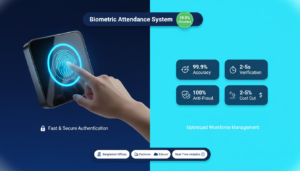

Running a small business means every dollar counts. When payroll errors and time theft eat into your profits month after month, something has to change. That’s exactly why more small businesses are switching to biometric attendance systems, not because it’s trendy, but because traditional methods are costing them real money.
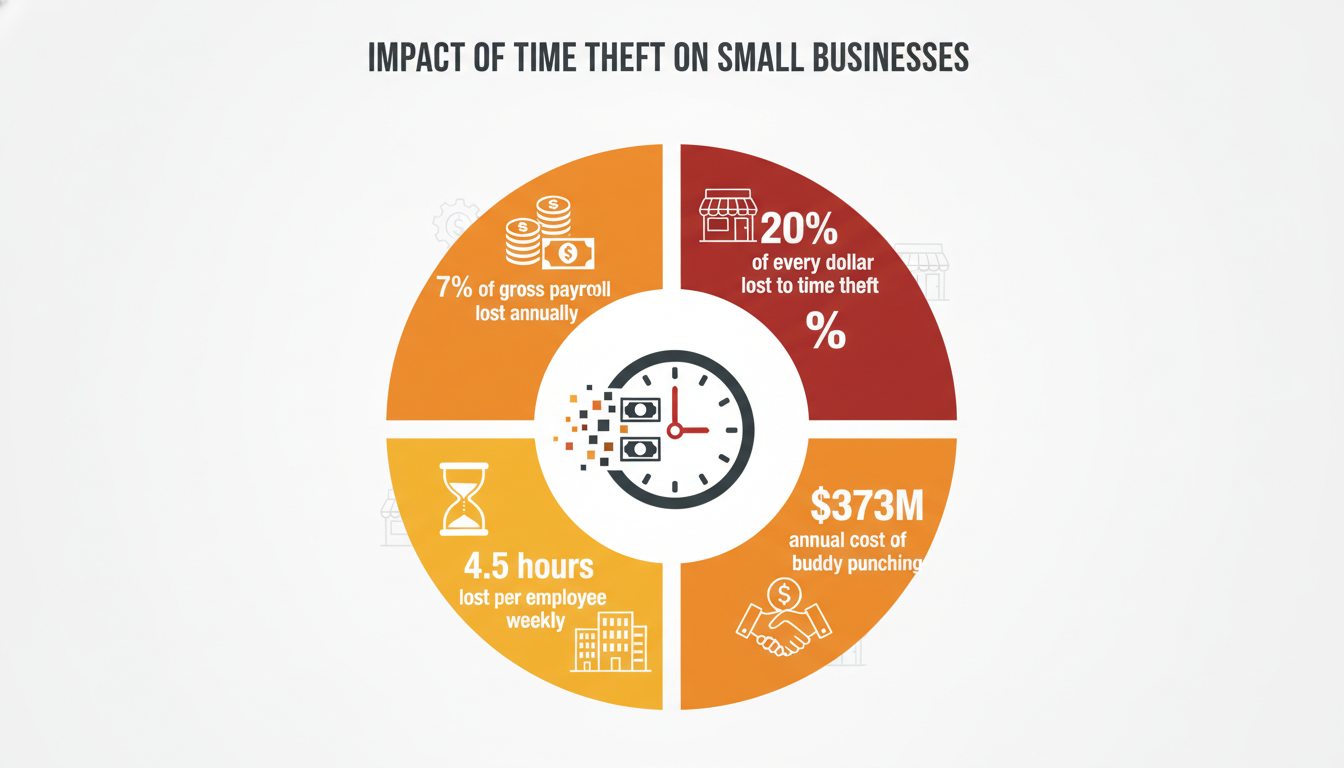
The numbers tell the story. Buddy punching costs U.S. employers an estimated $373 million every year, and time theft costs U.S. businesses approximately 20% of every dollar. For small businesses operating on thin margins, these losses can make the difference between growth and struggle.
The Breaking Point: When Old Systems Stop Working
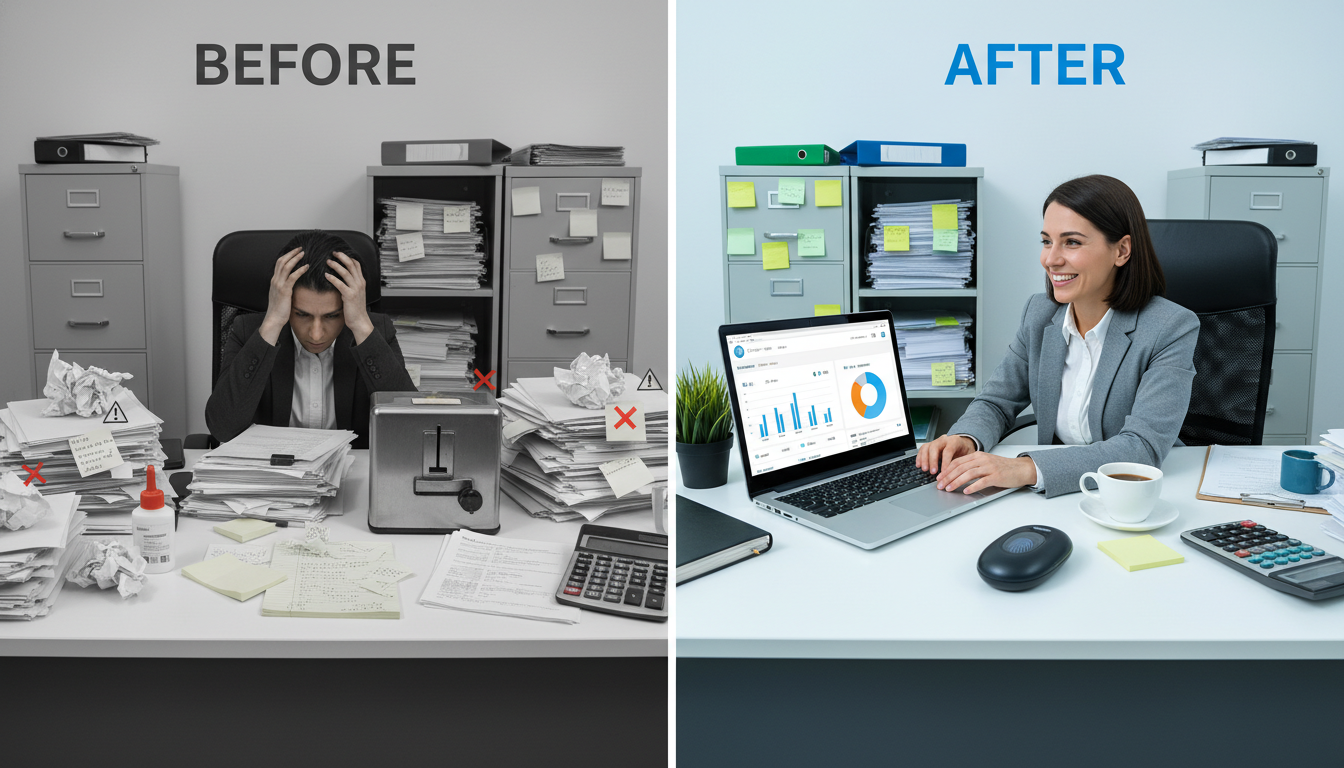
Most small business owners don’t wake up thinking about attendance technology. They switch to biometric systems when their current method becomes too expensive or too frustrating to ignore.
Take a typical small retail store with 25 employees. If just a few workers arrive 10 minutes late daily or have coworkers clock them in early, that’s thousands of dollars vanishing from the bottom line. Employers lose 4.5 hours per week per employee in time theft, which adds up to $2,340 a year of lost time and company money for a single worker making $10 an hour.
But the money is just part of the problem. Small business owners spend hours each week fixing timesheet errors, dealing with payroll disputes, and trying to figure out who actually worked when. One manufacturing company owner described spending every Monday morning correcting attendance records instead of focusing on growing the business.
Common Problems That Trigger the Switch
Small businesses hit their breaking point for specific reasons:
- Buddy punching gets out of control: When employees clock in for absent coworkers, payroll costs spike without explanation.
- Disputed hours drain time and trust: Arguments about who worked when create tension and require hours of investigation.
- Compliance risks pile up: Labor audits can expose inaccurate records, leading to fines and legal trouble.
- Manual tracking becomes impossible: As teams grow past 10-15 people, paper timesheets or punch cards become unmanageable.
The decision usually isn’t about wanting cutting-edge technology. It’s about solving a problem that’s costing money and creating headaches every single week.
How Small Businesses Actually Use Biometric Systems
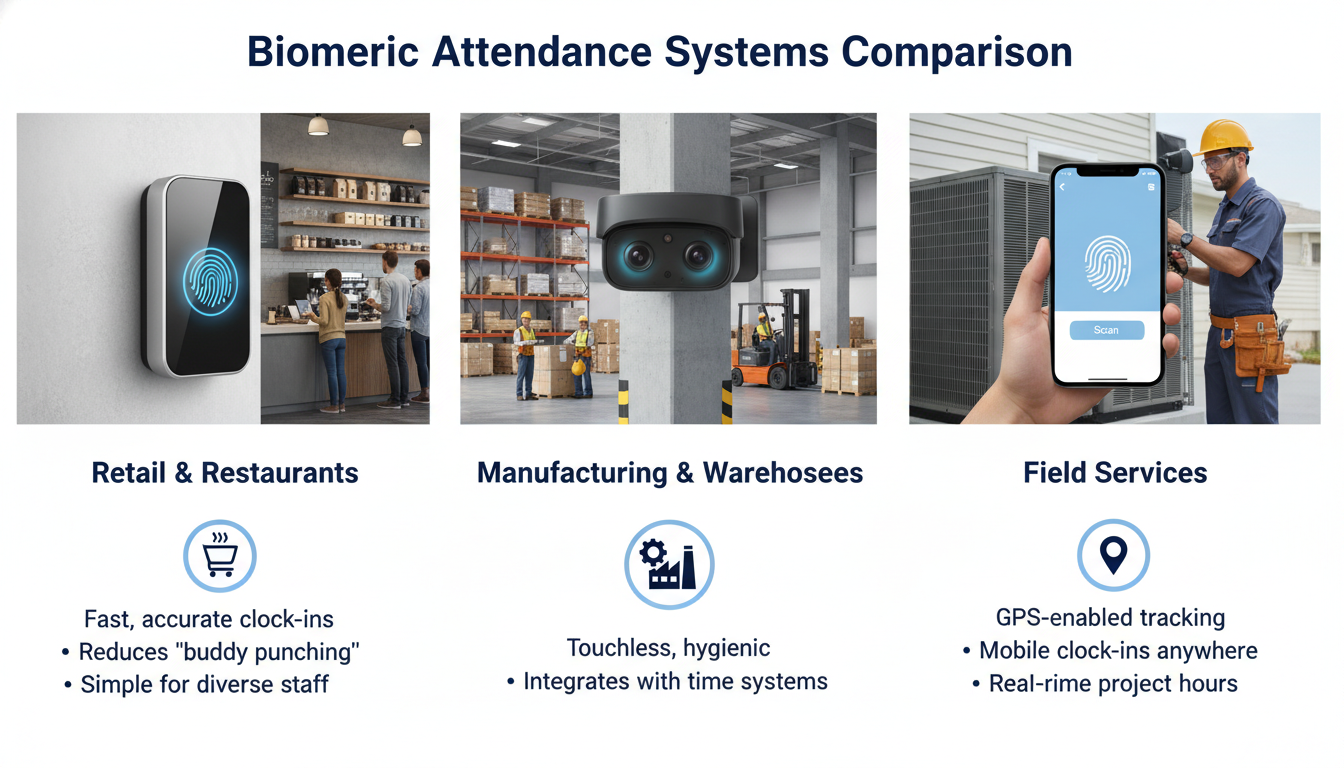
Different types of small businesses choose biometric attendance for different reasons. What works for a coffee shop might not work for a construction company.
Retail and Restaurant Operations
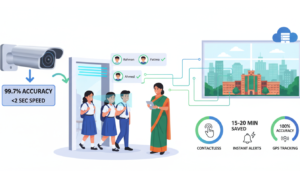
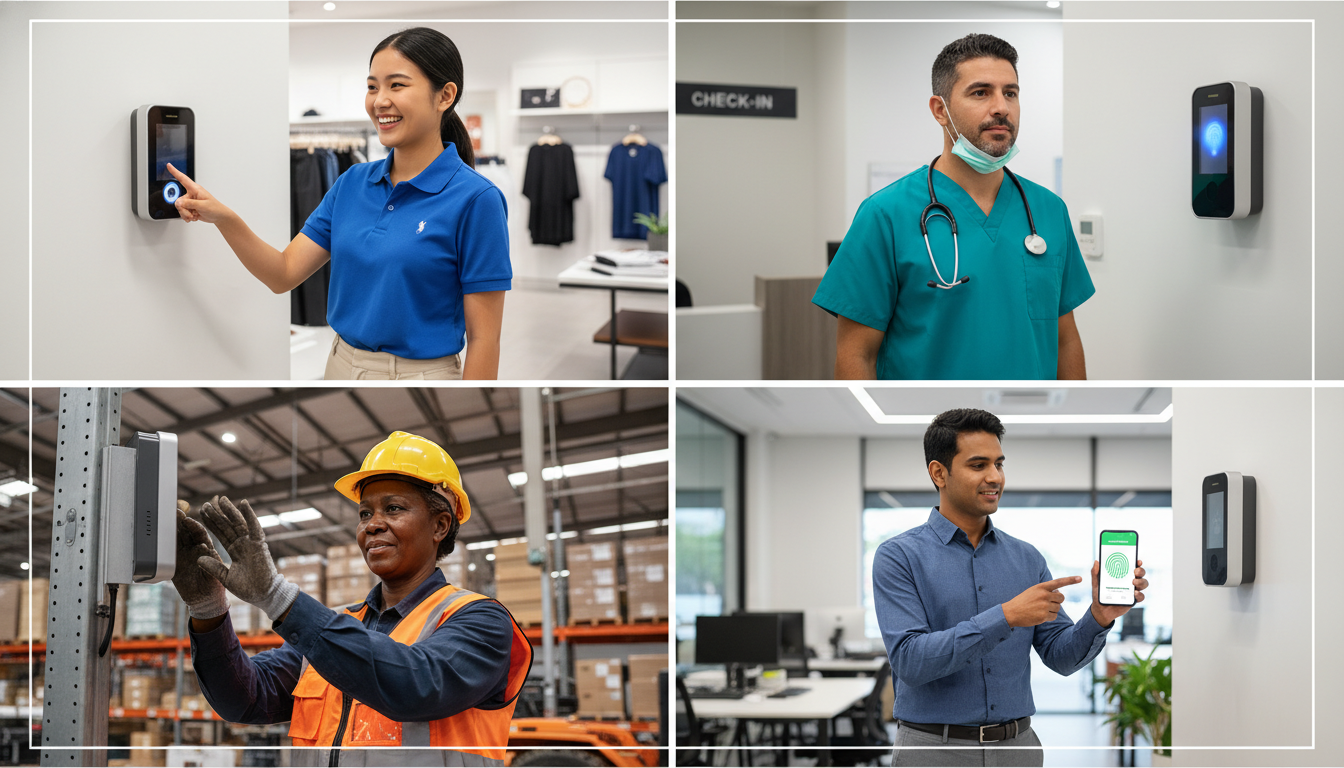
Small retail stores and restaurants deal with shift work, part-time staff, and high turnover. A fingerprint scanner at the entrance solves several problems at once. Employees can’t forget their badge or share login codes. Managers working the evening shift know exactly who came in and when, even if the owner isn’t there.
A small cafe owner explained that after installing a facial recognition system, time theft through buddy punching dropped 100 percent, and payroll errors fell from 25 a month to just two. The system paid for itself in six months just from catching early clock-ins and late clock-outs.
Manufacturing and Warehouse Settings
For small manufacturers, gloves and dirty hands make card swipes impractical. Facial recognition systems work when employees have oil on their hands or are wearing protective equipment. These businesses also need accurate job costing, tracking which employees worked on which projects. Biometric systems linked to work orders give them that data automatically.
Service Businesses with Field Teams
Small HVAC, plumbing, and electrical companies face a unique challenge: workers start their day at home and drive to job sites. Mobile biometric apps with location tracking let these businesses verify that employees are actually at the customer’s location when they clock in. No more paying for drive time that didn’t happen or wondering if someone is padding their hours.
Healthcare and Professional Services
Medical offices, dental clinics, and small healthcare providers have strict privacy rules. The Healthcare sector is anticipated to dominate the market share due to complex & dynamic workforce management and stringent government regulations and compliance. Biometric systems create audit trails that satisfy regulators while also controlling access to areas with sensitive patient information.
The Real ROI Calculation
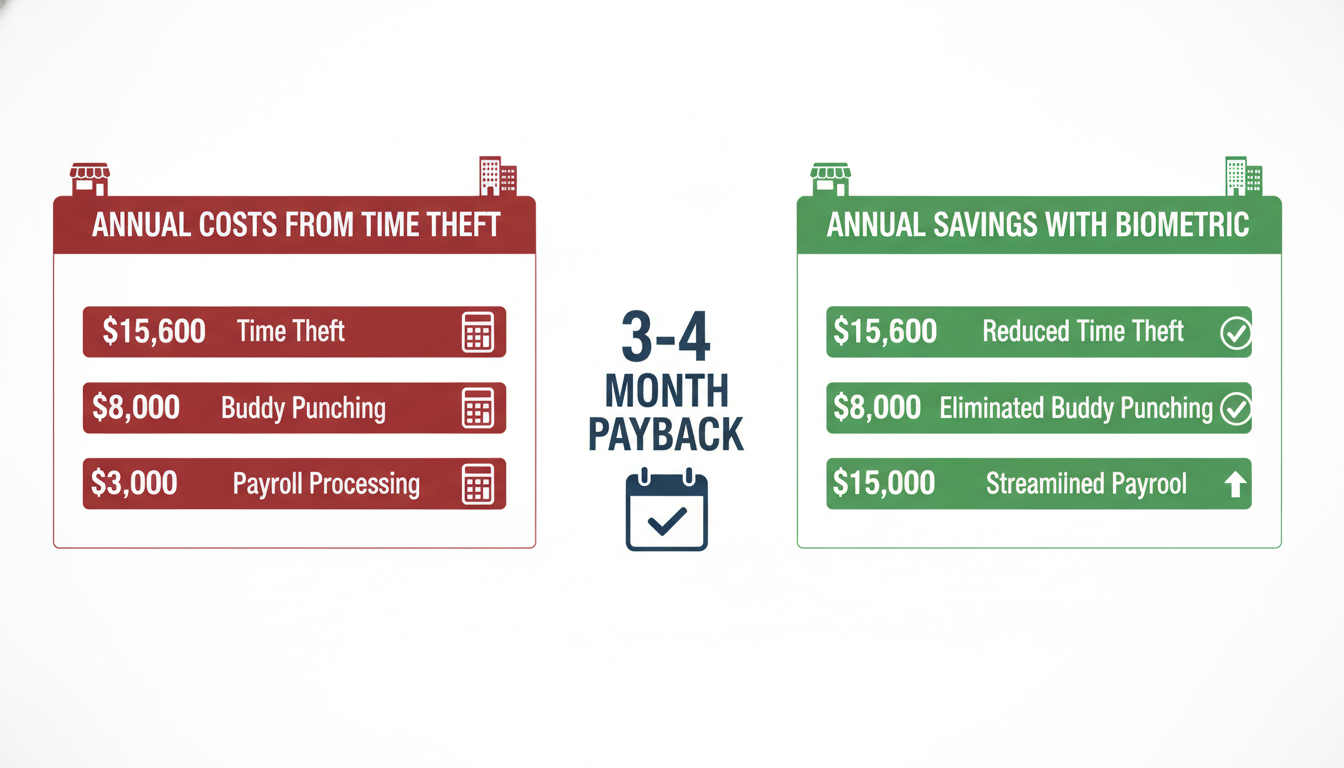
Small business owners are practical. They want to know: will this actually save me money, and how fast?
The math usually works out clearly. Here’s what a typical 20-employee small business might see:
| Cost Factor | Annual Impact |
|---|---|
| Time theft elimination (just 15 min/day per employee) | $15,600 saved |
| Reduced payroll processing time | $3,000 saved |
| Eliminated buddy punching (estimated at 2% of payroll) | $8,000 saved |
| Total Annual Savings | $26,600 |
| System cost (hardware + software) | $5,000-8,000 |
| Payback Period | 3-4 months |
A $5,000 investment in biometric employee time and attendance equipment resulted in a $15,000 annual savings due to greater productivity and the elimination of buddy punching.
Hidden Benefits That Add Up
Beyond the direct payroll savings, small businesses discover other advantages:
- Less time fixing mistakes: Instead of spending hours correcting timesheets, managers focus on customers and operations.
- Better labor data: Knowing exactly when you’re overstaffed or understaffed helps with scheduling.
- Fewer disputes: When the fingerprint scanner records the clock-in, there’s no argument about arrival times.
- Easier audits: Companies that conduct annual timekeeping audits experience 45% fewer compliance violations.
For many small businesses, getting back 5-10 hours of administrative time per week is worth as much as the direct cost savings.
What Actually Influences the Decision
When small business owners research biometric systems, certain factors matter more than others.
Price vs. Value
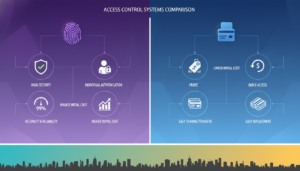
Yes, biometric systems cost more than paper timesheets. But small business owners compare the upfront cost to what they’re currently losing. Businesses lose as much as 7 percent of gross payroll to time theft annually. For a small business with a $200,000 payroll, that equates to $14,000 lost every year.
Cloud-based systems have made this technology affordable. Instead of buying expensive servers, small businesses can pay $10-25 per employee per month for software that includes updates, support, and data backup. The hardware (fingerprint scanner or facial recognition camera) typically costs $200-500 per location.
Easy Setup and Daily Use
Small businesses don’t have IT departments. They need systems that work out of the box. Modern biometric attendance systems connect to existing payroll software through simple integrations. Setup usually takes a few hours, not days or weeks.
Daily use matters too. If employees struggle with the system or it frequently fails to recognize fingerprints, people will find workarounds. The best systems work fast, recognize employees reliably, and don’t require constant attention.
Employee Acceptance
Some workers worry about privacy when they first hear about biometric systems. Smart business owners address this upfront:
- Explain that the system doesn’t store actual fingerprints, just mathematical patterns
- Show how it protects honest employees from being blamed for others’ mistakes
- Emphasize that accurate records mean accurate paychecks
- Offer alternative methods (like PIN codes) for anyone with concerns
46% of small and mid-sized businesses admit they’ve caught at least one instance of time theft or falsified timesheets in the past 12 months. When employees understand the system treats everyone fairly, resistance usually fades quickly.
Growth and Future Needs
Small businesses that are growing think about tomorrow, not just today. Can the system handle 50 employees if we hire more? What about opening a second location? Cloud-based systems scale easily. Adding new employees just means enrolling another fingerprint. Opening another location means installing another scanner that feeds into the same system.
Common Worries and Real Solutions
Every small business owner has concerns before making the switch. Here are the most common ones and what actually happens:
“What if the system breaks?”
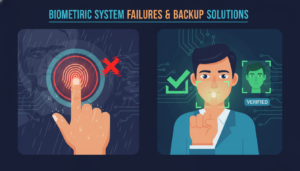
Modern biometric systems have backup options. If the fingerprint scanner fails, employees can clock in with a PIN code or through a mobile app. Most cloud systems also have 99%+ uptime guarantees, meaning they’re available virtually all the time.
“Is my data safe?”
Reputable biometric systems encrypt all data and store it securely. The system doesn’t keep your actual fingerprint, just a mathematical template that can’t be reverse-engineered. Many systems let you choose between cloud storage (managed by the vendor) and local storage (on your own network).
“What about privacy laws?”
Some states have specific biometric privacy laws. Good vendors know these regulations and build compliance into their systems. Generally, you need employee consent and clear policies about how biometric data is used and stored. This is straightforward to set up with the right guidance.
“Will it really work in my environment?”
This is where choosing the right type of biometric matters. Dirty hands? Use facial recognition. Employees wear masks? Fingerprint works better. Remote workers? Mobile apps with photo verification and location tracking. There’s usually a good solution for each situation.
Making the Right Choice
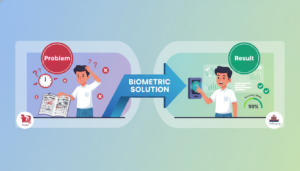
Small businesses choose biometric attendance systems when the pain of their current method becomes greater than the effort of switching. It’s not about chasing technology trends. It’s about solving real problems that cost real money.
The pattern is consistent across industries: businesses lose 2-7% of payroll to time theft and buddy punching, spend hours each week on administrative tasks, and deal with compliance risks. Over 60% of organizations globally are expected to adopt biometric attendance systems by 2027.
If you’re spending time each week correcting timesheets, arguing about hours, or just wondering if you’re paying for work that didn’t happen, it might be time to calculate what that’s really costing you. For most small businesses, the answer leads them to biometric attendance systems, not because they’re high-tech, but because they solve expensive problems that traditional methods can’t.
The technology has reached a point where it’s accessible and practical for businesses of all sizes. The question isn’t whether biometric systems work. The question is: how much is your current system costing you?
Frequently Asked Questions
How much does a biometric attendance system cost for a small business?
For a small business with 10-30 employees, expect to spend $200-500 for hardware (fingerprint scanner or facial recognition device) and $10-25 per employee per month for cloud-based software. The total first-year cost typically ranges from $2,000-8,000, depending on features and the number of locations.
How long does it take to see a return on investment?
Most small businesses see payback within 3-6 months. Organisations typically see a 3-5% reduction in labour costs within the first year. The exact timeline depends on how much time theft and buddy punching currently exist in your business.
Will employees resist using biometric systems?
Initial concerns about privacy are common, but they typically fade after clear explanation and a few weeks of use. Being transparent about data protection, offering alternative clock-in methods, and showing how the system prevents honest workers from being blamed for others’ mistakes helps with acceptance.
What happens if the biometric system fails or can’t read someone’s fingerprint?
Quality systems include backup methods. If a fingerprint won’t scan (due to injury, dry skin, etc.), employees can use a PIN code, proximity card, or mobile app. Most modern systems also work offline and sync data when connectivity returns.
Do I need special technical knowledge to manage a biometric system?
No. Modern cloud-based systems are designed for non-technical users. Setup is guided, daily operation is automatic, and most vendors provide phone and email support. You can usually train your team and get the system running in a few hours.
Are biometric attendance systems legal in all states?
Yes, but some states (like Illinois, Texas, and Washington) have specific biometric privacy laws. You need employee consent and clear policies about data use and retention. Reputable vendors include compliance tools and guidance to help you follow state requirements.
Can biometric systems work for remote or field employees?
Yes. Mobile biometric apps use facial recognition and GPS verification to confirm employees are at the right location when clocking in. This works well for field service teams, remote workers, and businesses with multiple job sites.