

Management strategies are planned approaches that business leaders use to guide their organizations toward specific goals. In simple terms, a management strategy is a roadmap that tells a business where it wants to go and how it plans to get there.
Every business, whether big or small, needs clear management strategies to stay organized, make smart decisions, and grow over time. Without a proper strategy, a business can lose direction, waste resources, and fall behind competitors.
At Tipsoi, we understand that the right management strategy can transform the way a business operates. From setting clear goals to managing people effectively, good strategies make everything work better.
Why Management Strategies Matter for Business Success
Running a business without a strategy is like driving without a map. You might move forward, but you are unlikely to reach your destination efficiently. Management strategies help business owners and managers:
- Make better decisions based on facts and data
- Use their time, money, and people more wisely
- Stay competitive in a changing market
- Motivate employees and improve performance
- Handle problems before they become serious
In a growing economy like Bangladesh, strong management strategies are especially important. Businesses face unique challenges such as market competition, limited resources, and changing customer needs. Having the right strategies in place helps businesses survive and succeed.
Overview of Proven Management Techniques
Over the years, business experts and successful companies have developed proven management techniques that actually work. These include strategic planning, performance management, employee engagement, operational efficiency, and leadership development.
This article covers all of these areas in detail. Whether you run a small shop in Dhaka or manage a mid-sized company across Bangladesh, you will find practical ideas here that you can apply right away.
Management Strategies vs Management Techniques
Key Differences Between Strategies and Techniques
People often use the words “strategy” and “technique” as if they mean the same thing, but they are actually different.
A management strategy is the big picture plan. It defines your overall direction and long-term goals. For example, a strategy might be to become the most trusted HR software company in Bangladesh.
A management technique is a specific action or method you use to carry out that strategy. For example, using weekly performance reviews or setting monthly sales targets are techniques that support a broader strategy.
Think of it this way: the strategy is the destination, and the techniques are the steps you take to get there.
When to Use Each in Business Management
Strategies are created at the leadership level and usually cover a period of one year or more. Techniques are used on a day-to-day or week-to-week basis by managers and team leaders.
You need a strategy when:
- You are starting a new business or entering a new market
- Your company is going through major changes
- You want to set long-term goals and direction
You need techniques when:
- You want to improve how your team works daily
- You are solving a specific operational problem
- You want to measure and improve individual or team performance
Both are important. The best businesses use strong strategies supported by smart, practical techniques.
Core Management Strategies and Techniques
Strategic Planning and Goal Setting
Strategic planning is the process of deciding where your business wants to be in the future and figuring out how to get there. It involves setting clear goals, identifying the steps needed to achieve them, and allocating the right resources.
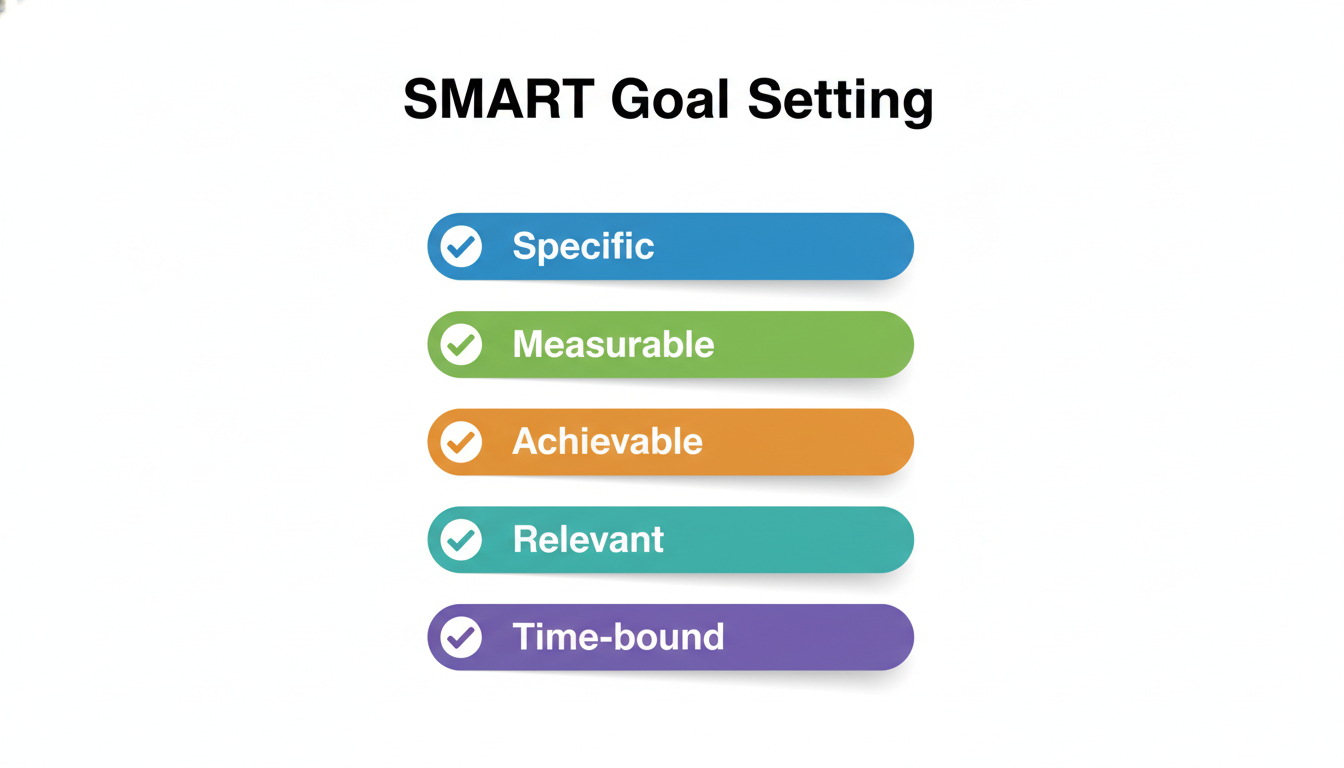
Good goal setting follows the SMART framework. Goals should be Specific, Measurable, Achievable, Relevant, and Time-bound. For example, instead of saying “we want to grow,” a SMART goal would be “we want to increase our customer base by 20% within the next 12 months.”
Performance Management and Measurement Systems
Performance management is about making sure that everyone in your organization is working toward the same goals and performing at their best. It includes setting expectations, tracking progress, giving feedback, and making improvements.
A good performance management system helps managers identify top performers and recognize their work. It also helps identify employees who may need extra support or training.
Operational Management and Efficiency Improvement
Operational management focuses on the day-to-day activities that keep a business running. This includes managing workflows, handling resources, and making sure that products or services are delivered on time and at the right quality.
Improving efficiency means doing more with less. It means cutting out unnecessary steps, reducing waste, and making processes run smoother and faster.
Growth and Stability Strategies
Every business needs to balance two things: growth and stability. Growth strategies focus on expanding the business, reaching new customers, or launching new products. Stability strategies focus on keeping the business strong and sustainable during uncertain times.
For businesses in Bangladesh, both are important. A company might use a growth strategy during a boom period and shift to a stability strategy when facing economic challenges.
Cost Leadership and Differentiation Strategies
Cost leadership means becoming the business that offers the lowest prices in the market. This works by reducing production costs and operating efficiently. Many Bangladeshi manufacturers use this strategy to compete in global markets.
Differentiation means offering something unique that competitors cannot easily copy. This could be better quality, faster service, or a more personalized customer experience. Tipsoi, for example, differentiates itself by providing smart digital solutions designed specifically for the needs of Bangladeshi businesses.
Strategic Management Process
Clarifying Vision and Business Objectives
The strategic management process always starts with a clear vision. Your vision is a simple statement of what you want your business to become. Your business objectives are the specific outcomes you want to achieve in order to reach that vision.
For example, a vision might be: “To help every small business in Bangladesh manage its workforce digitally.” The objectives would then include specific targets around product development, customer growth, and market reach.
Gathering and Analyzing Business Data
Before you can make a good strategy, you need good information. This means gathering data about your business performance, your customers, your competitors, and the overall market.
Data can come from sales reports, customer surveys, employee feedback, market research, and financial records. Once you have the data, you analyze it to find patterns, problems, and opportunities.
Strategy Development and Planning
Once you understand your vision and have gathered the right data, you can start developing your strategy. This involves choosing the best path forward, setting priorities, and deciding how to allocate your budget, people, and time.
Good strategy development is a team effort. It should involve input from managers, department heads, and sometimes even frontline employees who understand the day-to-day challenges.
Strategy Execution and Implementation
A strategy is only as good as its execution. Many businesses create excellent plans but fail to implement them properly. Successful execution requires clear communication, strong leadership, defined responsibilities, and regular follow-up.
Each team member must understand their role in the strategy. Deadlines, budgets, and performance targets should be clearly set and monitored.
Evaluation and Control Mechanisms
After implementing a strategy, you need to track whether it is working. This is done through regular evaluation. You compare actual results against your targets and look for gaps.
If the strategy is not working as expected, you adjust it. This cycle of planning, executing, evaluating, and adjusting is what keeps a business on track and moving forward.
Strategic Planning in Management
Long-Term Goal Setting and Vision Development
Long-term goals give a business direction and purpose. They usually cover a period of three to five years. Setting long-term goals requires business leaders to think beyond the current month or quarter and imagine where they want the company to be in the future.
Vision development is closely tied to this. A well-developed vision inspires employees, attracts customers, and guides all business decisions.
SWOT Analysis for Strategic Decision Making
SWOT analysis is one of the most useful tools in strategic planning. SWOT stands for Strengths, Weaknesses, Opportunities, and Threats.
- Strengths are what your business does well
- Weaknesses are areas where you need improvement
- Opportunities are external factors that could help your business grow
- Threats are external challenges that could harm your business
By conducting a SWOT analysis, business leaders can make smarter decisions about where to focus their energy and resources.
Aligning Business Objectives with Market Trends
Market trends are constantly changing. Customer preferences shift, new technologies emerge, and economic conditions fluctuate. Successful businesses align their objectives with these trends instead of ignoring them.
In Bangladesh, key trends include the rapid growth of digital technology, the rise of e-commerce, increasing urbanization, and a growing young workforce. Businesses that align their strategies with these trends will be better positioned for success.
Performance Management Systems
Balanced Scorecard Approach
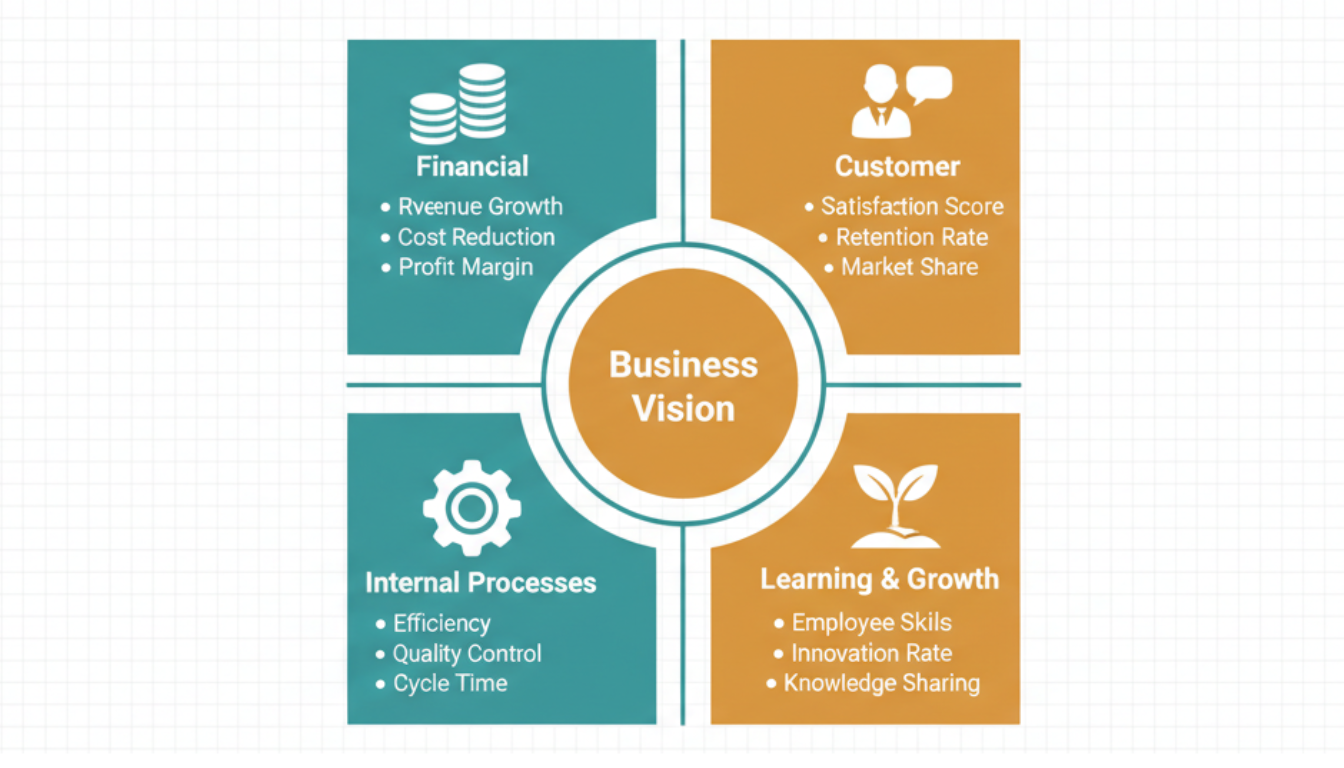
The balanced scorecard is a popular performance management framework that measures business success from four different perspectives: financial, customer, internal processes, and learning and growth.
Instead of only looking at profits, the balanced scorecard gives a complete picture of business health. This helps managers make more balanced and well-informed decisions.
Key Performance Indicators Across Business Areas
Key Performance Indicators, or KPIs, are measurable values that show how well a business is achieving its goals. Different areas of a business use different KPIs.
Financial Performance Metrics
Financial KPIs include revenue growth, profit margins, return on investment, and cash flow. These metrics show whether the business is making money and using its financial resources wisely.
Customer-Focused Metrics
Customer KPIs include customer satisfaction scores, customer retention rates, and the number of new customers gained. These metrics show how well the business is serving its customers.
Internal Process Metrics
Internal process KPIs measure how efficiently the business operates. This includes order fulfillment time, error rates, and productivity levels.
Learning and Growth Metrics
These KPIs measure employee development and organizational growth. Examples include employee training completion rates, employee satisfaction scores, and the number of new skills developed within the team.
Operational Management and Workflow Optimization
Improving Daily Business Operations
Good operational management starts with understanding how your business runs on a daily basis. This means mapping out every process, identifying bottlenecks, and finding ways to make things run more smoothly.
Simple improvements such as better scheduling, clearer communication, and smarter use of tools can make a big difference in day-to-day operations.
Enhancing Productivity and Process Efficiency
Productivity is about getting more done in less time without sacrificing quality. To enhance productivity, managers should set clear daily priorities, reduce unnecessary meetings, and give employees the tools and information they need to work efficiently.
Process efficiency means eliminating steps that do not add value. If a task takes five steps but only three are necessary, removing the extra steps saves time and reduces errors.
Learn More- Work Productivity Improve Hacks
Process Standardization and Automation
Standardization means creating consistent processes that everyone follows. When processes are standardized, training becomes easier, quality improves, and mistakes are reduced.
Automation takes standardization a step further by using technology to handle repetitive tasks. Tools like Tipsoi’s digital HR solutions can automate tasks like attendance tracking, leave management, and payroll processing, freeing up time for managers to focus on higher-value work.
Management Styles and Their Impact on Business Success
Most Effective Management Styles
Different situations call for different management styles. However, research consistently shows that certain styles produce better results.
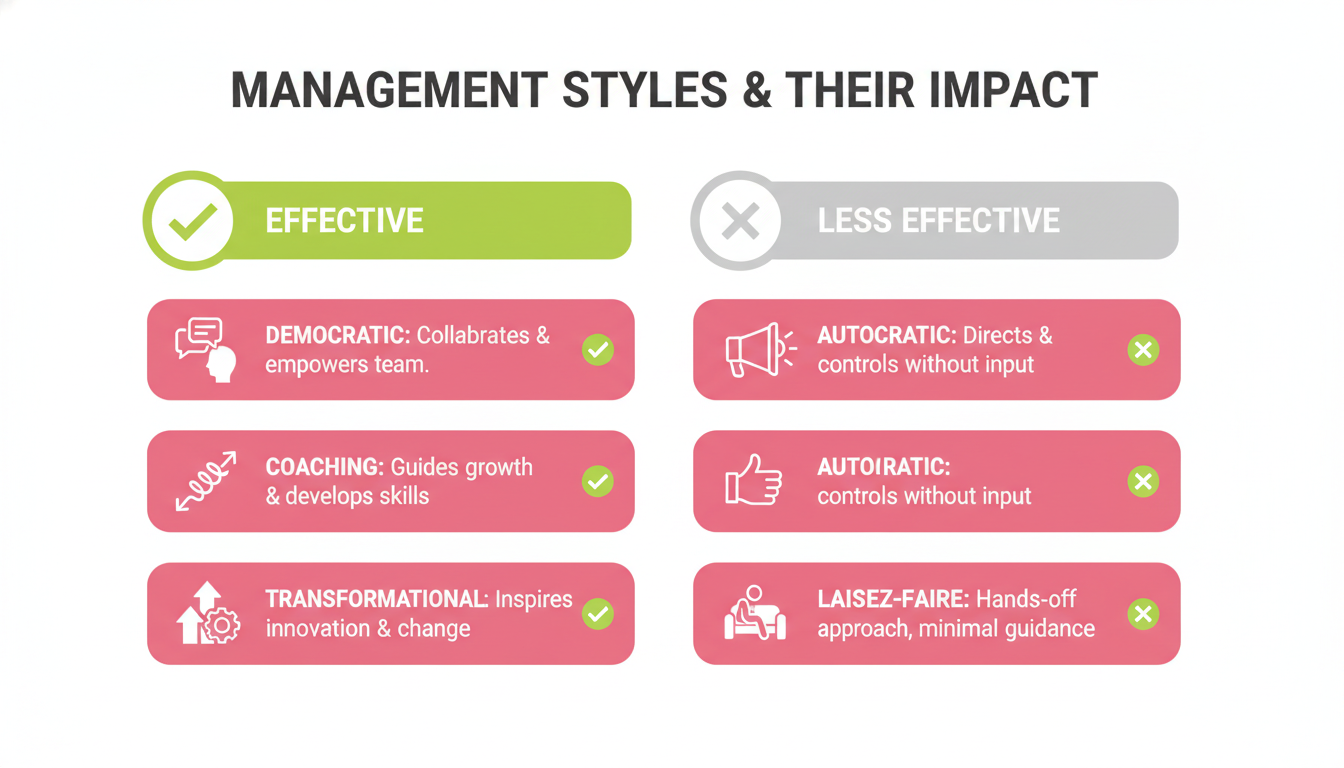
Democratic management involves team members in decision-making. Employees feel valued and are more likely to be engaged and committed. This style works well when the team is experienced and capable.
Coaching management focuses on developing employees’ skills and helping them grow. Managers act as mentors rather than bosses. This style builds strong, capable teams over time.
Transformational management inspires employees through a compelling vision and encourages innovation. Leaders who use this style motivate people to go beyond what is expected.
Least Effective Management Styles
Autocratic management involves one person making all decisions without input from others. While this can work in emergencies, it generally leads to low morale and high employee turnover.
Laissez-faire management gives employees complete freedom with very little guidance. Without proper structure, this can lead to confusion, low productivity, and a lack of accountability.
Choosing the Right Management Style for Your Business
The best management style depends on your team, your industry, and the situation you are in. Good managers know how to read the room and switch between styles as needed.
For most Bangladeshi businesses, a combination of democratic and coaching styles tends to work well. These styles build trust, encourage open communication, and help employees grow professionally.
Leadership and Employee Management Strategies
Importance of Effective Leadership in Organizations
Leadership is at the heart of every successful management strategy. Good leaders set the tone for the entire organization. They create a culture where people feel safe, valued, and motivated to do their best work.
Poor leadership, on the other hand, leads to confusion, low morale, and high staff turnover. Investing in leadership development is one of the smartest things any business can do.
Clear Communication and Feedback Mechanisms
Communication is one of the most important skills a manager can have. Clear communication means sharing information in a way that is easy to understand, timely, and honest.
Feedback mechanisms such as regular one-on-one meetings, team check-ins, and performance reviews help keep everyone aligned. When employees know what is expected of them and how they are performing, they can do their jobs more effectively.
Delegation and Employee Empowerment
Many managers make the mistake of trying to do everything themselves. Effective delegation means assigning tasks to the right people and trusting them to do the job well.
Delegation does not mean dumping work on others. It means giving employees the authority, resources, and support they need to succeed. When employees are empowered, they take ownership of their work and deliver better results.
Inclusive Leadership and Workplace Culture
Inclusive leadership means making sure that every person in the organization feels respected, heard, and valued, regardless of their background, gender, or position. Inclusive workplaces are more creative, more productive, and better at solving problems.
Building a positive workplace culture takes time and consistent effort. Leaders play a key role in modeling the behaviors and values they want to see in their teams.
Employee Motivation and Engagement Strategies
Motivated employees are the backbone of any successful business. To keep employees motivated, managers should recognize good work, provide growth opportunities, offer fair compensation, and create a supportive work environment.
Engaged employees are not just doing their jobs. They are invested in the success of the business and go above and beyond what is required.
Learn More- Team Productivity Hacks
Employee Engagement and Motivation Strategies
Importance of Employee Engagement in Performance
Research consistently shows that businesses with high employee engagement perform better. Engaged employees are more productive, more creative, and less likely to leave the company.
Employee engagement is not just about keeping people happy. It is about creating an environment where people feel connected to the work they do and the organization they work for.
Rewarding and Recognizing Employee Performance
Recognition does not always have to be financial. A simple “thank you,” a public acknowledgment during a team meeting, or a certificate of achievement can go a long way.
That said, fair and competitive compensation is also important. Employees who feel they are paid fairly are more likely to stay with the company and perform at a high level.
Building Trust and Accessibility in Leadership
Trust is the foundation of a strong team. Employees who trust their managers are more open, more honest, and more willing to put in extra effort. Trust is built through consistency, transparency, and follow-through.
Accessibility means being approachable and available. Managers who are open to questions and concerns create a healthier and more communicative work environment.
Conducting Regular Meetings and Check-Ins
Regular meetings and check-ins keep everyone on the same page. They provide a space for sharing updates, discussing challenges, and celebrating wins. They also give employees an opportunity to raise concerns before they become bigger problems.
The key is to keep meetings focused and productive. Set a clear agenda, stick to the time limit, and follow up on action items.
Practical Management Techniques for Managers
Clear and Consistent Communication Techniques
Good communication starts with clarity. When giving instructions or sharing information, be direct and specific. Avoid jargon and technical terms that people may not understand.
Consistency is equally important. If expectations change frequently without explanation, employees become confused and frustrated. Make sure your messages are consistent across all channels and situations.
Effective Delegation Techniques
Start by identifying the strengths and skills of each team member. Match tasks to people based on their abilities and development goals. When delegating, clearly explain what needs to be done, why it matters, and what a successful outcome looks like.
Check in periodically without micromanaging. Give employees the space to figure things out, but be available if they need support.
Continuous Feedback and Performance Improvement
Feedback should not only happen during annual performance reviews. Managers should provide regular, real-time feedback that helps employees improve as they go.
Constructive feedback is specific, actionable, and respectful. Instead of saying “your work is not good enough,” say “this report needs more detailed data in the second section.” That kind of feedback gives employees something concrete to act on.
Data-Driven Decision-Making Techniques
Making decisions based on gut feelings alone is risky. Data-driven decision-making means using real information to guide your choices. This could include sales data, employee performance metrics, customer feedback, or financial reports.
When managers use data, they make more objective decisions and are better able to justify those decisions to their teams and stakeholders.
Team Development and Training Techniques
Investing in your team’s development pays off in the long run. Regular training sessions, mentorship programs, and professional development opportunities help employees build new skills and stay motivated.
Cross-training, where employees learn about other roles within the business, also improves flexibility and collaboration across teams.
Implementation of Management Strategies
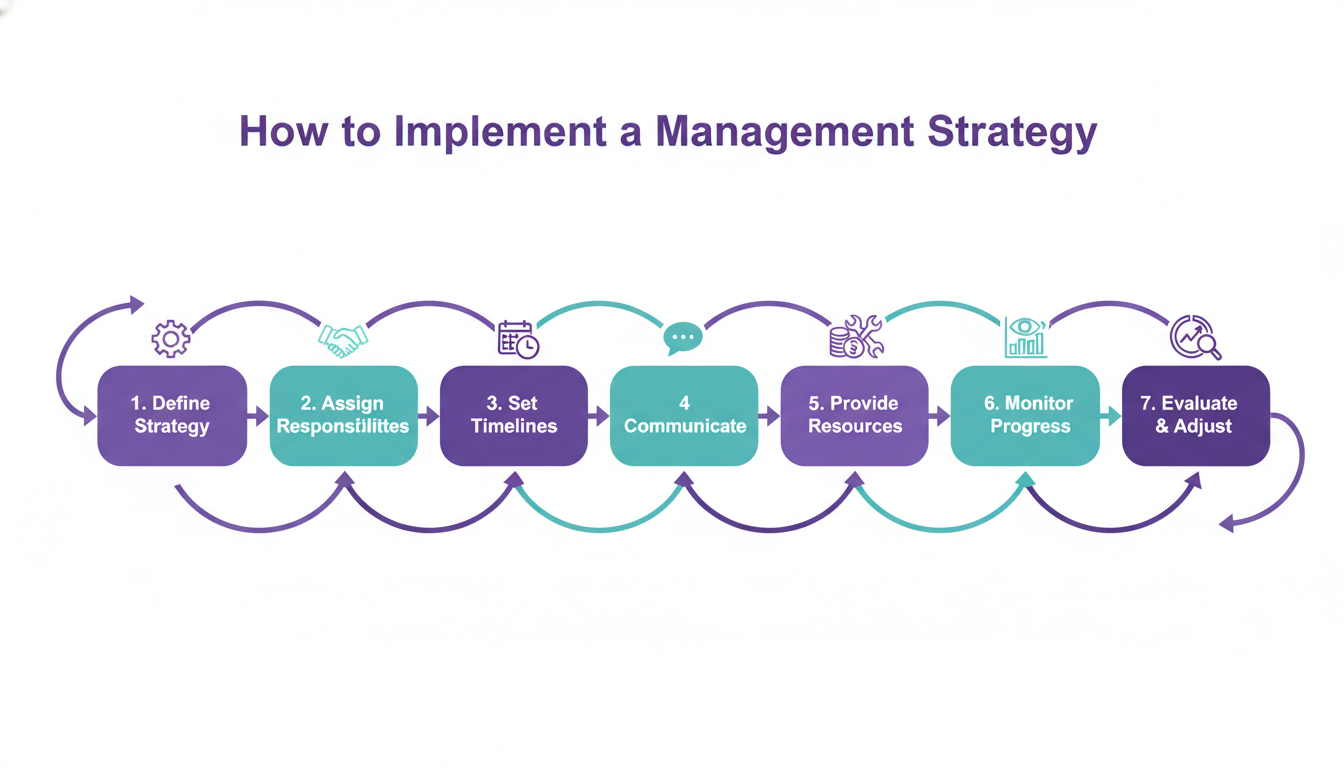
Step-by-Step Process to Implement Strategies
Implementing a management strategy involves several clear steps:
- Define your strategy clearly so that everyone understands what it is and why it matters.
- Assign responsibilities so that each person knows their specific role in the implementation.
- Set timelines and milestones so that progress can be tracked.
- Communicate the plan to all relevant stakeholders.
- Provide the necessary resources, including budget, tools, and training.
- Monitor progress regularly and address issues as they arise.
- Evaluate results and make adjustments based on what you find.
Common Challenges in Strategy Execution
Even the best strategies can fail during execution. Common challenges include:
- Lack of clear communication about what the strategy involves
- Insufficient resources or budget
- Resistance from employees who are used to old ways of working
- Unrealistic timelines
- Poor coordination between departments
Overcoming Barriers to Implementation
To overcome these barriers, involve your team in the planning process from the beginning. When people feel included, they are less likely to resist change. Be transparent about why the strategy is being implemented and what benefits it will bring.
Provide training and support so that employees have what they need to adapt. Break the implementation into smaller, manageable steps to prevent overwhelm.
Change Management and Adaptability
Change is inevitable in business. Change management is the structured approach to transitioning individuals, teams, and organizations from a current state to a desired future state.
Effective change management requires empathy, communication, and patience. Leaders should acknowledge that change can be difficult and should actively support their teams through the transition.
Modern Management Tools and Technologies
Role of Technology in Business Management
Technology has completely changed the way businesses are managed. From cloud-based software to mobile applications, modern tools help managers do their jobs more efficiently and effectively.
In Bangladesh, the adoption of digital management tools is growing rapidly. Businesses that embrace technology gain a significant advantage over those that rely solely on manual processes.
Project Management and Collaboration Tools
Project management tools help teams organize tasks, track deadlines, and collaborate more effectively. Tools like Trello, Asana, and Microsoft Teams allow managers to see at a glance what is being worked on, who is responsible, and whether things are on track.
These tools reduce the need for constant meetings and make it easier for remote teams to stay connected.
Data-Driven Decision Making and Analytics
Analytics tools turn raw data into useful insights. Business intelligence software can show which products are selling best, which customers are most valuable, and which processes are causing delays.
When managers have access to good data, they can make faster and smarter decisions. Tipsoi integrates data reporting features that help business owners in Bangladesh track their operations and make informed choices.
Automation and Digital Transformation
Automation replaces repetitive manual tasks with technology. This could be as simple as automatically sending a payment reminder to a customer or as complex as using software to manage an entire production process.
Digital transformation is the broader process of integrating technology into all areas of a business. It changes how businesses operate and deliver value to their customers. For Bangladeshi SMEs, digital transformation is not just a trend. It is a necessity for staying competitive.
Management Strategies for Small and Medium Businesses in Bangladesh
Business Challenges in the Bangladesh Market
Small and medium businesses (SMEs) in Bangladesh face a unique set of challenges. These include limited access to capital, a shortage of skilled workers, infrastructure limitations, and intense market competition.
Additionally, many SMEs operate informally and lack the structured processes needed to scale effectively. Navigating regulatory requirements and managing cash flow are also ongoing challenges for local businesses.
Cost-Effective Management Techniques for SMEs
For SMEs with limited budgets, cost-effective management techniques are essential. Some practical approaches include:
- Using free or affordable digital tools for communication and project management
- Cross-training employees to reduce dependence on specialized roles
- Focusing on customer retention rather than constantly chasing new customers
- Outsourcing non-core functions to reduce overhead costs
- Leveraging platforms like Tipsoi to manage HR and workforce operations affordably
Scaling and Growth Strategies for Local Businesses
Growth does not happen by accident. For Bangladeshi SMEs looking to scale, key strategies include:
- Building a strong and loyal customer base through excellent service
- Exploring new geographic markets within Bangladesh
- Partnering with other local businesses for mutual benefit
- Investing in digital marketing to reach a wider audience
- Improving product or service quality consistently
Adapting to Economic and Market Conditions
The Bangladeshi economy is dynamic. Exchange rates, inflation, changing regulations, and shifting consumer behavior all affect how businesses operate. Successful businesses build flexibility into their strategies so they can adapt quickly when conditions change.
This might mean maintaining a cash reserve for tough times, diversifying revenue streams, or staying closely informed about market and regulatory developments.
How to Choose the Right Management Strategy
Assessing Business Goals and Resources
Before choosing a strategy, you need to know what you want to achieve and what you have to work with. Take stock of your financial resources, your team’s skills, your current technology, and your time.
Match your strategy to what is realistic, given your resources. An ambitious strategy that you do not have the capacity to execute will only lead to frustration and failure.
Evaluating Different Strategy Types
Different types of management strategies work better in different situations. Growth strategies are best when the market is expanding. Cost-cutting strategies are best during tough economic times. Innovation strategies are best when competition is intense and differentiation matters.
Evaluate the pros and cons of each type in the context of your specific business before making a decision.
Aligning Strategy with Business Size and Industry
A strategy that works for a large corporation may not work for a small business. Similarly, a strategy that works in the retail industry may not translate well to manufacturing or services.
Make sure your strategy is tailored to your business size, your industry, and the specific market you operate in. In Bangladesh, local context matters enormously. What works in Dhaka may need to be adjusted for businesses operating in Chittagong, Sylhet, or rural areas.
Measuring the Success of Management Strategies
Key Metrics to Track Performance
You cannot improve what you do not measure. Key metrics for tracking the success of management strategies include:
- Revenue growth rate
- Employee productivity and satisfaction
- Customer satisfaction and retention
- Operational efficiency and error rates
- Return on investment for new initiatives
Track these metrics regularly and compare them against your targets to see how well your strategy is working.
Continuous Improvement and Optimization
No strategy is perfect from the start. Continuous improvement is the ongoing process of making small, regular improvements to your systems, processes, and products. This approach, sometimes called Kaizen, helps businesses grow steadily and sustainably.
Encourage your team to identify problems and suggest solutions. Create a culture where improvement is celebrated, and innovation is welcomed.
Strategy Adjustment Based on Data Insights
When data shows that a strategy is not producing the expected results, it is time to make adjustments. This does not mean scrapping everything and starting over. Often, it means making targeted changes to specific parts of the strategy.
Being willing to adjust based on data is a sign of a mature and healthy organization. The best businesses are both strategic and adaptable.
Benefits of Effective Management Strategies
Improved Business Performance and Productivity
One of the biggest benefits of effective management strategies is improved performance across the board. When people know what they are doing and why, they work more purposefully and efficiently. Productivity increases, waste decreases, and results improve.
Better Decision-Making and Resource Utilization
Good management strategies give decision-makers a clear framework for choosing between options. Instead of reacting to problems as they come up, managers can make proactive, informed decisions that serve the business well.
Resources, including money, time, and people, are used more wisely when there is a clear strategy guiding their allocation.
Competitive Advantage in the Market
Businesses with strong management strategies are better positioned to compete. They are more agile, more efficient, and more responsive to customer needs. Over time, this translates into stronger market share, better reputation, and greater financial success.
Common Mistakes in Management Strategies
Lack of Clear Goals and Direction
One of the most common reasons strategies fail is that the goals are not clearly defined. When everyone has a different understanding of what the strategy is trying to achieve, execution falls apart. Always start with crystal-clear goals.
Poor Communication and Leadership Gaps
Even the best strategy will fail if it is not communicated well. Employees need to understand the strategy, why it matters, and what their role is in it. Leadership gaps, where managers are unavailable or uninvolved, can leave teams feeling lost and unmotivated.
Ignoring Employee Feedback
Employees are often the first to notice when something is not working. When managers ignore or dismiss employee feedback, they miss valuable insights. Create channels for employees to share their observations and make sure their input is taken seriously.
Failure to Adapt to Market Changes
The business world changes constantly. A strategy that made sense two years ago might not be relevant today. Businesses that stick rigidly to outdated strategies without adapting to new realities put themselves at serious risk. Stay informed, stay flexible, and be ready to evolve.
Real-World Examples of Management Strategies
Examples of Successful Business Strategies
BRAC is one of the world’s largest NGOs and a prime example of a successful management strategy in Bangladesh. BRAC grew rapidly by combining a clear social mission with disciplined operational management, strong community engagement, and a constant focus on measurement and learning.
Grameenphone succeeded in Bangladesh by adopting a differentiation strategy focused on network quality and customer service. Their long-term investment in infrastructure and brand trust helped them maintain market leadership.
Square Pharmaceuticals grew into Bangladesh’s largest pharmaceutical company through a combination of cost leadership, quality focus, and strategic diversification. Their commitment to operational excellence and compliance is a model for Bangladeshi manufacturers.
Lessons Learned from Management Failures
Many businesses fail not because of bad products, but because of poor management. Common lessons from failed strategies include:
- Do not ignore warning signs in your financial data
- Do not expand too quickly before your foundation is solid
- Do not assume that what worked in the past will continue to work in the future
- Do not underestimate the importance of your people and your culture
Every failure carries lessons. The best managers study these lessons carefully and use them to make better decisions going forward.
Conclusion
Key Takeaways on Effective Management Strategies
Management strategies are not just for large corporations. Every business, from a small garment workshop in Narayanganj to a growing tech company in Dhaka, can benefit from clear, well-implemented management strategies.
The key takeaways from this article are:
- Strategy gives your business direction and purpose
- Performance management keeps your team aligned and accountable
- Good leadership and communication are the backbone of any successful strategy
- Technology and data are powerful tools for modern business management
- Continuous improvement and adaptability are essential for long-term success
- Bangladeshi businesses face unique challenges that require locally relevant strategies
Future Trends in Business Management
The future of business management is digital, data-driven, and people-focused. Artificial intelligence, automation, and advanced analytics will continue to reshape how businesses operate. At the same time, the importance of human connection, strong leadership, and a positive workplace culture will only grow.
For businesses in Bangladesh, the opportunity is enormous. As digital infrastructure improves and more people join the formal economy, well-managed businesses will be perfectly placed to capture this growth.
At Tipsoi, we are committed to helping businesses across Bangladesh build stronger management systems through smart, affordable digital tools. Because when businesses are well managed, communities thrive.