

The Office Is Tired. And Honestly, So Is HR
Picture your HR team on a Monday morning. There’s a stack of leave requests. Payroll needs to run by Friday. Three new hires start this week. And someone forgot to update the attendance sheet. Again.
This is not a rare story. It’s every week for most companies.
HR automation is changing that. Not in a robotic, sci-fi way. In a quiet, practical, “finally someone fixed this” kind of way.
This post breaks down what HR automation actually is. It shows how it works, what it fixes, and why your team deserves better than spreadsheets and sticky notes. Whether you’re running a 10-person startup or a 500-person company, this one’s for you.
What Is HR Automation?
HR automation means using software to handle repetitive HR tasks automatically.
Think: sending offer letters, tracking attendance, running payroll, or approving leave. The software does it. Your team doesn’t have to touch it every single time.
It’s not about replacing people. It’s about giving people their time back. There’s a Bangladeshi saying that fits perfectly here: “যে জমিতে হাল দাও, সেই জমিতে ফসল পাও” — you harvest where you put in real work. Automation clears the weeds so your HR team can finally focus on the real work.
The Old Way of Doing HR (And Why It Burns People Out)
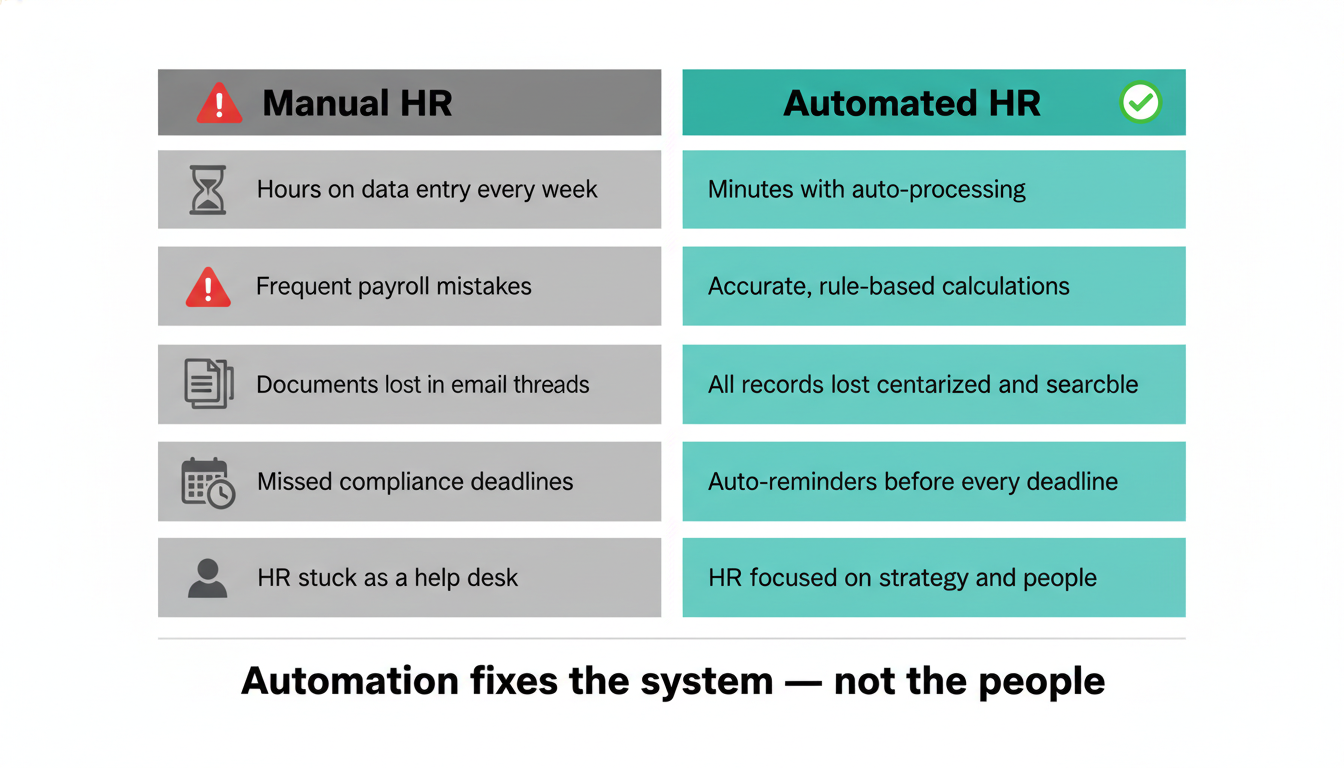
Before automation, HR ran on spreadsheets, email chains, and memory.
Someone had to manually track who showed up late. Someone had to calculate overtime by hand. Someone had to email every new hire their documents one by one.
That someone was usually overworked. And over time, mistakes crept in. Payroll errors. Missed compliance deadlines. Documents lost in email threads.
It wasn’t laziness. It was a broken system. Automation fixes the system, not the people.
How HR Automation Actually Works
At its core, HR automation software connects your people data to actions.
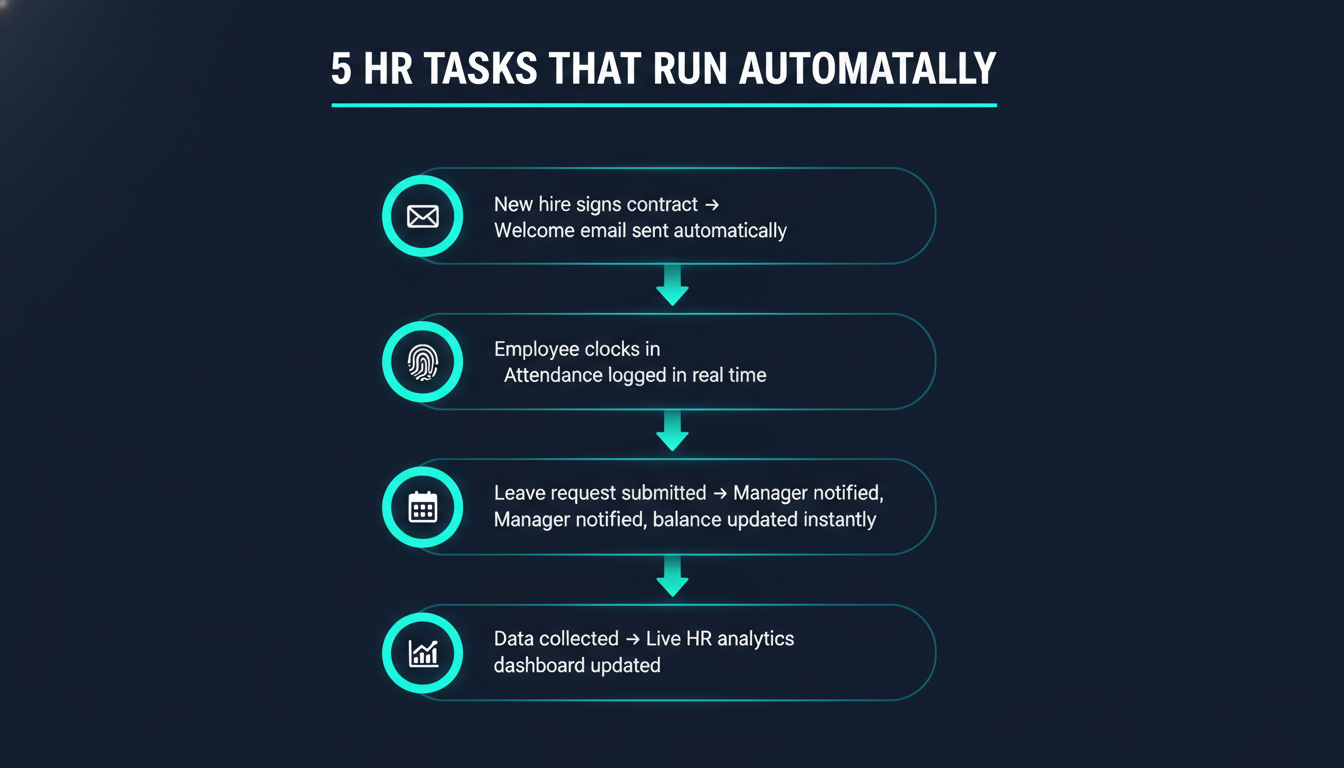
You set the rules once. The system follows them every time. An employee submits a leave request. The system checks the available balance. It notifies the manager. It logs the approval. Done.
No emails. No waiting. No chasing.
It works like a smart assistant that never forgets, never sleeps, and never gets frustrated.
The Core Components of HR Automation Software
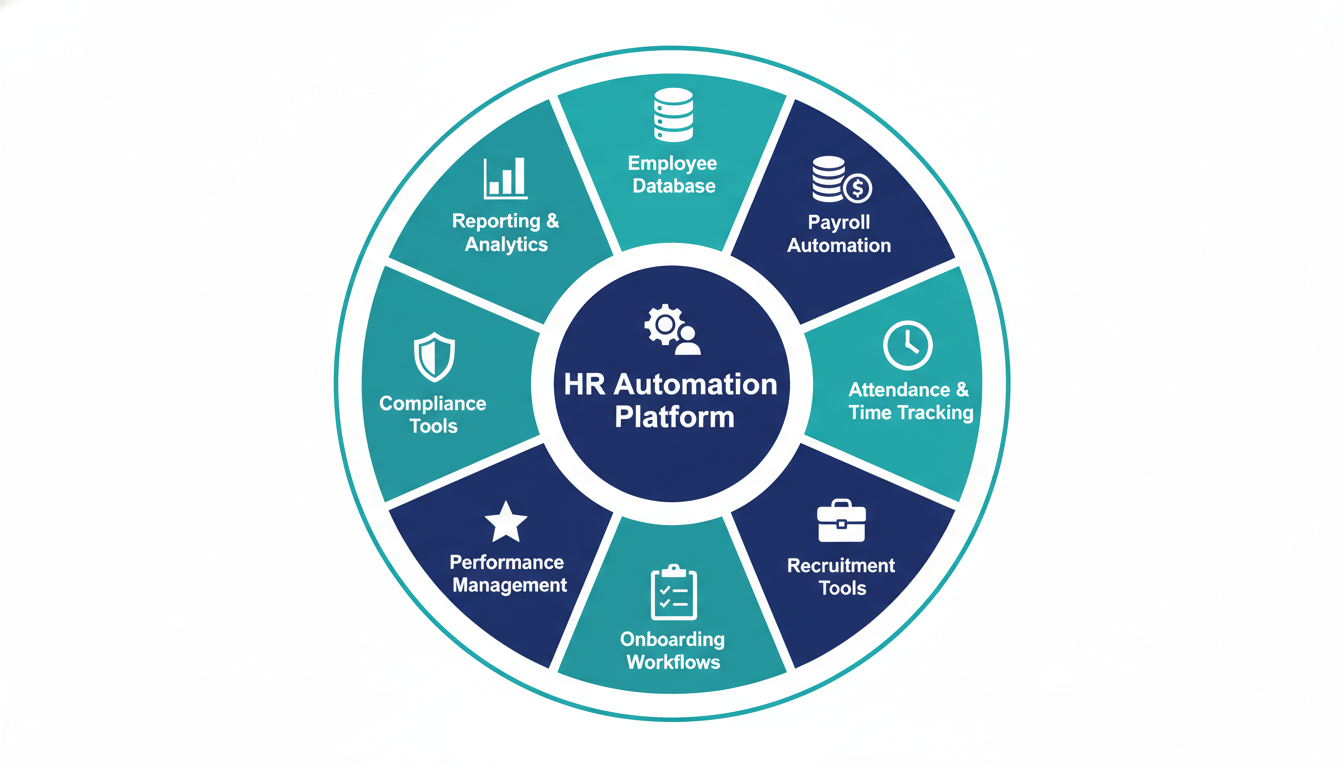
Most HR automation platforms include:
- Employee database management – One place for all staff records
- Payroll automation – Auto-calculate salaries, taxes, deductions
- Attendance and time tracking – Clock-ins, absences, overtime logged automatically
- Recruitment tools – Job postings, application tracking, interview scheduling
- Onboarding workflows – Checklists, document collection, welcome emails
- Performance management – Goal setting, reviews, feedback cycles
- Compliance tools – Auto-reminders for renewals, audits, filings
- Reporting and analytics – Live dashboards, trend data, headcount reports
Each piece connects. Together, they remove the manual load from your HR team.
HR Automation and Employee Onboarding
First impressions stick. A slow, messy onboarding tells new hires what to expect.
With automation, onboarding runs like a well-oiled machine. The new hire gets a welcome email the moment they sign their contract. Documents get sent automatically. A checklist tracks what’s done and what’s next.
Your HR team doesn’t have to babysit the process. The system does. That frees them up to actually welcome the new person instead of chasing paperwork.
This matters more than most companies realise. Research shows that structured onboarding improves new hire retention by over 80%. A smooth start builds trust from day one.
Digital Document Collection and E-Signatures
Gone are the days of printing, signing, scanning, and emailing.
Automated onboarding tools collect documents digitally. E-signature tools let new hires sign contracts from their phones. Everything goes straight into the system.
No paper. No delays. No lost files.
Payroll Processing Gets a Long-Overdue Upgrade
Payroll is probably the most stressful HR task. And the least forgiving.
One mistake and employees notice immediately. Get it wrong twice, and trust starts to erode fast.
HR automation handles payroll calculations with precision. It pulls attendance data, applies leave deductions, adds overtime, applies tax rules, and generates payslips. All automatically. All on time.
This is the kind of relief HR managers describe with a full exhale. No more all-nighters before salary day.
Automated Tax Compliance in Payroll
Tax rules change. Compliance slips. Penalties hurt.
Automated payroll tools stay updated with current tax tables. They apply the right deductions every time. They generate reports for audits without extra effort.
This protects your company. And it takes a massive weight off your HR team’s shoulders.
Leave and Attendance Management Made Simple
Manual attendance tracking is basically archaeology. Someone digs through logs, checks registers, and tries to piece together who was where.
HR automation replaces that with real-time data.
Employees clock in via an app, biometric device, or web portal. The system logs it instantly. Managers see live attendance dashboards. Leave balances update automatically when requests are approved.
Nobody has to chase anyone for a timesheet. The data is just there.
Recruitment Automation: Hire Faster, Hire Smarter
Hiring is expensive. A slow hiring process costs you good candidates.
Recruitment automation speeds things up without cutting corners. Job postings go live across multiple platforms with one click. Applications flow into a central dashboard. The system filters candidates based on your criteria.
You spend time on the best candidates, not on data entry.
Applicant Tracking Systems (ATS) Explained
An ATS is the backbone of recruitment automation.
It stores every application. It tracks where each candidate is in the process. It sends automated status updates to applicants. It schedules interviews without back-and-forth emails.
For candidates, this feels professional. For recruiters, it’s a game-changer. According toSHRM’s research on HR technology adoption, companies using ATS reduce time-to-hire by an average of 30%.
That’s not a small number. That’s a real competitive edge.
Performance Management in the Automation Age
Annual performance reviews are almost universally dreaded. By managers. By employees. By HR.
Automation changes the rhythm. Instead of one big painful review each year, you get continuous feedback cycles. Goals are set in the system. Progress is tracked automatically. Check-ins are scheduled and logged.
Managers stay informed. Employees feel seen. HR has a clean record of everything.
This is what modern performance management looks like. Less guesswork. More data. Better conversations.
360-Degree Feedback Tools
Automated HR platforms make 360-degree feedback easy to run.
The system collects feedback from peers, managers, and direct reports. It compiles results into a readable report. No spreadsheets. No awkward email chains.
Employees get honest, structured feedback. Companies build stronger teams.
HR Automation and Compliance: Staying on the Right Side
Compliance isn’t the sexiest topic. But missing a filing deadline or losing an employee document can cost serious money.
HR automation keeps you covered. It sends reminders before deadlines. It flags expired certifications. It logs every action with a timestamp.
Think of it like a compliance co-pilot. It doesn’t fly the plane. But it makes sure you never miss a critical checklist item.
Labour laws shift. Regulations update. An automated HR system adapts faster than any manual process ever could.
Employee Self-Service Portals: Power Back to the People
How many times does your HR team answer the same question? “How many leaves do I have left?” “Can I get a copy of my payslip?” “When’s my contract renewal?”
Self-service portals end this cycle.
Employees log in and find their own data. Leave balance, payslips, attendance records, tax documents — all accessible without involving HR. They update their own personal details. They apply for leave directly in the system.
HR stops being a help desk. They become a strategy team.
This shift is huge. It gives employees independence. It gives HR professionals their dignity back.
Data and Analytics: HR Finally Gets Smart Insights
What’s your average time-to-hire? What’s your employee turnover rate by department? Where do most performance issues come from?
Most HR teams can’t answer these fast because the data lives in different places.
HR automation consolidates everything. Dashboards show live metrics. Reports are generated in seconds. Trends become visible before they become problems.
This is where HR stops being reactive and starts being strategic.
Workforce planning becomes sharper. Budget decisions get backed by data. Leadership trusts HR more when the numbers are right there.
Small Businesses Can Benefit from HR Automation Too
A lot of small business owners think automation is for big companies. It’s not.
Actually, small teams benefit the most. A 20-person company can’t afford a 5-person HR department. But one person with the right automated tools can manage HR for 50 people effectively.
You don’t need a big budget. You need the right system.
Affordable HR automation platforms now exist for growing teams. They scale as you scale. You pay for what you use.
The question isn’t whether you can afford automation. The question is: can you afford to keep doing it manually?
Common Myths About HR Automation (Busted)
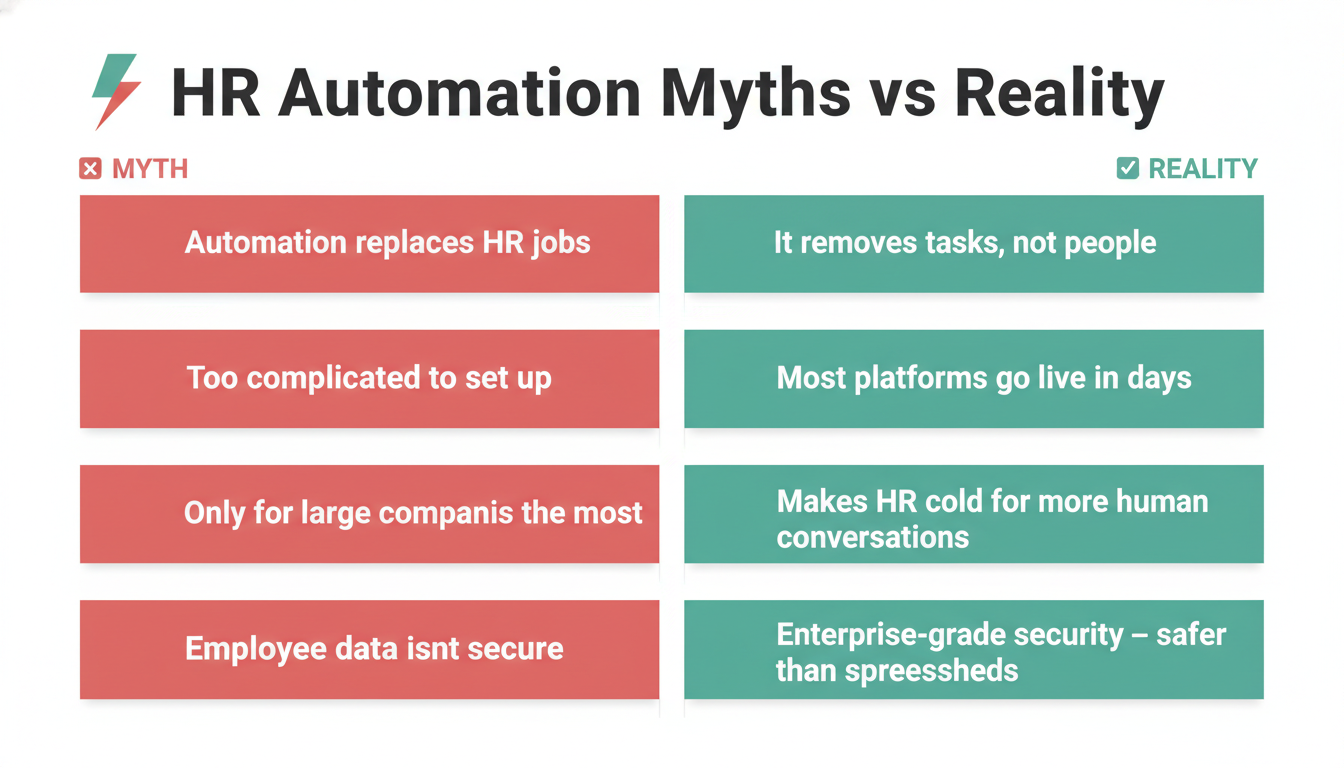
Let’s clear the air. A few myths keep companies from making the move.
Myth 1: Automation will replace HR jobs. Wrong. It removes tasks. HR professionals are still needed for judgment, empathy, and relationships.
Myth 2: It’s too complicated to set up. Modern platforms are designed for non-technical users. Most take days to set up, not months.
Myth 3: It’s only worth it for large companies. As covered above, small teams benefit just as much. Often more.
Myth 4: Automation makes HR feel cold and impersonal. Done right, it does the opposite. It frees HR to have more real human conversations.
Myth 5: The data isn’t secure. Reputable HR automation platforms use enterprise-grade security. Your data is safer than in a shared spreadsheet.
How to Choose the Right HR Automation Software
Not all platforms are equal. Choosing the wrong one wastes time and money.
Start with your biggest pain points. Is it payroll? Recruitment? Attendance? Pick a platform that solves your actual problems, not just the most popular features.
Look for ease of use. If your team won’t use it, it won’t work. A clean interface matters.
Check integration options. Does it connect with your existing tools? Your accounting software? Your communication apps?
Questions to Ask Before You Buy
Before signing up for any HR automation platform, ask these:
- Can it handle our specific payroll rules and local tax requirements?
- Does it scale as our team grows?
- What does onboarding and support look like?
- Is there a mobile app for employees and managers?
- How is data backed up and protected?
- Can we try it before committing?
These questions will save you from buyer’s remorse later.
The Human Side of HR Automation
Here’s the thing people forget. Automation is a tool. Culture is still a human job.
You can automate a performance review form. You can’t automate a manager who actually cares about their team. You can automate payroll. You can’t automate trust.
The best companies use automation to handle the mechanical stuff. They free their people up for the meaningful stuff.
Think of it like electricity in a kitchen. The appliances don’t cook the meal. But without them, cooking takes all day. Automation is the electricity. Your HR team is still the chef.
What the Future of HR Automation Looks Like
HR automation is already impressive. It’s going to get smarter.
AI-powered tools are starting to predict employee turnover before it happens. Smart systems flag burnout signals from attendance and performance patterns. Chatbots handle basic HR queries 24/7 in any language.
The future isn’t just automated. It’s predictive.
HR teams will spend less time solving problems after they happen. They’ll prevent problems before they start. That’s a fundamentally different and far more valuable role.
How Tipsoi Helps You Automate HR the Right Way
Tipsoi was built for teams that are done fighting manual HR processes.
We understand what it feels like to run HR with limited resources. Too many tasks. Too few hands. Too many things that could go wrong.
Tipsoi brings together attendance tracking, payroll, leave management, recruitment tools, and reporting into one clean platform. You get a system that works from day one. Not after months of complicated setup.
We work with teams of all sizes. From small growing businesses to established companies ready to scale smart.
Want to see how it works for your team? Reach out to us directly.
- Phone: +8801600010004
- Email: contact@tipsoi.pro
We’d love to show you what your HR process could look like.
Your HR Team Deserves Better Tools
HR automation isn’t a luxury anymore. It’s the baseline for any serious company.
The old way burns people out. It creates errors. It slows everything down. And it keeps HR stuck doing data entry instead of driving culture and growth.
Automation changes the game. It handles the mechanical work so your people can do the human work.
Your HR team didn’t sign up to manage spreadsheets. They signed up to build great workplaces. Give them the tools to actually do that.
The modern workplace runs on people. And people run better with the right support.
FAQs
1: What tasks can HR automation handle for a small business?
HR automation can manage payroll, attendance tracking, leave requests, onboarding, and compliance reminders. Even a small team sees immediate time savings when these tasks run automatically.
2: Is HR automation software safe for storing sensitive employee data?
Yes. Reputable platforms use encrypted storage, role-based access, and regular backups. Your employee data is typically safer in an automated system than in shared spreadsheets or email.
3: How long does it take to implement an HR automation system?
Most modern platforms take a few days to a few weeks to set up. Cloud-based tools are especially fast. Your team can usually go live within a week if the data is ready.
4: Can HR automation improve the employee experience?
Absolutely. Self-service portals let employees access their own data anytime. Faster onboarding makes new hires feel welcome. Timely payroll builds trust. All of this improves how employees feel about their company.
5: What is the difference between HRMS, HRIS, and HR automation software?
HRIS (Human Resource Information System) stores employee data. HRMS (Human Resource Management System) adds management tools like payroll and scheduling. HR automation software focuses specifically on automating repetitive tasks across these systems. Many modern platforms combine all three