

TL;DR: Workforce management for remote and hybrid teams in Bangladesh means tracking attendance, hours, and output across offices, homes, and field sites from one system. The right software captures mobile check-ins, calculates overtime at the legal 2x rate, keeps you compliant with the Bangladesh Labour Act, and replaces manual spreadsheets. Below is a practical 2026 guide with the features to look for and the rules you must follow.
Managing a team you cannot see in one room is the core challenge of workforce management for remote and hybrid teams in Bangladesh. The answer is a single system that records who is working, from where, for how long, and whether the hours obey the law. This guide covers why hybrid work is growing here, the five problems it creates, the software features that solve them, and how to stay compliant.
2x overtime pay
Mandatory beyond 48 hours a week (Labour Act, Sec. 108).
48-hour week
Standard limit, with a 60-hour hard cap including overtime.
2nd worldwide
Bangladesh is the 2nd-largest global supplier of online workers.
13% more output
Productivity lift from well-run work-from-home (Stanford study).
What is workforce management for remote and hybrid teams in Bangladesh?
Workforce management for remote and hybrid teams in Bangladesh is the practice of tracking attendance, hours, leave, and output when staff are split across the office, home, and field. It combines a mobile time clock, a shared roster, overtime rules, and reporting in one place. The point is visibility without micromanagement.
People often search for “workforce management remote hybrid teams Bangladesh” when they mean one practical thing: a single, trusted record of who worked, from where, and for how long. That record is what the rest of this guide helps you build.
A hybrid team means some staff work in the office some days and remotely on others. A remote team rarely meets in person at all. Both need the same thing: a reliable record of work that everyone trusts. Spreadsheets cannot do this once people scatter.
Why remote and hybrid work is rising in Bangladesh
Remote work in Bangladesh is not a passing trend. The country is the second-largest supplier of online labour in the world, behind only India, according to the Oxford Internet Institute’s Online Labour Index (Dhaka Tribune). Bangladesh leads globally in sales and marketing support services delivered online.
That freelancing base has trained a generation to work from home. Local IT firms, agencies, NGOs, and startups now run hybrid rosters as a norm. The talent pool expects flexibility, and employers who offer it hire faster and keep people longer.
There is a productivity case too. A Stanford experiment with a large call centre found a 13% rise in performance from working from home, driven by fewer breaks and a quieter workspace. Attrition among home workers roughly halved. The lesson is that remote work rewards good management, not the absence of it.
The 5 biggest workforce management challenges for distributed teams
Spreading a team across locations breaks the informal controls of a shared office. Five problems appear fast.
1. No real-time view of who is working
You cannot glance across a room to see attendance. Without a live check-in feed, managers guess. Guessing leads to disputes over hours and quiet absenteeism.
2. Overtime and Labour Act compliance
Remote hours blur. Staff log in early and reply to messages late. Under the Bangladesh Labour Act, work beyond 48 hours a week must be paid at twice the basic rate. Untracked hours become an unpaid liability.
3. Communication that turns into silos
Distance quietly reshapes how teams talk. A study of a large firm in Nature Human Behaviour found remote work made collaboration networks more static and siloed, with less cross-team contact.[1] Managers must design communication on purpose.
4. Productivity that is hard to read
Hours worked and value delivered are not the same. A recent review of post-pandemic remote work confirms outcomes depend on job design and support, not just location.[3] You need output signals, not just login times.
5. Payroll errors from manual data
When attendance lives in scattered sheets, payroll inherits every mistake. One wrong overtime entry multiplies across a pay run. Manual reconciliation eats days each month.
Must-have features in workforce management software
The fix is software that turns location-independent work into clean, auditable data. These are the features that matter for hybrid teams here.
Mobile and GPS attendance
Staff clock in from a phone, with location stamps for field visits. This replaces the office fingerprint reader for people who never enter the office.
Geofencing and face verification
Geofencing limits check-ins to approved zones, like a client site. Face verification stops buddy punching, a known weakness of remote logging. Research on remote work design highlights trust and verification as central concerns.[2]
Automated timesheets and overtime
The system totals hours and flags overtime against the 48-hour rule automatically. It applies the 2x rate so payroll is correct before you run it.
Leave, roster, and shift management
A shared roster shows who is on, off, or on leave across every location. Shift swaps and approvals move through the app, not over scattered chats.
Productivity and payroll integration
Reports surface late arrivals, absence trends, and hours by project. Attendance flows straight into payroll, so one clean dataset drives both.
Manual tracking vs workforce management software
The gap between a spreadsheet and a proper system widens with every remote worker you add. Here is the direct comparison.
| Task | Manual spreadsheets | Workforce management software |
|---|---|---|
| Attendance visibility | End of day, if at all | Real-time, all locations |
| Remote and field check-in | Not possible | Mobile GPS and geofencing |
| Overtime calculation | Manual, error-prone | Automatic at the 2x legal rate |
| Labour Act compliance | Hard to prove | Auditable records on file |
| Payroll accuracy | Depends on retyping | Direct data, no re-entry |
| Time to close a pay cycle | Several days | Hours |
Staying compliant with the Bangladesh Labour Act
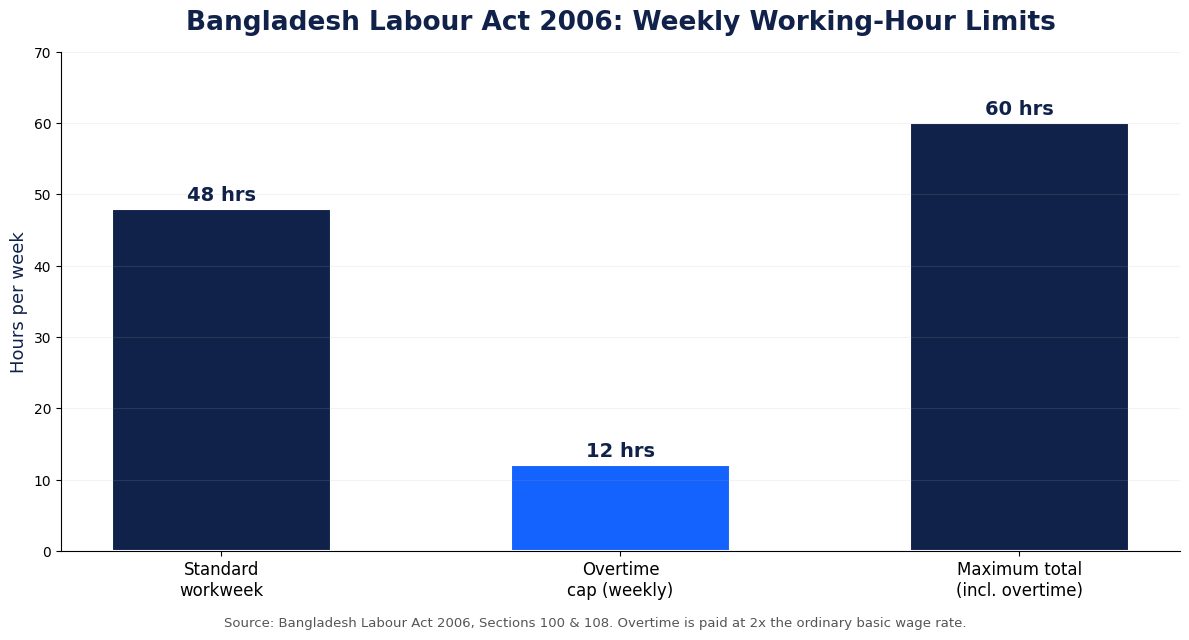
Compliance is where remote hours become a real risk. The Bangladesh Labour Act 2006 sets clear limits, and they apply whether staff sit in the office or at home. A standard workweek is 48 hours, or 8 hours a day across six days.
Overtime is paid at twice the ordinary basic wage under Section 108 (Bangladesh Labour Act 2006, official text). Total hours must not cross 10 a day or 60 a week, and weekly overtime is capped at 12 hours. The chart below shows the three limits at a glance.
Software matters here because it timestamps every hour and stores it. If a labour inspector or an employee questions a pay run, you have the record. In my experience, that audit trail settles disputes in minutes instead of days.
How Tipsoi manages remote and hybrid teams
Tipsoi was built as a workforce management system for Bangladesh SMEs, so these problems shaped the product. Staff check in from a phone with GPS and face verification, or from a device at the office. The same feed covers both.
Overtime is totalled against the 48-hour rule and priced at the legal 2x rate automatically. Attendance flows into payroll without re-entry. For teams weighing hardware against an app, our biometric attendance solution explains where each fits. You can also compare options in our guide to the best HR software in Bangladesh.
Here is my contrarian view. More monitoring is not better management. Surveillance-heavy tools breed distrust and push good people out. You cannot manage what you cannot see, but you also cannot motivate what you only surveil. The goal is clarity and fair pay, not spying.
Frequently asked questions
What is workforce management for remote and hybrid teams?
It is the practice of tracking attendance, hours, leave, and output when staff work across the office, home, and field. Software centralises the data so managers see one accurate record for every worker, wherever they are.
How do you track attendance for remote employees in Bangladesh?
Staff clock in through a mobile app that captures a timestamp and GPS location. Face verification and geofencing confirm the right person checked in from an approved place, which replaces the office fingerprint reader.
Is remote work legal under the Bangladesh Labour Act?
Yes. The Labour Act does not ban remote work. It sets hour limits and overtime pay that apply to all staff, so remote and hybrid hours must be recorded and paid the same way as office hours.
How is overtime calculated for hybrid teams in Bangladesh?
Overtime is any work beyond 48 hours a week or 8 hours a day. It is paid at twice the ordinary basic wage under Section 108. Weekly overtime is capped at 12 hours, and total hours cannot exceed 60 a week.
What features should workforce management software have for hybrid teams?
Look for mobile GPS check-in, geofencing, face verification, automated overtime rules, leave and roster management, and payroll integration. These turn scattered remote work into one clean, auditable dataset.
Can small businesses in Bangladesh afford this software?
Yes. Most systems price per active user, so a small team pays a small monthly fee. The saved payroll hours and avoided overtime errors usually cover the cost within the first pay cycles.