

AI in HR for Bangladesh has moved from a buzzword to a daily tool. Across Dhaka, Chattogram, and Gazipur, HR teams now test chatbots, CV screeners, and payroll bots. I work with HR leaders every week, and the question has changed. They no longer ask if AI in HR matters. They ask what comes next, and how to start without wasting money.
This guide answers both. I will show where the technology stands today. Then what is coming, the honest risks, and a simple first step. My aim is a plan you can act on this quarter, not a wish list for 2030.
Key stats on AI in HR adoption
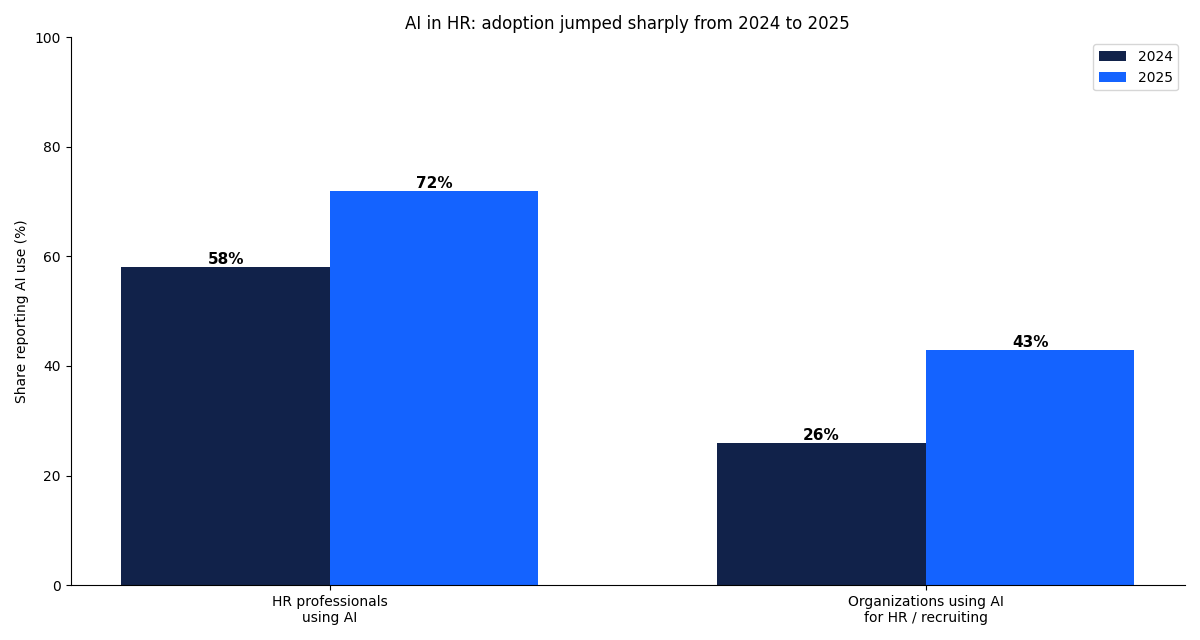
| 72% of HR professionals reported using AI in 2025, up from 58% in 2024. | |
| 43% of organizations used AI for HR and recruiting tasks in 2025, up from 26% in 2024. | |
| Bangladesh backs its 2025 AI strategy with about US$1 billion in funding and 2,500 startups. |
Where AI in HR stands right now
Most Bangladeshi firms already use some form of it, even if they do not call it that. Attendance devices flag odd patterns. Job boards rank applicants. Payroll tools catch errors before payday. These are small wins, but they add up over a year.
Take the garment sector, our largest employer. A single factory may run thousands of workers across shifts. Manual rosters and paper leave slips buckle at that scale. Smart attendance and automated payroll checks remove hours of grind each week. That is a practical entry point, not science fiction. The tools pay back fast at that scale.
Adoption is climbing fast worldwide. Surveys in 2025 showed a sharp jump in how many teams touch these tools. The chart below shows that shift in plain numbers.
Bangladesh is not standing still. The government’s 2025 plan puts real money behind pilots in health, agriculture, and services. That momentum reaches HR too, as detailed in our guide to HR software in Bangladesh.
What AI in HR actually does today
It helps to separate hype from work. Below I map common HR tasks to the manual way and the automated way. The last column shows why it matters for a Bangladeshi team.
| HR task | Traditional way | The AI in HR way | Why it matters here |
|---|---|---|---|
| CV screening | Read every CV by hand | Rank and shortlist in seconds | High applicant volumes for each open role |
| Employee questions | HR answers each query | Chatbot handles leave and policy FAQs | Frees HR from repeat questions |
| Payroll checks | Manual spreadsheet review | Flags errors before payday | Fewer disputes and rework |
| Attrition risk | Notice after people quit | Predicts who may leave | Time to act before exits |
Research backs this split. A systematic review by Vrontis and colleagues found AI mostly augments HR work rather than replacing it.[2] The pattern holds in hiring, onboarding, and analytics, as I explain in our piece on how AI in HR reshapes hiring.
What’s next for AI in HR for Bangladesh
Three shifts stand out for the year ahead. Each is close enough to plan for now, and none needs a research lab.
1. Generative AI moves into daily HR work
Tools like ChatGPT now draft job posts, policies, and replies. A 2023 study on generative AI in HR maps both the gains and the guardrails needed.[3] Expect Bangla language support to improve fast. That will widen access for smaller firms outside the capital.
2. Mobile-first AI reaches frontline staff
Most workers here reach HR through a phone, not a desktop. So the next wave of these tools will live inside mobile apps. Think leave requests, payslips, and quick answers on the factory floor. New features are already arriving, as we cover in what is coming in HR automation.
3. Analytics shifts from reports to decisions
Old dashboards told you what happened last month. The newer systems suggest what to do next. A capability framework by Chowdhury and colleagues shows firms need skills and clean data to reach that stage.[4] Firms that invest early will pull ahead of slower rivals.
The honest risks of AI in HR
Here is my contrarian view. This technology will not fix a broken process. If your leave policy is unclear, a chatbot just spreads that confusion faster. Automate a mess and you get a faster mess.
Bias is the second risk. A screening model trained on old hiring data can repeat old bias. So a human must review the shortlist, not rubber-stamp it. Privacy is the third risk, and it is serious. Sentiment tools can cross a line, which I discuss in our note on ethical AI in HR.
Local research echoes this caution. A 2024 study of HR professionals in Bangladesh found real barriers. Cost, trust, and job-security fears slow uptake.[1] These worries are valid. They are also solvable with clear rules and honest talk with staff.
What AI in HR costs and returns
Price is the first question I hear from owners. The good news is that entry costs have dropped. Many features now sit inside HR software you may already pay for. A chatbot or a smart screener is often a small add-on, not a new system.
Measure the return in saved hours, not magic. If screening drops from two days to two hours, that time funds better interviews. If payroll errors fall, you cut disputes and rework. Track those numbers for one quarter. The case for spending more then makes itself.
Watch the hidden costs too. Clean data takes effort to prepare. Staff need time to learn a new tool. Budget for both, or the promised savings never arrive. A realistic plan beats an optimistic one.
How Bangladeshi businesses can start
You do not need a big budget. Start with one painful task and one tool. Here is the path I recommend to teams.
First, pick a task that eats time and follows rules. CV screening or leave FAQs are good picks. Second, choose a tool that already fits your HR software. Third, run it beside the manual way for one month. Compare results before you trust it.
Fourth, write a short policy on what AI can and cannot decide. Keep a human in the loop for hiring and pay. Fifth, tell staff what the tool does with their data. Trust grows when people are not surprised by it.
One mid-size firm I advised began with leave FAQs alone. The chatbot took over 300 repeat questions a month. HR then used that time for exit interviews they had skipped for years. Small start, real payoff.
Do not forget your people in the rush to buy tools. Give HR staff a few hours of hands-on training. Let them break the tool in a safe test first. Confidence with the system matters as much as the system itself. Skills, not slogans, decide the result. A trained team spots bad output that a rushed one would miss. That habit protects both fairness and trust.
Key takeaways
- AI in HR is already here, mostly augmenting HR work, not replacing it.
- Adoption is rising fast, with 72% of HR professionals using AI in 2025.
- Next up: generative AI, mobile-first tools, and predictive analytics.
- Start small, keep a human in the loop, and be open about data.
- Automation will not fix a broken process, so tidy the workflow first.
Frequently asked questions
Is AI in HR going to replace HR jobs in Bangladesh?
No, not in the near term. It mostly handles repeat tasks like screening and FAQs. That frees HR staff for people work, such as coaching and conflict. Roles will shift toward oversight and judgment.
How much does AI in HR cost for a small business?
Many tools now come inside existing HR software at low extra cost. You can start with one feature, such as a chatbot. Run a one-month trial before you commit. Compare the time saved against the fee.
What is the biggest risk of using AI in HR?
Bias and blind trust are the biggest risks. A model can repeat old hiring bias if left unchecked. Always keep a human reviewing shortlists and pay. Clear rules and data transparency reduce the danger.
Where should a Bangladeshi company start with AI in HR?
Start with one rule-based, time-heavy task. CV screening and leave FAQs are safe first steps. Test the tool beside your manual process for a month. Then expand only if the results hold.
References
- Hossain, M. M. A., & Nahid, M. H. (2024). Artificial Intelligence Adoption Intention among HR Professionals in Bangladesh. https://doi.org/10.1145/3723178.3723267
- Vrontis, D., Christofi, M., Pereira, V., & Tarba, S. Y. (2021). Artificial intelligence, robotics, advanced technologies and human resource management: a systematic review. https://doi.org/10.1080/09585192.2020.1871398
- Budhwar, P., Chowdhury, S., Wood, G., & Aguinis, H. (2023). Human resource management in the age of generative artificial intelligence: Perspectives on ChatGPT. https://doi.org/10.1111/1748-8583.12524
- Chowdhury, S., Dey, P. K., Joel-Edgar, S., & Bhattacharya, S. (2022). Unlocking the value of artificial intelligence in human resource management through an AI capability framework. https://doi.org/10.1016/j.hrmr.2022.100899