

Valid casual leave reasons include a family emergency, a medical or dental appointment, an urgent personal or household matter, a short one- or two-day illness, bereavement, and compensatory rest after overtime. Any genuine short-notice need your leave policy recognizes usually qualifies. Here are 20 reasons HR teams approve fastest, with the exact wording to use.
| Valid casual leave reason | When you would use it |
|---|---|
| Family emergency | Sudden illness or crisis involving a close family member |
| Medical or dental appointment | A doctor, dental, or diagnostic visit you cannot book after hours |
| Short illness (1–2 days) | A minor illness that does not warrant formal sick leave |
| Urgent household repair | Urgent home repairs, maintenance issues, or essential household matters |
| Bank, legal, or government paperwork | Important banking, legal, or government-related paperwork that requires your presence |
| Child’s school emergency | An urgent situation involving your child’s school that requires your immediate attention |
| Bereavement or funeral | Attending a funeral or supporting family after a loss |
| Religious observance | Observing an important religious occasion or obligation |
| Vehicle breakdown | An unexpected vehicle breakdown or urgent vehicle-related issue requiring your attention. |
| Compensatory rest after overtime | Time off after sustained overtime, where company policy allows |
Sometimes an unexpected situation arises, and you need to step away from work. Whether it is a sudden health issue, a family emergency, or an urgent personal matter, casual leave is your go-to option. But what exactly does casual leave mean, and how do you use it without overstepping your workplace policy?
Having the option to take casual leave matters. It gives you the flexibility to manage personal affairs while keeping your professional responsibilities on track, and knowing when and how to request it makes your time away far smoother.
Let’s break down everything you need to know about casual leave, including its meaning, how to apply, and some examples of valid reasons for taking it.
What Is Casual Leave?
Casual leave is short-notice paid time off, usually 1 to 3 days, that employees take for personal matters or emergencies that cannot be scheduled in advance. Under the Bangladesh Labour Act 2006, workers are entitled to 10 days of casual leave per year; entitlements in other countries vary by policy.
As a matter of fact, it’s up to your manager or CEO to decide whether you can take a leave of absence, and they will decide if it’s okay. An individual’s ability to take a leave of absence varies based on the situation and the valid reasons for leave, as well as the rules of the workplace. Casual leave reasons can include family emergencies, personal issues, or health-related problems.
All things considered, you should only take casual leave if you really need it, and you shouldn’t abuse it. By all means, you need to make sure you have a valid reason for casual leave and that you’ve told the right person in advance. If possible, provide the reason for your leave application so that it’s clear and understood.
However, if your organization has an HRMS System or software, you can apply for leave through that system as well. Also, most of the offices now have a biometric authentication system for proper attendance maintenance. So, eventually, it will notify your immediate manager if you haven’t already entered the office premises on time. This ensures that any casual leave request is documented properly and no discrepancies arise.
Casual Leave Policy: How It Works?
A casual leave policy sets how many days you get, how to request them, and what happens to unused leave. Details vary by company, but these six rules appear in almost every policy:
1. Entitlement
Typically 6 to 12 days per year, depending on company size and local law. Under the Bangladesh Labour Act 2006, the entitlement is 10 days. New employees usually get pro-rata leave based on joining date, and some companies restrict casual leave during probation.
2. Duration limit
Usually capped at 2 to 3 consecutive days. Need longer? The absence is counted as earned leave, or as paid or unpaid leave per policy.
3. Notice and approval
Request ahead of time when you can. In a genuine emergency, you can take leave first and inform your manager or HR as soon as possible, then follow up with a formal application. Approval sits with your manager, and employers can decline a request if business needs demand it.
4. How to apply
A short written application or a request through your company’s HRMS or leave portal. Systems keep the approval and your balance on record; verbal requests get lost.
5. Carry forward
Casual leave normally lapses at year-end and does not carry over. Encashment is rare for casual leave; it typically applies to earned leave only.
6. Documentation
Rarely required for 1 to 2 days. Longer or health-related absences may need a doctor’s note, which usually means the request belongs under sick leave instead.
Know these six rules before applying, and your request will move through approval without back and forth.
20 Reasons for Casual Leave
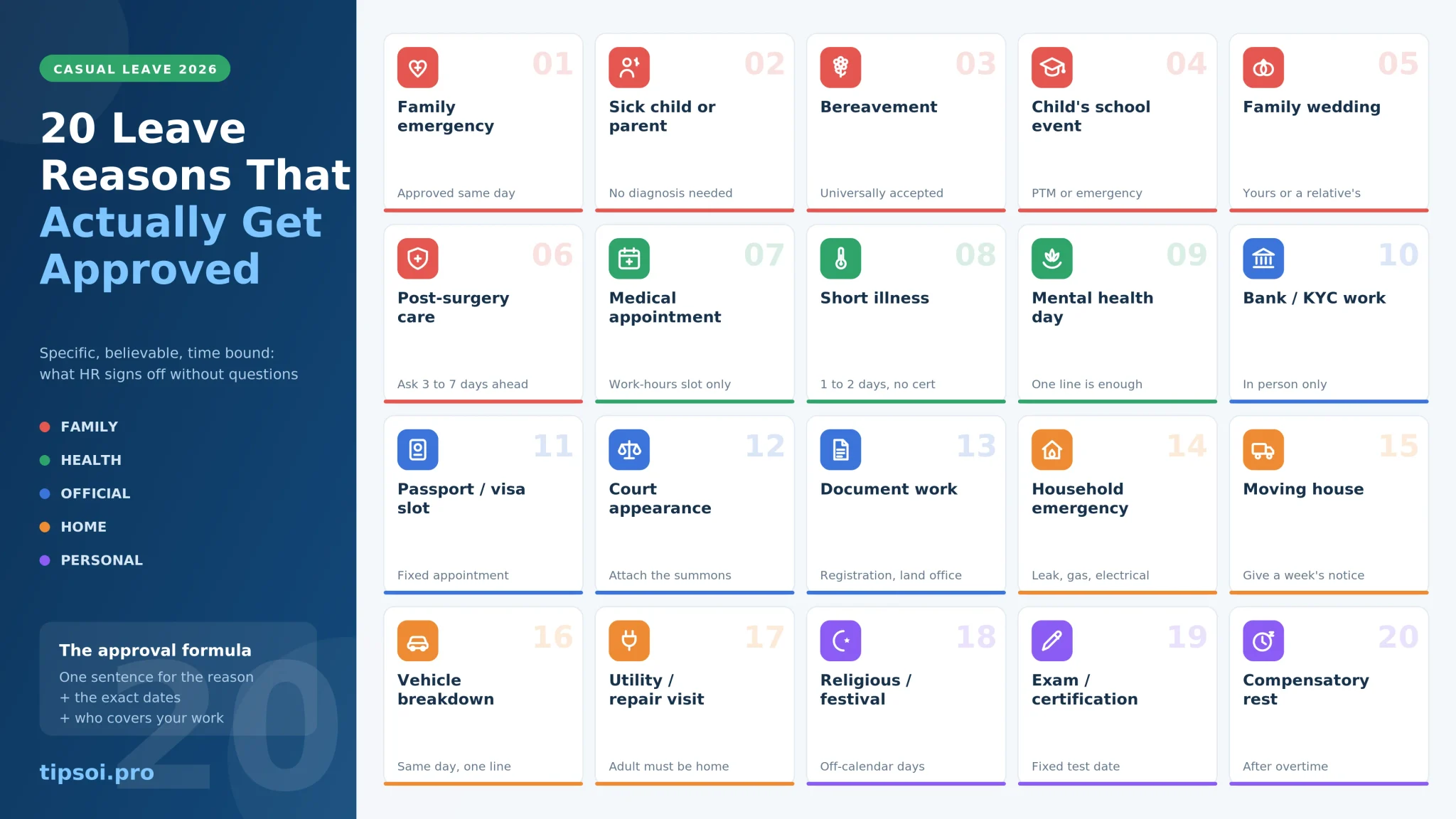
Casual leave covers short-notice personal needs that cannot wait for a scheduled day off. Each company sets its own rules, but in my experience reviewing leave requests, these 20 reasons get approved with the fewest questions because they are specific, believable, and clearly time-bound.
Family and dependents
- Family emergency. A close family member is suddenly ill or hospitalized or just got sick and needs to be taken care of. For example, attending to a sick spouse or parent who requires immediate care. This is the fastest approval on this list; one sentence is enough to get approval.
- Sick child, spouse, or parent. You need to arrange care or be present for a sick child, spouse, or parent. For example, staying home with a child who has a fever or taking a parent to a doctor. No diagnosis or medical details are required.
- Bereavement or funeral. A death in the family requires you to attend a funeral, support relatives, or handle immediate family arrangements. For example, attending the funeral of a parent, sibling, grandparent, or close relative. This can generally be requested for the same day when necessary.
- Child’s school commitment. You need to attend a parent-teacher meeting, admission interview, school appointment, or respond to an emergency call from your child’s school. For example, attending a parent-teacher meeting or going to the school because your child needs to be picked up urgently.
- Family wedding or ceremony. You need to attend your own or a close relative’s wedding, engagement, or important family ceremony. For example, attending your sibling’s wedding or a close family member’s engagement ceremony. Request the leave in advance when the date is known.
- Caring for a family member after surgery. You need to be available at home to care for a close family member during their recovery after surgery. For example, staying home to help a parent or spouse after a surgical procedure. Since this is usually planned, request the leave 3 to 7 days ahead when possible.
Health
- Medical or dental appointment. You have a checkup, diagnostic test, dental appointment, or therapy session that is only available during work hours. For example, attending a doctor’s appointment, dental treatment, blood test, or scheduled diagnostic scan. Provide the appointment date and confirm that your work is covered.
- Short illness (1 to 2 days). You are dealing with a minor personal health issue that needs rest or attention but does not require formal sick leave. For example, a cold, migraine, fever, stomach upset, or minor injury that does not warrant a medical certificate.
- Mental health day. You need a personal day to attend to your health, rest, or recover from temporary stress or exhaustion. For example, taking a day to rest and recover after a particularly demanding period at work. You are not required to provide private medical details; a simple statement such as “I need to take a personal day to attend to my health” is sufficient.
Official errands (easiest approvals; they come with proof)
- Bank work or KYC update. You need to complete a transaction, account service, KYC update, or verification that requires your presence during banking hours. For example, visiting a bank to update KYC information or resolve an account-related issue. Provide documentation if requested.
- Passport, visa, or NID appointment. You have a fixed government appointment for a passport, visa, NID, or related document that cannot reasonably be scheduled outside work hours. For example, attending a passport appointment, visa interview, or NID biometric appointment. Include the appointment date and time on the application.
- Legal or court appearance. You need to attend a court hearing, legal appointment, summons, notarization, or other official legal matter that requires your presence. For example, appearing in court, responding to a legal summons, or attending a scheduled notarization. Attach the relevant document when asked. However, most organizations don’t really ask for it, as it is a personal document.
- Property or document verification. You need to attend property registration, land-office work, tenancy paperwork, or official document verification that requires your presence during government or office hours. For example, visiting a land office for property registration or signing tenancy documents. Provide the appointment or supporting document if needed. Again, these are personal documents that an organization does not ask to see.
Home and logistics
- Household emergency. A water leak, gas issue, electrical fault, or other urgent household problem may require you to stay at home to ensure the repairs are carried out. For example, staying home while a plumber repairs a major water leak or an electrician fixes an urgent electrical fault. State the issue briefly and confirm that your work is handed over to someone eligible among your colleagues.
- Moving house. You need time to move to a new residence or complete essential moving arrangements. For example, coordinating movers, transporting essential belongings, or completing the handover of your current or new home. Give approximately a week’s notice where possible; one to two days is generally sufficient for the move itself.
- Vehicle breakdown or minor accident. Your vehicle has broken down or been involved in a minor accident, and you need to handle the immediate situation. For example, arranging roadside assistance, taking the vehicle to a workshop, or handling the immediate aftermath of a minor accident. For same-day leave, one sentence is enough: “My vehicle broke down; I need to take today as casual leave.”
- Utility or service appointment. An internet installation, appliance repair, utility visit, delivery, or other service requires an adult to be present at home. For example, waiting for an internet technician, appliance repair technician, or essential delivery that requires your presence. Provide the scheduled date and confirm that your work responsibilities are covered.
Personal and religious
- Religious observance or festival. You need time to observe a religious ceremony, ritual, festival, or important religious occasion that is not already covered by the company holiday calendar. For example, attending a religious service, family ritual, or festival celebration. Request the date in advance when it is known.
- Exam or professional certification. You need to attend an examination, professional certification test, licensing exam, or course assessment that takes place during work hours. For example, sitting for a professional certification exam, driving test, or university examination. Provide the exam date and confirm your work coverage.
- Compensatory rest after overtime. You need time off to balance sustained extra working hours or overtime, where company policy permits compensatory leave. For example, taking a day off after working extended hours or several consecutive overtime shifts. Mention the overtime period and the date you are requesting for rest.
One rule ties all 20 together: state the reason in one sentence, name the date, and confirm your work is covered. Vague requests (“personal reasons, 3 days”) invite follow-up questions; any reason above, stated plainly, rarely does.
Personal Leave Reasons List
Personal leave reasons overlap heavily with casual leave: family emergency, medical appointment, sick child or parent, bereavement, urgent bank or government paperwork, household emergency, moving house, religious observance, exam, and a mental health day. The difference is naming: some companies call short-notice time off “casual leave”, others “personal leave”, and many treat them as one bucket. All 20 reasons above are valid under either label; check which term your leave policy uses before you apply.
How to Ask for Casual Leave So It Gets Approved
Knowing how to ask for casual leave the right way makes the difference between instant approval and a pending request with follow-up questions. Whether you are asking for one day of casual leave or two, the same five rules apply in any office:
1. Be honest and specific State your valid reason for casual leave in one sentence, without oversharing. Specific beats detailed.
- “I need to take time off for a family emergency, and I would appreciate your understanding.”
- “I have a doctor’s appointment that I have been waiting for, and it is impossible to reschedule.”
2. Ask politely and professionally A courteous leave request gets read differently. Keep the tone formal even when the reason is personal:
- “I would be grateful if you could approve my leave for [date].”
- “I kindly request your approval for casual leave on [date].”
3. Give notice when you can Casual leave is often unplanned, but even a day’s notice shows consideration and lets your manager adjust the team’s workload. In a genuine emergency, inform your manager or HR as soon as possible and follow up with a formal application.
- “I wanted to inform you in advance that I may need casual leave for [reason] on [date].”
4. State the duration clearly Name the exact dates and your return date. For one day casual leave, say it directly: “I would like to request one day casual leave on [date].”
5. Follow company protocol Submit through the right channel: your HRMS, leave portal, or a formal email, per company policy. Common casual leave reasons for office settings, such as a medical appointment, a family emergency, or urgent banking or government paperwork, move fastest when they arrive through the official process with the dates stated.
- “I have submitted my request via the HR portal, as per our company policy.”
Dos and Don’ts of Asking for Casual Leave
Dos:
- Give Adequate Notice: Plan ahead and inform your manager as early as possible to allow time for adjustments.
- Communicate Clearly: Be upfront about your reason for leave, duration, and any arrangements you have made to manage your responsibilities.
- Follow Company Policy: Familiarize yourself with your organization’s leave protocols, including documentation requirements.
- Show Gratitude: Always thank your manager or HR for considering your request.
- Be Flexible: If possible, offer alternative dates if your request conflicts with work priorities.
Don’ts:
- Wait Until the Last Minute: Avoid eleventh-hour requests unless it is a real emergency.
- Bypass Your Manager: Communicate with your direct supervisor first.
- Be Vague About Details: State the purpose and timeline clearly to avoid misunderstandings.
- Ignore Work Responsibilities: Delegate or finish tasks before you go.
- Demand Approval: Asking for leave is a request, not a right. Stay polite and professional.
Casual Leave vs Sick Leave
| Feature | Casual Leave | Sick Leave |
|---|---|---|
| Purpose | For personal or urgent matters | For health-related issues |
| Documentation | Not always required | Often requires a medical certificate |
| Advance Notice | Recommended if possible, though emergencies occur | May be taken immediately due to sudden illness |
| Approval Process | Subject to company policies and scheduling | Typically straightforward with proper documentation |
| Duration | Typically short-term (a day or two) | Variable based on severity of the illness |
Sample Casual Leave Applications
Here are three ready-to-copy casual leave applications covering the most common situations:
1. Casual Leave Request for Personal Reasons
Subject: Casual Leave Request for Personal Reasons
Dear [Manager’s Name],
I am writing to inform you that I need to take casual leave on [date] due to personal reasons. I will ensure that all my responsibilities are taken care of before my absence. Kindly approve my leave request.
Thank you for your understanding.
Sincerely,
[Your Name]
2. Casual Leave Request for Medical Emergency
Subject: Request for Casual Leave Due to Medical Emergency
Dear [Manager’s Name],
I would like to request casual leave for [date] due to a medical emergency. I am currently unable to attend work but will keep you updated. Please let me know if you require any further details or documentation.
Thank you for your consideration.
Sincerely,
[Your Name]
3. Casual Leave Request for Family Emergency
Subject: Request for Casual Leave for Family Emergency
Dear [Manager’s Name],
I need to take casual leave on [date] due to a family emergency that requires my immediate attention. I apologize for any inconvenience this may cause and will ensure my tasks are covered.
Thank you for your understanding.
Best regards,
[Your Name]
Need the Full Application Format?
Once you have your reason, the application takes two minutes: a formal salutation, the leave type and dates, your reason in one sentence, and a polite request for approval. For ready to copy formats for every situation, including same day emergency requests and email versions, see our full guide: How to Write a Casual Leave Application (With Samples).
Casual leave reasons: quick answers
Casual leave is your safety net in an unpredictable world. It helps maintain work-life balance by allowing you to step away when life throws an unexpected curveball. By following leave request etiquette, understanding your company’s casual leave policies, and providing clear leave reasons, you ensure your time off is smooth and professional.
What does casual leave mean?
Casual leave is short-notice paid time off for genuine personal needs, a family emergency, a medical appointment, or an urgent personal matter, usually taken for one to three days without a long approval process.
What are valid reasons for casual leave?
Widely accepted reasons include a family emergency, a medical or dental appointment, an urgent household or personal matter, a short illness, bereavement, and compensatory rest after overtime.
How much casual leave am I entitled to?
The amount of casual leave you can take varies depending on your company’s policy. Some companies offer a set number of days, while others have a more flexible approach.
Can I apply for casual leave through an HRMS system?
Yes, if your organization uses an HRMS system, you can often apply for casual leave directly through the system, streamlining the request and approval process.
What should I do if my casual leave is urgent?
If your leave is urgent, inform your manager immediately via email or phone. Apologize for the short notice and explain the urgency clearly in your communication.
Can I take casual leave without prior notice?
Yes, you can take casual leave without prior notice if it’s an emergency. However, it’s important to inform your manager or HR as soon as possible via email, phone, or text message, explaining the urgency. Always follow up with a formal application afterward.
What’s the difference between casual leave and sick leave?
Casual leave is taken for personal or urgent matters that are not necessarily health-related, such as family obligations or appointments. Sick leave, on the other hand, is specifically for health-related issues and often requires a medical certificate as proof.
What is a good casual leave reason for one day?
A single-day medical appointment, an urgent household or official errand, or a short family commitment are all strong one-day reasons because they are specific, believable, and clearly time-bound.
What is a valid casual leave reason for the office?
In an office setting, a medical appointment, a family emergency, or an official personal errand (banking, government paperwork) are readily accepted. State the reason briefly and give notice as early as you can.
How many casual leave days do employees usually get?
It varies by company and country, but many employers grant roughly 7 to 12 casual leave days a year; always check your own organisation’s leave policy for the exact entitlement.
References
- Bangladesh Labour Act, 2006, Section 115: Casual Leave (full text, ILO)
- Bangladesh Labour Act, 2006 (official, bdlaws)
- Employee benefits under Bangladesh Labour Act 2006 (Jural Acuity)
- Labor Code of the Philippines, Article 95: Service Incentive Leave (Respicio & Co.)
- Service Incentive Leave Philippines 2026 Guide (Sprout Solutions)
- Minimum leave entitlements across jurisdictions (Lexology)