

Keeping attendance records by hand takes time. It also creates errors. Employees can mark attendance for each other. Papers get lost. Managers spend hours fixing mistakes every month.
Biometric attendance devices solve all of this. They read a part of your body, like your finger or face, and record attendance in seconds. No fake entries. No lost records. Just clean, accurate data every day.
Bangladesh has seen fast growth in biometric attendance system adoption. Offices, factories, schools, and hospitals across the country now use these devices. But there are many types of biometric attendance devices available. Each one works differently and suits different needs.
This guide covers every type of biometric attendance device available in Bangladesh. You will know exactly which one fits your business by the end.
If you want a ready-to-use biometric attendance system with full setup and support in Bangladesh, Tipsoi is the most trusted name to start with.
What Is a Biometric Attendance Device?
A biometric attendance device is a machine that identifies a person using a unique body feature. It can be a fingerprint, face, eye, or palm. The device scans that feature, matches it with saved data, and records the attendance with the exact time.
Every person has a unique body. So the device always knows exactly who walked in. No card can be shared. No one can punch in for a colleague.
How It Works
The process is simple. First, each employee registers their biometric data in the device. This is called enrollment. After that, every time they arrive or leave, they scan their finger or face. The device matches the scan with the saved data and records the time. The whole process takes less than one second.
Why Bangladesh Is Adopting Biometric Systems Fast
Manual attendance registers are still common in many businesses across Bangladesh. But they fail in many ways. Employees mark attendance for absent colleagues. Records are easy to manipulate. Calculating work hours for payroll takes days every month.
Biometric attendance systems remove all of these problems. They are accurate. They are fast. They connect directly to payroll and HR software. That is why so many garment factories, corporate offices, schools, and hospitals in Bangladesh are switching to biometric devices every year.
Main Types of Biometric Attendance Devices Available in Bangladesh
There are six main types of biometric attendance devices used in Bangladesh today. Each type uses a different technology to identify employees.
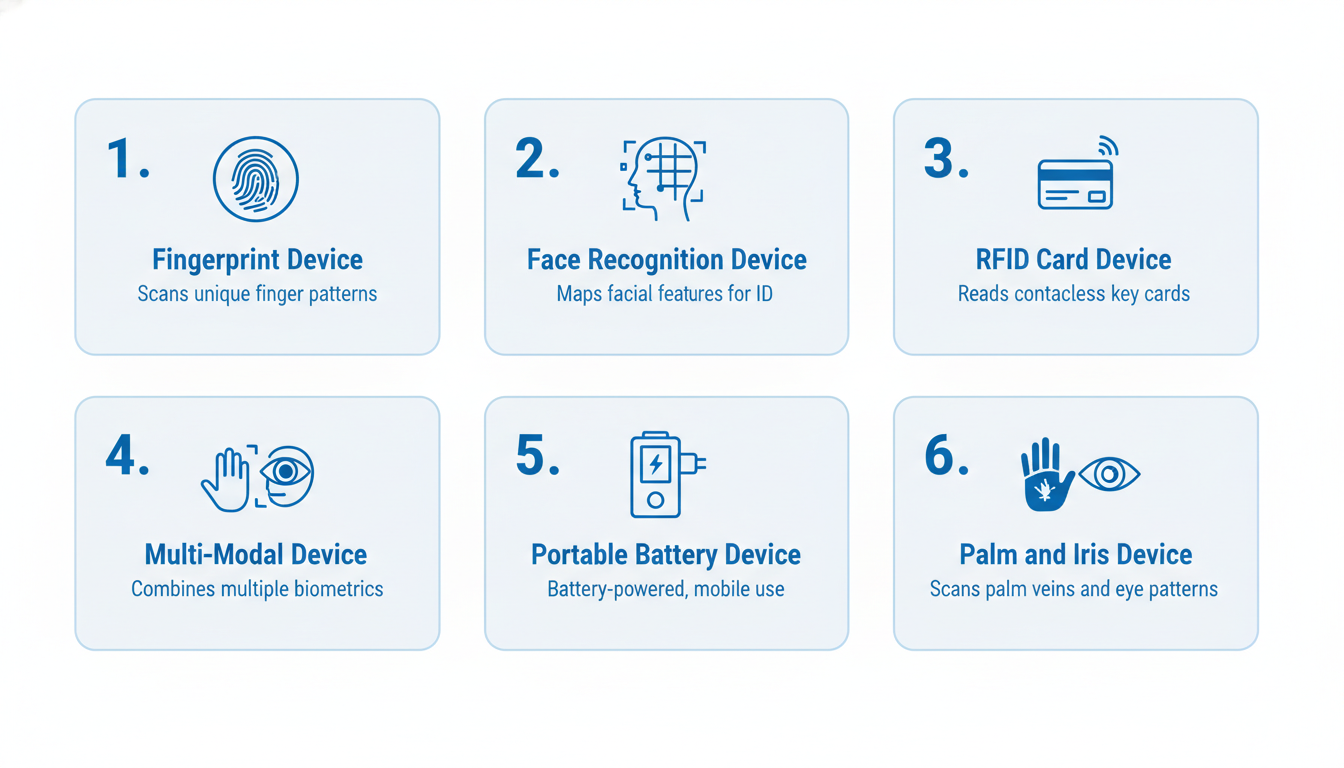
1. Fingerprint Attendance Devices
Fingerprint attendance devices are the most widely used type in Bangladesh. They are affordable, easy to use, and work well for most businesses.
How Fingerprint Devices Work
The device has a small optical or capacitive sensor. When you place your finger on it, the sensor captures the ridge patterns of your fingerprint. It then compares this with the stored fingerprint data. If it matches, attendance is recorded.
The whole scan takes less than one second. Most fingerprint devices can store between 500 and 10,000 fingerprints, depending on the model.
Popular Fingerprint Device Models in Bangladesh
| Model | Brand | Best For |
| Tipsoi Smart Attendance | Tipsoi | All business types with full support |
| ZKTeco K40 | ZKTeco | Small offices |
| ZKTeco F18 | ZKTeco | General office use |
| Realtime T101 | Realtime | Budget offices |
| Hikvision DS-K1T501SF | Hikvision | SME businesses |
Advantages of Fingerprint Devices
Fingerprint devices are the most budget-friendly option. They are simple to install and easy to manage. They work well in most indoor environments. Most models also support TCP/IP connectivity, so attendance data flows directly to your software.
Limitations of Fingerprint Devices
Fingerprint sensors can fail when fingers are wet, oily, or injured. Workers in factories who do manual labor may have worn fingerprints that the sensor struggles to read. In those cases, a different device type works better.
Best For
Small offices, retail shops, garment factories with clean-hand workers, and educational institutions with limited budgets.
2. Face Recognition Attendance Devices
Face recognition attendance devices identify employees by scanning their faces. There is no physical touch needed. This makes them clean, fast, and modern.
How Face Recognition Works
The device has a camera and a built-in AI chip. When an employee stands in front of the device, the camera captures their face. The AI maps facial features like the distance between eyes, nose shape, and jawline. It then matches this map with the saved face data and records attendance.
Most good face recognition devices work even in low light or with glasses on.
Why Face Recognition Became Popular in Bangladesh
After COVID-19, many businesses in Bangladesh wanted touchless attendance solutions. Face recognition devices solved this perfectly. Employees do not touch anything. The device marks attendance automatically as they walk past. This is hygienic and fast.
Popular Face Recognition Models in Bangladesh
| Model | Brand | Key Feature |
|---|---|---|
| Tipsoi Smart Attendance | Tipsoi | Face recognition + cloud sync + complete solution |
| ZKTeco UFace800 | ZKTeco | Face + fingerprint combo |
| Hikvision DS-K1T671M | Hikvision | Very fast recognition |
| Realtime FT100 | Realtime | Good for medium offices |
| Anviz FacePass 7 | Anviz | Stylish design |
Advantages of Face Recognition Devices
They are contactless, hygienic, and very fast. Many models can recognize faces in under half a second. They work well for high-traffic entry points where employees rush in at the same time.
Limitations of Face Recognition Devices
Face recognition devices cost more than fingerprint devices. They need decent lighting to work accurately. Direct sunlight can sometimes interfere with the camera sensor.
Best For
Corporate offices, hospitals, clinics, schools, and any place where hygiene and a professional image matter.
3. RFID Card-Based Attendance Devices
RFID card-based devices use a card instead of a body part. Each employee gets a card. They tap it on the device when they arrive or leave.
How RFID Works
RFID stands for Radio Frequency Identification. Each card has a small chip inside it. The device sends out a radio signal. When the card comes close, the chip responds and sends the employee ID to the device. The device then records the attendance. You do not need to swipe or insert the card. Just bring it close.
Popular RFID Device Models in Bangladesh
| Model | Brand | Key Feature |
| Tipsoi Smart Attendance | Tipsoi | RFID + face + cloud sync + complete solution |
| ZKTeco SC700 | ZKTeco | RFID + PIN support |
| Realtime B10C | Realtime | Simple and reliable |
| Hikvision DS-K1T501SF | Hikvision | Card + fingerprint combo |
Advantages of RFID Card Devices
RFID devices are very fast. They can process hundreds of employees quickly. They work well when fingerprint scanning is not practical, such as for workers with rough or dirty hands. They are also easy to set up and manage.
Limitations of RFID Card Devices
Cards can be shared. One employee can give their card to another. This defeats the purpose of attendance tracking. For this reason, many businesses use RFID cards together with a fingerprint or PIN for two-factor authentication.
Best For
Factories, warehouses, construction sites, and large workplaces where employees punch in and out in large groups.
4. Multi-Modal Biometric Devices
Multi-modal biometric devices use more than one method to identify a person. For example, a device might use both fingerprint and face recognition. Or it might combine an RFID card with a PIN.
How Multi-Modal Devices Work
The device stores multiple types of biometric data for each employee. During check-in, it may ask for two factors, such as a fingerprint scan followed by a face scan. Or it may allow any one of the registered methods. The system is flexible and very accurate.
Why Multi-Modal Devices Offer Better Security
When a device uses two methods, it is much harder to fool. Even if someone tries to fake a fingerprint, the face scan will catch the mismatch. If an employee injures their finger, they can use their face instead. Multi-modal devices offer both high security and flexibility at the same time.
Popular Multi-Modal Models in Bangladesh
| Model | Brand | Modes Supported |
| Tipsoi Smart Attendance | Tipsoi | Face + fingerprint + card + PIN + cloud |
| ZKTeco ProFace X | ZKTeco | Face + fingerprint + card + PIN |
| Virdi UBio-X Pro | Virdi | Face + fingerprint |
| Suprema BioStation 2 | Suprema | Face + fingerprint + card |
| Anviz W2 Pro | Anviz | Face + fingerprint + card |
Tipsoi is the top choice for multi-modal biometric attendance in Bangladesh. Their system supports face recognition, fingerprint, RFID card, PIN, and cloud-based attendance management in one complete package. Unlike other devices that only give you hardware, Tipsoi gives you the full solution. This includes the device, software, payroll integration, and local support. For businesses in Bangladesh that want a reliable multi-modal system without the hassle of setup, Tipsoi is the smartest choice.
Advantages of Multi-Modal Devices
They offer the highest accuracy and security. They are flexible because employees can use whichever method works for them. They work well in high-security environments where a single method is not enough.
Limitations of Multi-Modal Devices
They cost significantly more than single-mode devices. Setup and management are also more complex. They are not the right choice for a small office with a tight budget.
Best For
Banks, corporate head offices, data centers, embassies, and any organization that needs tight access control and accurate attendance data.
5. Portable and Battery-Backup Biometric Devices
Portable biometric devices are designed for places where power is not always available or where attendance needs to be taken at different locations.
Why This Type Matters in Bangladesh
Load shedding is still a real challenge in many parts of Bangladesh, especially in rural areas and industrial zones. A standard biometric device stops working when the power goes out. A portable or battery backup device keeps running. No attendance data is lost.
Field teams, construction projects, and businesses with multiple locations also benefit from portable devices. HR officers can carry the device to different sites and take attendance directly.
Popular Portable and Battery-Backup Device Models in Bangladesh
| Model | Brand | Key Feature |
| Tipsoi Smart Attendance | Tipsoi | Portable + battery backup + cloud sync + full support |
| ZKTeco MB360 | ZKTeco | Built-in battery backup |
| Realtime T301 | Realtime | Portable, good for field |
| ZKTeco P160 | ZKTeco | Handheld biometric device |
Tipsoi is the best portable biometric attendance solution for businesses in Bangladesh. Their system works during power cuts and syncs attendance data to the cloud automatically when the connection is restored. No data is ever lost. Other devices only give you the hardware. Tipsoi gives you the full package including device, software, and ongoing local support across Bangladesh.
For field teams, remote sites, or offices in load-shedding areas, Tipsoi is the most complete and reliable choice available in Bangladesh today.
Advantages of Portable Devices
They keep working during power cuts. They can be used at multiple locations. Field teams can carry them anywhere. They offer the same accuracy as fixed devices.
Limitations of Portable Devices
Battery life is limited. They need regular charging. Storage capacity may be lower than fixed devices. They are also slightly more expensive than basic fixed fingerprint devices.
Best For
Construction sites, field operations, businesses in areas with frequent load shedding, and organizations with employees spread across multiple locations.
6. Palm Vein and Iris Recognition Devices
These are the most advanced biometric attendance devices available. They use very precise body features that are impossible to fake.
How Palm Vein and Iris Devices Work
Palm vein devices use infrared light to scan the vein patterns inside your palm. No two people have the same vein map. Even identical twins have different vein patterns. Iris devices scan the colored ring around your eye. The pattern there is also completely unique to each person.
Both methods are contactless, extremely accurate, and very secure.
Availability in Bangladesh
Palm vein and iris recognition devices are not yet common in Bangladesh. They are expensive and are mostly used in very high-security environments. Brands like Fujitsu and Iris ID offer these devices. Some government offices and research institutions in Bangladesh have started using them.
Best For
Government buildings, banks, research centers, and any location where the highest level of security is required.
Comparison of All Biometric Attendance Device Types
Here is a quick comparison of all six types to help you decide.
| Device Type | Technology | Price Range (BDT) | Touch Required | Best Use |
| Fingerprint | Fingerprint scan | 3,000 to 15,000 | Yes | Small office, retail |
| Face Recognition | Camera + AI | 8,000 to 35,000 | No | Corporate, hospital |
| RFID Card | Radio frequency | 3,500 to 12,000 | No | Factory, warehouse |
| Multi-Modal | Finger + Face + Card | 15,000 to 60,000 | Optional | Bank, high security |
| Portable/Battery | Fingerprint + battery | 6,000 to 20,000 | Yes | Field work, remote sites |
| Palm/Iris | Vein or eye scan | 50,000 and above | No | Government, research |
Fingerprint vs Face Recognition: Which Is Better?
Both are good. But they suit different situations.
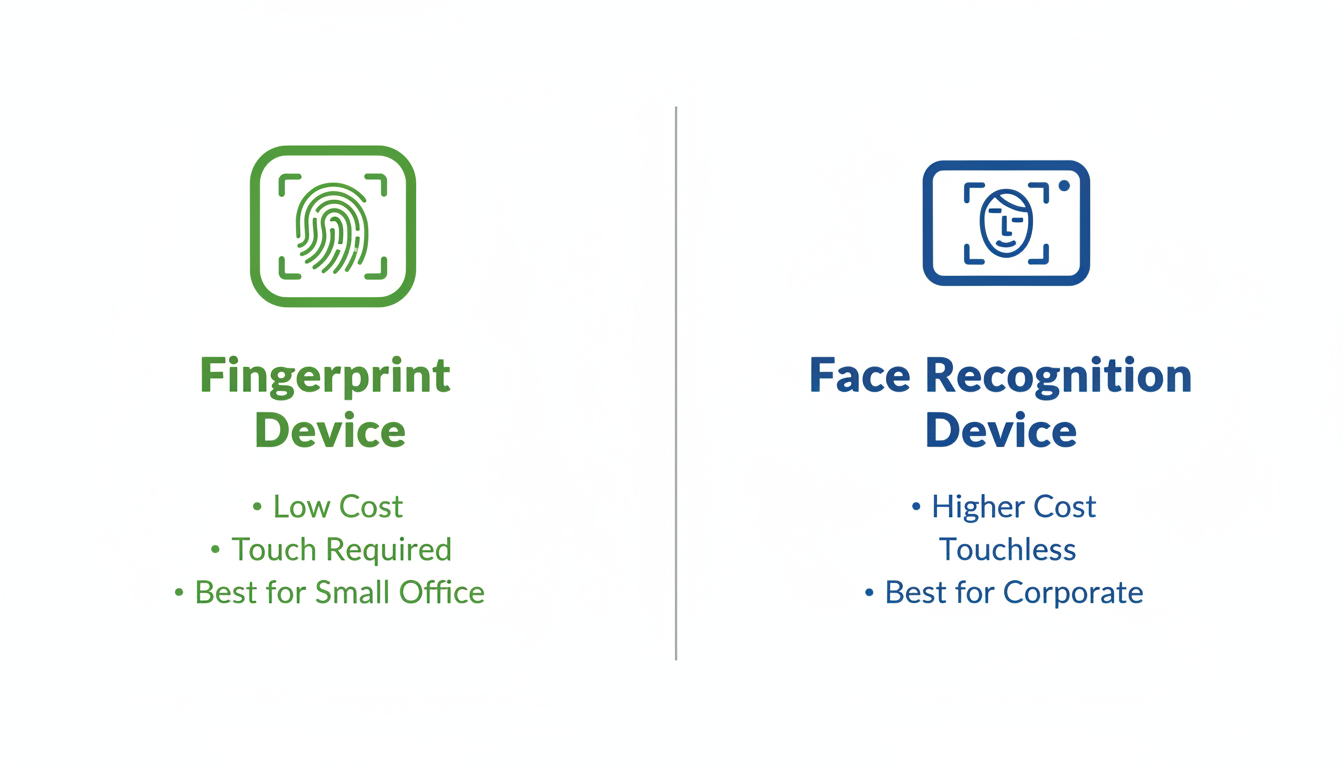
Fingerprint devices cost less and are easier to find in Bangladesh. They work well for most offices. But they require touch and can fail if fingers are wet or worn.
Face recognition devices cost more but offer a touchless experience. They are faster for large groups. They look more professional. In hospitals or schools where hygiene matters, face recognition is the better choice.
If budget is your main concern, go with a fingerprint device. If you want a modern, touchless system, face recognition is worth the extra cost.
Single-Mode vs Multi-Modal: What Should You Choose?
Single-mode devices are simpler and cheaper. They work perfectly for most small and medium businesses. A fingerprint device or a face recognition device alone is enough for most offices in Bangladesh.
Multi-modal devices are for organizations that need tight security. They are more accurate and harder to bypass. But they cost more and require more setup time.
For most businesses in Bangladesh, a single-mode fingerprint or face recognition device is enough. Only go multi-modal if security is a top priority for your organization.
Which Biometric Device Is Right for Your Business?
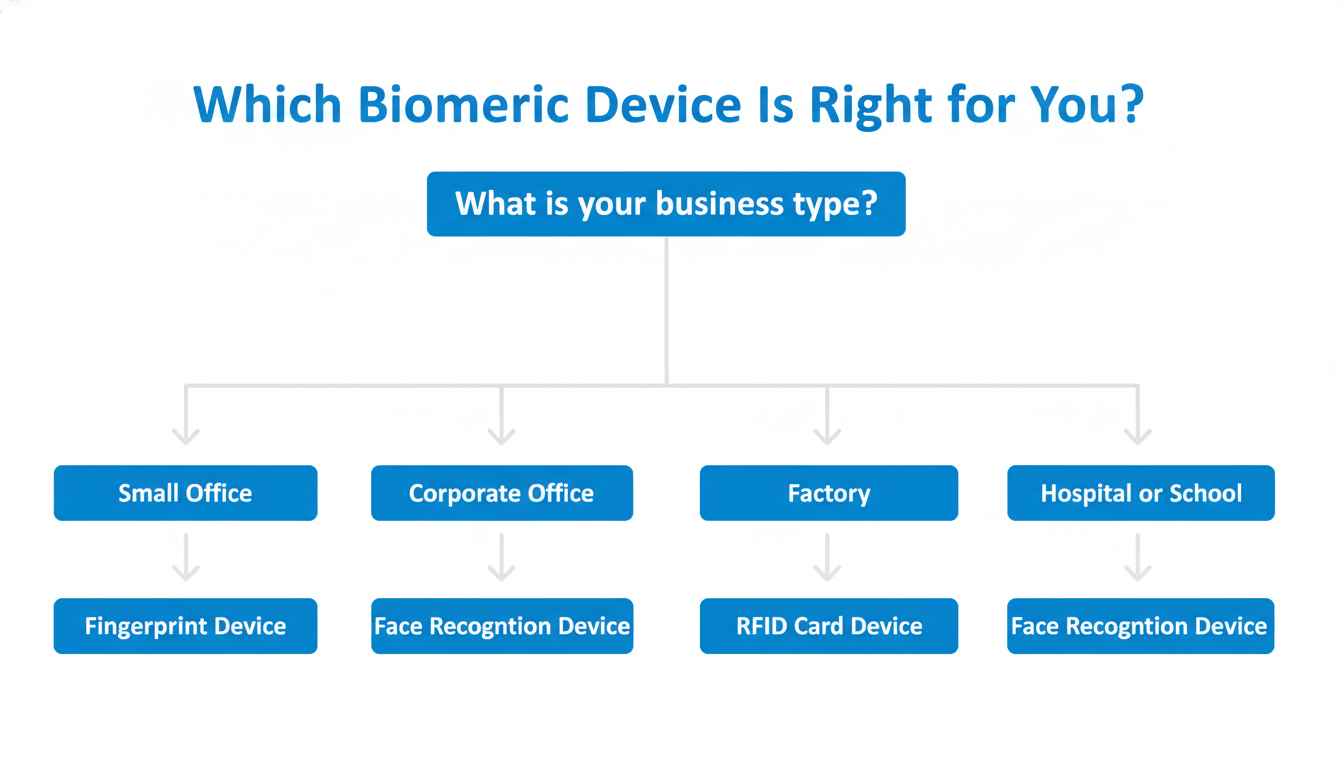
Small Offices and Retail Shops
A basic fingerprint device is the right choice. It is affordable, easy to install, and does the job well. Devices like ZKTeco K40 or Realtime T101 are great starting points. You do not need anything complex for a team of under 50 people.
Corporate Offices and MNCs
Go with a face recognition or multi-modal device. It looks professional, handles large teams, and integrates easily with HR and payroll software. Devices like ZKTeco UFace800 or Virdi UBio-X Pro work very well in these environments.
Factories and Industrial Businesses
RFID card devices or rugged fingerprint devices are the best fit. Workers in factories often have rough hands or wear gloves. RFID cards do not require physical contact and are very fast for large groups. Look for devices that are dustproof and can handle industrial environments.
Schools, Hospitals, and Institutions
Face recognition devices are the best option. They are touchless, hygienic, and easy for students and patients to use. They also work quickly during busy entry periods. Hikvision and ZKTeco have good models for these institutions.
Businesses in Load-Shedding Areas
Choose a device with a built-in battery backup. This ensures attendance is recorded even during power cuts. ZKTeco MB360 is a popular choice for this use case in Bangladesh.
Popular Biometric Attendance Brands in Bangladesh
Tipsoi
Tipsoi is one of the most trusted biometric attendance solution providers in Bangladesh. Unlike device-only vendors, Tipsoi provides a complete system. This includes the device, attendance management software, payroll integration, and after-sales support. Businesses across Bangladesh use Tipsoi for its reliability and local support.
If you are looking for a complete biometric attendance system in Bangladesh, Tipsoi is the best place to start. They help you choose the right device, set it up, and keep it running.
ZKTeco
ZKTeco is the most widely available biometric brand in Bangladesh. They offer all types of devices, from basic fingerprint machines to advanced multi-modal systems. Their devices are reliable, affordable, and backed by a wide dealer network across the country.
Realtime
Realtime is a budget-friendly brand popular among small businesses in Bangladesh. Their devices offer good value for money. They are simple to use and maintain. Popular models include T101, T301, and FT100.
Hikvision
Hikvision is known for its strong focus on face recognition and security cameras. Their biometric devices are well-built and trusted by financial institutions including Bangladesh Bank regulated organizations. They are a good choice for businesses that want both attendance and security in one ecosystem.
Virdi and Suprema
These are premium brands used in high-security environments. Virdi and Suprema devices offer very high accuracy and advanced features. They cost more but are worth it for banks, embassies, and corporate head offices that need the best performance.
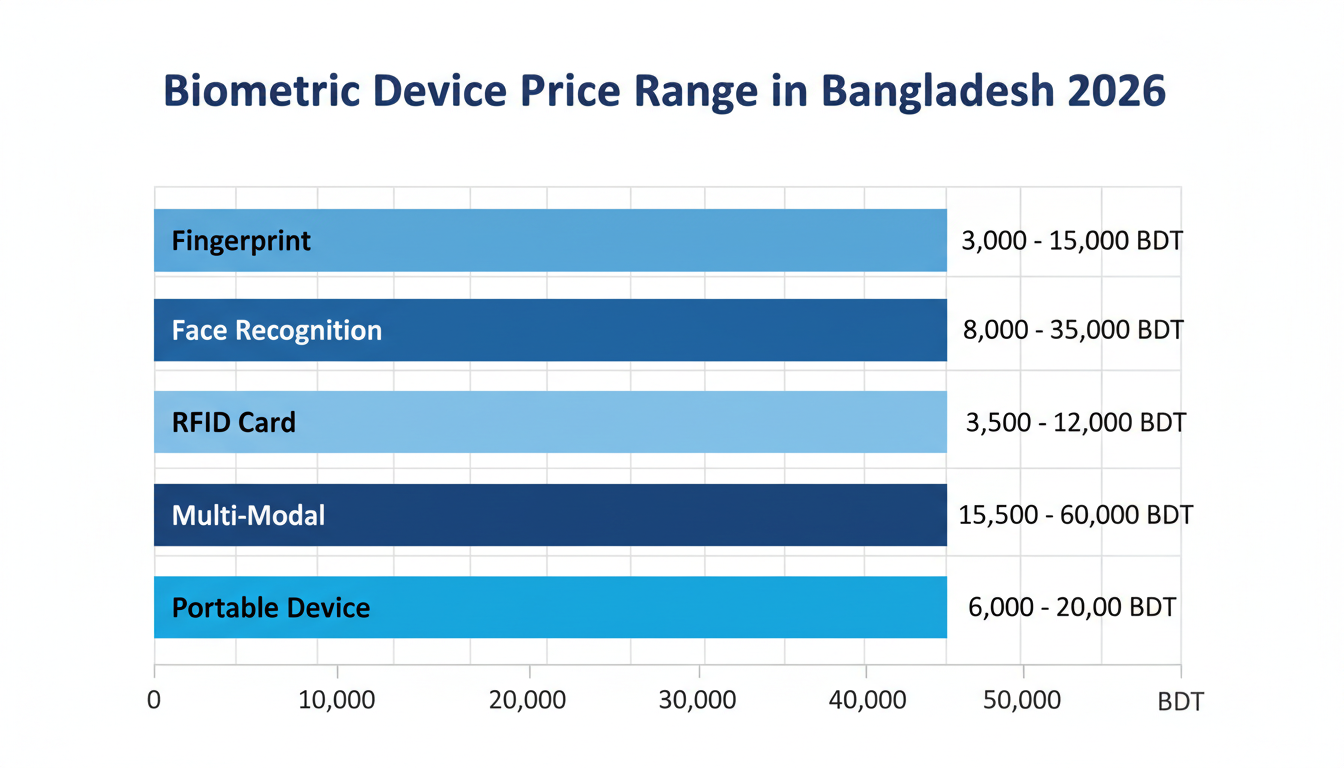
Price Range of Biometric Attendance Devices in Bangladesh (2026)
Fingerprint Devices
Basic fingerprint devices start from around BDT 3,000. Mid-range models with better storage and connectivity cost between BDT 6,000 and 12,000. Premium fingerprint devices can go up to BDT 15,000.
Face Recognition Devices
Entry-level face recognition devices start from around BDT 8,000. Good quality mid-range models cost between BDT 15,000 and 25,000. High-end face recognition systems cost BDT 30,000 to 35,000 and above.
Multi-Modal Devices
Multi-modal devices start from around BDT 15,000 for basic models. Good quality systems cost between BDT 25,000 and 40,000. Premium brands like Suprema and Virdi can cost BDT 50,000 to 60,000 or more.
Portable and Battery-Backup Devices
Portable biometric devices cost between BDT 6,000 and 20,000, depending on brand and features.
Palm Vein and Iris Devices
These advanced devices start from BDT 50,000 and can go much higher depending on the specifications.
Key Features to Check Before Buying a Biometric Attendance Device
Connectivity Options
Check whether the device supports TCP/IP, Wi-Fi, or cloud connectivity. TCP/IP is standard and reliable. Wi-Fi gives you more flexibility in placement. Cloud-based devices let you access attendance data from anywhere, which is useful for businesses with multiple branches.
User Capacity and Storage
Make sure the device can handle your team size. A small office device may store 500 to 1,000 users. For a factory or large organization, you need a device that stores 5,000 to 10,000 users or more.
Power Backup
If your area experiences load shedding, choose a device with a built-in battery backup. Most battery-backup models can run for several hours on a single charge.
Durability
For factories and outdoor environments, look for devices with an IP rating. This tells you how well the device handles dust and water. A device with an IP65 rating or higher is suitable for industrial use.
Software and Payroll Integration
Most biometric devices come with free attendance software. But check if that software can integrate with the payroll or HR system your business already uses. Good integration saves hours of manual data entry every month.
Software and Integration with Biometric Attendance Systems
A biometric device alone is only half the solution. The other half is the software that manages the data.
Most devices in Bangladesh come with basic attendance software. This software shows who came in, at what time, and how many hours they worked. More advanced software can calculate overtime, generate reports, and connect to payroll systems.
Cloud-based attendance systems are becoming popular in Bangladesh. They let managers check attendance from their phone from anywhere. They also remove the need for a local server.
Tipsoi offers a complete biometric attendance system with integrated software and payroll support. Their system is designed for Bangladeshi businesses and follows local labor law requirements. You can learn more about their full solution at Tipsoi Biometric Attendance System in Bangladesh.
Where to Buy Biometric Attendance Devices in Bangladesh
Online Options
You can find biometric devices on Daraz and other local e-commerce platforms. This is convenient but risky if you do not know what to look for. Many listings do not include after-sales support or genuine warranties.
Offline Dealers
Authorized dealers across Dhaka, Chittagong, Sylhet, and other major cities sell biometric devices. Visiting a dealer allows you to see the device before buying and ask technical questions.
Solution Providers Like Tipsoi
The best option for most businesses is to buy from a complete solution provider. A provider like Tipsoi does not just sell you a device. They assess your needs, recommend the right device, install it, configure the software, and provide ongoing support. This is much better than buying a device alone and figuring out the setup yourself.
Conclusion
There are many types of biometric attendance devices available in Bangladesh. Each one suits a different need, budget, and environment.
Fingerprint devices are the best starting point for small businesses. Face recognition is ideal for corporate offices and hygiene-sensitive environments. RFID cards work well for factories and large teams. Multi-modal devices give the highest security for high-risk locations. Portable devices solve the load-shedding problem. And palm vein or iris devices are the future for ultra-secure facilities.
The right device depends on your team size, your budget, your location, and how you want to manage your attendance data.
If you want expert help choosing and setting up the right biometric attendance system for your business in Bangladesh, Tipsoi is the most reliable partner to work with. They provide complete solutions with full local support.