
Introduction to Biometric Attendance for RMG Factories in Bangladesh
Running a garment factory in Bangladesh is hard work. You have hundreds or even thousands of workers coming in every day. Keeping track of who came, who left, and how many hours they worked is a big job.
That is where biometric attendance for RMG factories comes in.
What Is a Biometric Attendance System
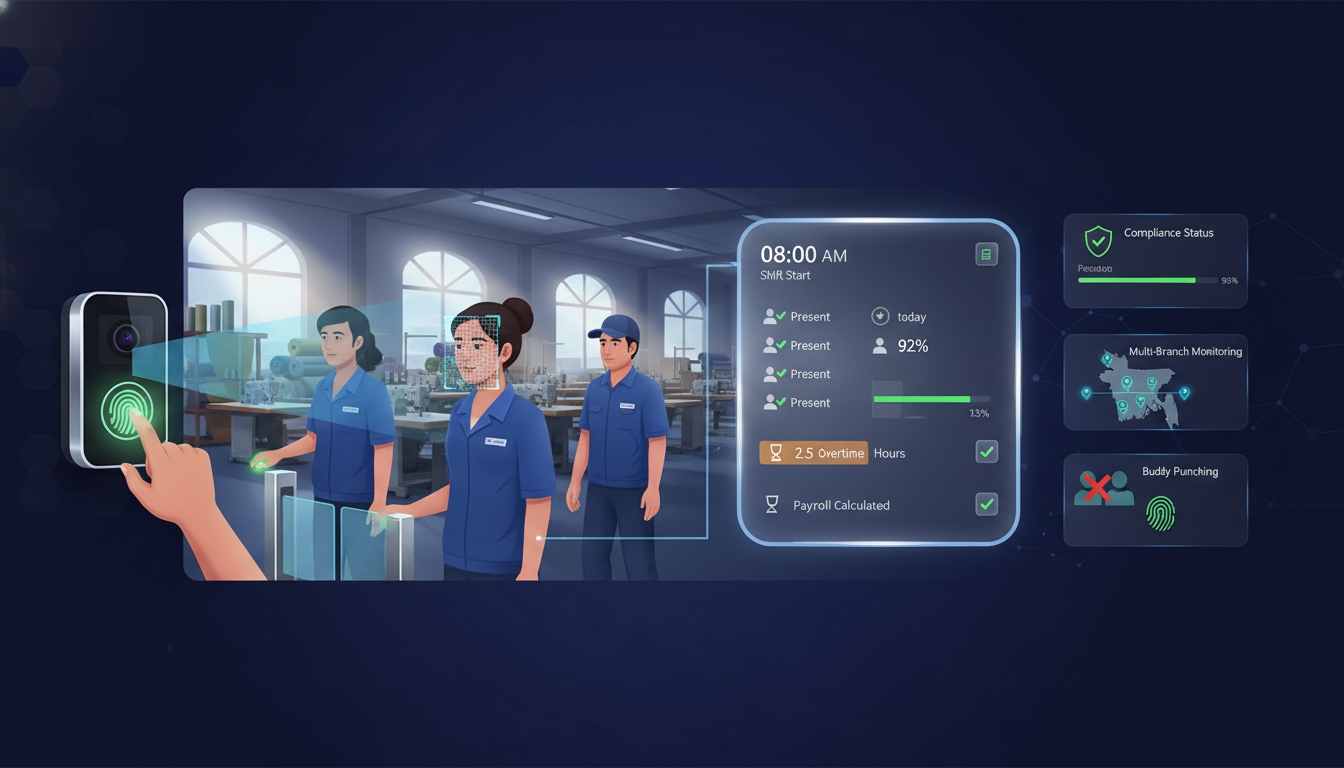
A biometric attendance system is a machine that knows who you are by your body. It can read your fingerprint, scan your face, or look at your eyes. When a worker touches the machine or stands in front of it, the machine saves their name and the time they arrived.
No cards. No paper. No guessing.
The machine stores all this data. Your HR team can then see who came on time, who was late, and how many hours each worker completed.
Why Biometric Systems Are Essential in the RMG Sector
Bangladesh has over 4,000 active garment factories. These factories employ millions of workers. Managing attendance with paper sheets or punch cards creates many problems.
Workers can ask a friend to sign in for them. Papers get lost. Payroll mistakes happen. Auditors find errors.
A biometric attendance system fixes all of these problems. It gives you clean, honest data every single day.
Buyers from Europe and the USA now ask for proof that factories treat workers fairly. Accurate attendance records are part of that proof.
Overview of Workforce Challenges in Garment Factories
Garment factories face some tough daily challenges:
- Thousands of workers across multiple floors and shifts
- High worker turnover makes record-keeping messy
- Night shifts and overtime are hard to track manually
- Payroll errors lead to worker complaints and strikes
- Auditors from BGMEA, Accord, and buyers need accurate data
Biometric attendance systems solve these challenges with simple, automatic record-keeping.
Key Benefits of Biometric Attendance Systems for RMG Factories
Compliance and Audit-Readiness with BGMEA and Global Standards
When auditors visit your factory, they ask for attendance records. They want to know if workers got their proper hours, rest days, and overtime pay.
A biometric system gives you clean digital records ready to show in seconds. You do not need to search through old papers or notebooks.
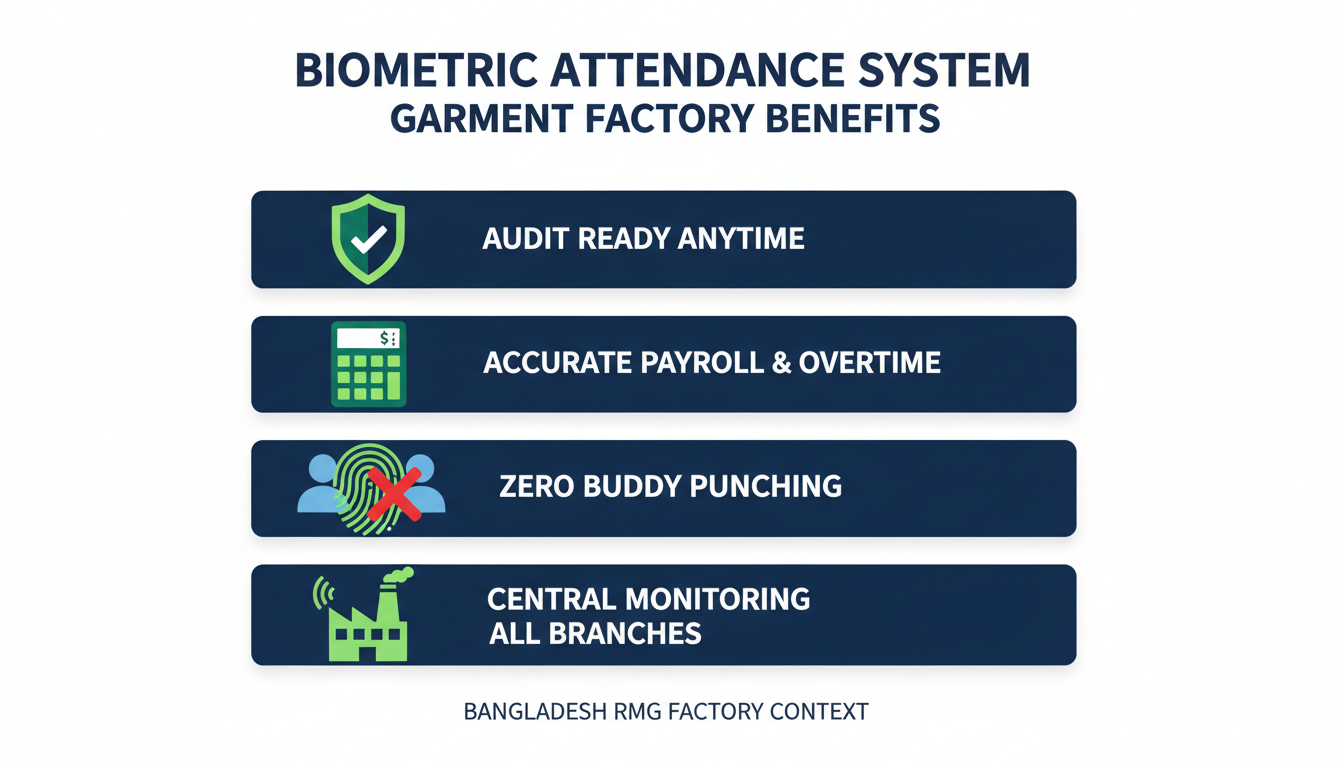
BGMEA, Accord, Alliance, and global buyers all want to see proper workforce records. A good biometric attendance system in Bangladesh helps you stay ready for any audit at any time.
Improved Payroll Accuracy and Automated Overtime Tracking
Manual payroll is slow and full of mistakes. Someone types in the wrong number, and a worker gets paid too little or too much.
A biometric system connects directly to your payroll software. It counts the hours automatically. Overtime is calculated the right way, every time.
This saves your HR team many hours every month. It also reduces worker complaints about wrong pay.
Enhanced Security and Elimination of Buddy Punching
Buddy punching means one worker clocks in for another worker who is not actually there. This is a common problem in large factories. It costs factories a lot of money every month.
With a biometric system, only the real person can clock in. A fingerprint or face cannot be faked or shared. Buddy punching becomes impossible.
This also improves factory security. You always know exactly who is inside the building.
Centralized Workforce Monitoring and Multi-Branch Management
Many garment factories have more than one building or location. Managing attendance across different places used to mean collecting papers from each location.
A modern biometric attendance system sends all data to one central place. You can sit in your office and see attendance from all floors and all locations on one screen.
This makes factory management much easier and faster.
Types of Biometric Attendance Devices and Pricing
Basic Fingerprint Devices for Small-Scale Operations
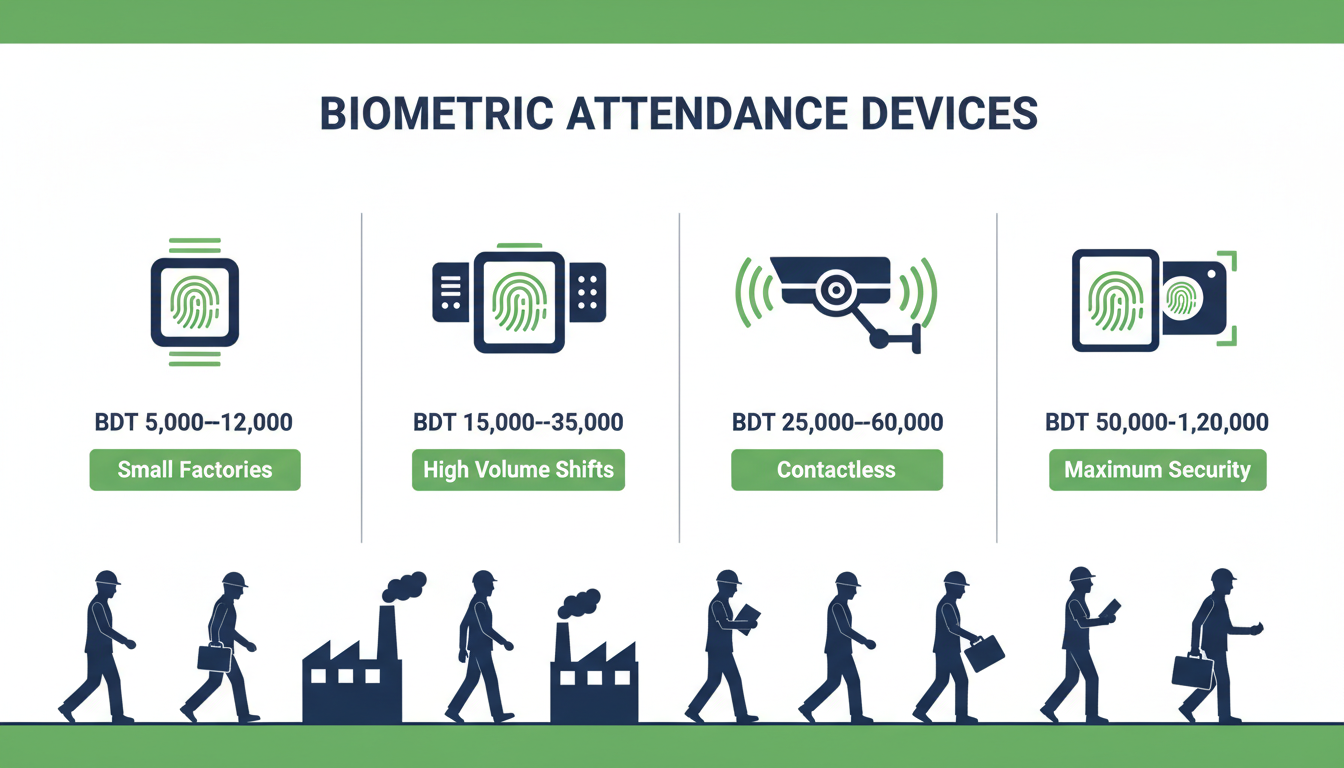
Basic fingerprint devices are good for smaller factories or factories just starting with biometric systems. They are simple to use and easy to install.
These devices read one finger and save time. They work well in offices and smaller production areas.
Price range: BDT 5,000 to BDT 12,000 per device.
Advanced Fingerprint Systems for High-Volume Shifts
Large garment factories need faster machines. When 500 workers are trying to clock in at the same time, a slow machine creates long lines.
Advanced fingerprint systems can process thousands of workers per hour. They store more fingerprint records and connect easily to your network.
Price range: BDT 15,000 to BDT 35,000 per device.
Face Recognition Systems for Contactless Attendance
Face recognition systems do not need any physical touch. A worker just walks up to the camera, and the machine recognizes them in less than one second.
These are great for factories that want faster, cleaner, and more hygienic attendance. After the COVID pandemic, many factories switched to contactless systems.
Price range: BDT 25,000 to BDT 60,000 per device.
Multi-Modal Devices for Maximum Security and Efficiency
Multi-modal devices use more than one method. They can read fingerprints and faces. Some also use ID cards as a backup.
These are the best options for factories with high security needs or workers whose fingerprints are hard to read due to rough hands from industrial work.
Price range: BDT 50,000 to BDT 1,20,000 per device.
Factors That Influence Overall System Cost
The total cost of setting up biometric attendance for your RMG factory depends on several things:
- Number of devices you need
- Number of workers to enroll
- Software license fees
- Installation and wiring costs
- Training costs for your HR team
- Ongoing maintenance and support
A factory with 500 workers needs fewer devices than a factory with 5,000 workers. Always get a full quote that includes all of these items.
Want to know the right system for your factory size and budget? Check our biometric attendance system options for Bangladesh factories.
Biometric Attendance System Implementation Process in RMG Factories
Pre-Installation Planning and Site Assessment
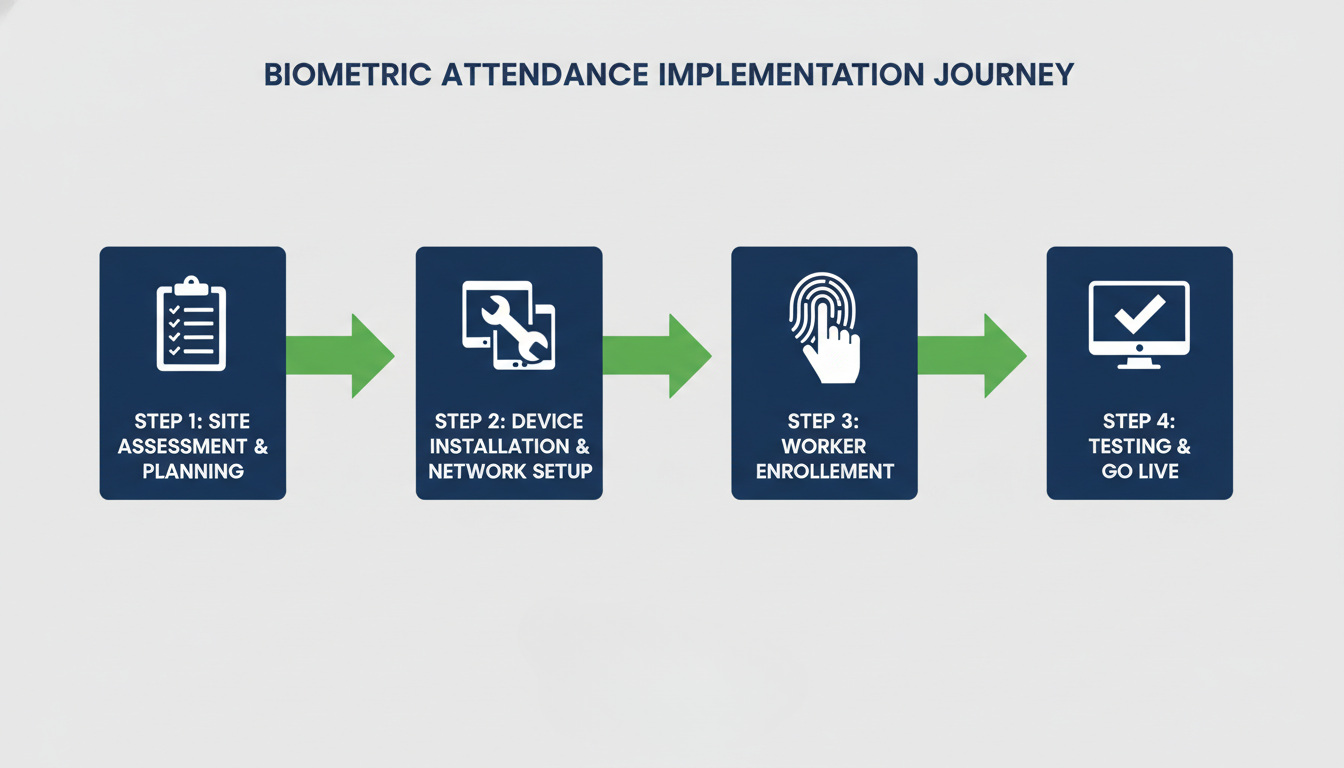
Before buying any device, you need to plan carefully. A site assessment helps you figure out:
- How many entry and exit points does your factory have
- Where to place the devices so workers can access them easily
- What kind of network or internet connection is available
- How many workers need to be enrolled
Good planning saves time and money later.
Device Installation and Network Setup
Once you have a plan, the devices are installed at each entry and exit point. They connect to your factory network so all data goes to one central system.
Proper installation includes wiring, power supply setup, and testing the network connection. A good vendor will do all of this for you.
Employee Enrollment and Data Registration
Every worker needs to be registered in the system. This means their fingerprint or face is scanned and saved along with their name and employee ID.
This process takes time in a large factory. A good vendor will help you set up fast enrollment stations to do this quickly.
System Testing and Go-Live
Before going live, the system is tested. Every device is checked. The data flow to the central system is confirmed. Payroll integration is tested with real data.
Once everything works correctly, the system goes live. From that day, all attendance is recorded automatically.
Software Integration and Data Management
Integration with Payroll and HRM Systems
The real power of a biometric system comes when it connects to your payroll or HR software. Attendance data flows directly into payroll. Hours are calculated. Overtime is added. Salary is computed without any manual entry.
This saves your HR team many hours every month and removes the risk of human error.
Cloud-Based vs On-Premise Solutions
Cloud-based systems store all data on internet servers. You can access attendance reports from anywhere using a phone or computer. These are easier to manage and update.
On-premise systems store data on a server inside your factory. These are good if your internet connection is unreliable or if you want full control over your data.
Most modern factories in Bangladesh are moving toward cloud-based solutions because they are easier to use and maintain.
Real-Time Data Sync and Reporting Features
A good biometric attendance system gives you live reports. You can see right now how many workers are inside the factory. You can see who is absent today. You can check overtime hours for any worker at any time.
These real-time reports help factory managers make fast decisions.
Data Storage and Backup Practices
All attendance data must be stored safely. A good system keeps backups automatically. If a device breaks or data is accidentally deleted, you can restore it from the backup.
Make sure your vendor offers automatic backup as part of the system.
Challenges and Solutions in RMG Biometric Attendance Systems
Fingerprint Recognition Issues in Industrial Environments
Many garment workers have rough or damaged skin on their fingers. Machines that read fingerprints can have trouble recognizing these workers.
Solution: Use multi-modal devices that also offer face recognition as a backup. Or use optical fingerprint sensors instead of capacitive ones, as they work better with worn skin.
Device Downtime and Connectivity Problems
If a device breaks down during a shift, workers cannot clock in. This creates attendance gaps.
Solution: Have a backup device ready or set up offline mode so devices can store data locally and sync later when the connection is restored. Always have a service contract with your vendor for fast repairs.
Worker Resistance and Training Gaps
Some workers are not comfortable with biometric systems. They may worry about their personal data being misused.
Solution: Hold simple information sessions. Explain how the system works and how their data is used only for attendance and payroll. When workers understand the system, they accept it faster.
Data Accuracy and System Errors
Sometimes a device records the wrong time or misses a clock-in entirely.
Solution: Set up daily data checks. Your HR team should review attendance reports each morning and fix any errors quickly. A good system also sends alerts when something goes wrong.
Compliance and Industry Standards in Bangladesh
BGMEA Guidelines and Compliance Expectations
BGMEA, the Bangladesh Garment Manufacturers and Exporters Association, wants factories to maintain proper attendance records. These records must show working hours, rest periods, and overtime.
A biometric attendance system makes it easy to generate these records in the exact format auditors need.
Accord and Alliance Audit Requirements
The Accord on Fire and Building Safety and the Alliance for Bangladesh Worker Safety both require proper worker records. Today, these programs are managed by the RMG Sustainability Council (RSC). Factories that cannot show clean attendance data may lose their certification.
A digital biometric system keeps all records safe and easy to access during any audit.
Labor Law Considerations in Bangladesh
Bangladesh labor law sets clear rules about working hours, overtime limits, and rest days. Factories must follow these rules and prove they are following them.
A good biometric attendance system tracks all of this automatically. If a worker is about to exceed the legal overtime limit, the system can send an alert to your HR team.
Data Privacy and Employee Consent
When you collect biometric data, you must follow proper rules. Workers must give their consent. Their data must be stored safely. It must be used only for attendance purposes.
Make sure your system vendor helps you set up proper data consent forms and security settings.
Choosing the Right Biometric Attendance Vendor in Bangladesh
Key Features to Look for in a Reliable Supplier
A good vendor will offer:
- Devices that work well in factory environments
- Software that connects with your payroll system
- Cloud-based reporting with mobile access
- Easy worker enrollment process
- Full installation service
Do not just buy the cheapest device. Look for a complete solution that works for your factory’s specific needs.
Importance of Local Support and Service
If a device breaks down, you need someone to fix it fast. A vendor with a local team in Bangladesh can send a technician quickly.
Avoid vendors who only offer remote support by phone or email. In a factory environment, you need fast on-site help.
Comparing Vendors and Solution Packages
Ask at least three vendors for a full quotation. Compare:
- Device quality and brand
- Software features
- Installation cost
- Annual maintenance cost
- Response time for repairs
- Customer references from other RMG factories
Questions to Ask Before Purchasing
Before signing any contract, ask:
- How many workers can one device handle?
- Does the system work offline if the internet goes down?
- How long does it take to enroll all our workers?
- What happens to our data if we stop using your service?
- Do you have experience with RMG factories in Bangladesh?
Looking for a trusted provider? See our full biometric attendance system solutions for Bangladesh.
ROI of Biometric Attendance Systems in RMG Factories
Cost Savings from Reduced Payroll Errors
Payroll errors cost factories money every month. Overpayments, incorrect overtime, and missed deductions all add up.
A biometric system removes most of these errors automatically. Many factories recover the full cost of the system within the first year just from payroll savings.
Productivity Improvements and Time Efficiency
Your HR team spends less time on manual data entry. Managers spend less time checking attendance sheets. Workers get their correct pay on time.
All of this adds up to a more productive, happier workforce.
Reduction in Fraud and Time Theft
Buddy punching, late arrivals recorded as on time, and early departures that go unnoticed are all forms of time theft. In a factory with 1,000 workers, even small amounts of time theft can cost millions of taka every year.
A biometric system makes all of this impossible.
Long-Term Operational Benefits
As your factory grows, a biometric attendance system grows with you. Adding new workers, new floors, or new locations is easy. The system scales without needing to start over.
You also build years of clean workforce data that helps you make better management decisions.
Future Trends in Biometric Attendance for the RMG Sector
AI-Powered Face Recognition Advancements
New AI-powered face recognition systems are getting faster and more accurate every year. They can recognize workers even if they are wearing a mask or a hijab. They work in low light and from a longer distance.
These systems are becoming more affordable and will soon be common in Bangladeshi garment factories.
Contactless and Touchless Attendance Systems
The demand for contactless systems grew after COVID-19. Workers and factory owners both prefer systems where no touching is needed.
Touchless face recognition and iris scanning are the future of attendance in high-volume factory settings.
Integration with Smart Factory and IoT Systems
Modern factories are becoming smart factories. Biometric attendance systems can connect with other smart devices like door locks, CCTV cameras, and production monitoring systems.
This creates a fully connected factory where everything works together.
Mobile-Based Attendance and Remote Monitoring
Factory owners and managers want to check attendance from their phones. New systems send real-time notifications and full reports directly to a mobile app.
This means you can manage your workforce from anywhere, at any time.
Conclusion and Final Recommendations
Key Takeaways for RMG Factory Owners
Biometric attendance for RMG factories in Bangladesh is no longer a luxury. It is a basic need for any factory that wants to stay competitive, pass audits, and protect its workers.
Here is what to remember:
- Biometric systems stop fraud and payroll errors
- They make audit preparation fast and easy
- The right system saves money in the first year
- Choose a vendor with local support and RMG experience
- Start with a site assessment before buying anything
Steps to Get Started with Biometric Attendance Systems
Step 1: Count your workers and entry points. Step 2: Decide if you need fingerprint, face recognition, or both. Step 3: Talk to at least two or three vendors. Step 4: Ask for a demo and check references from other factories. Step 5: Plan your enrollment process. Step 6: Go live and train your HR team.
Ready to get started? Explore biometric attendance system options for your Bangladesh factory here.