

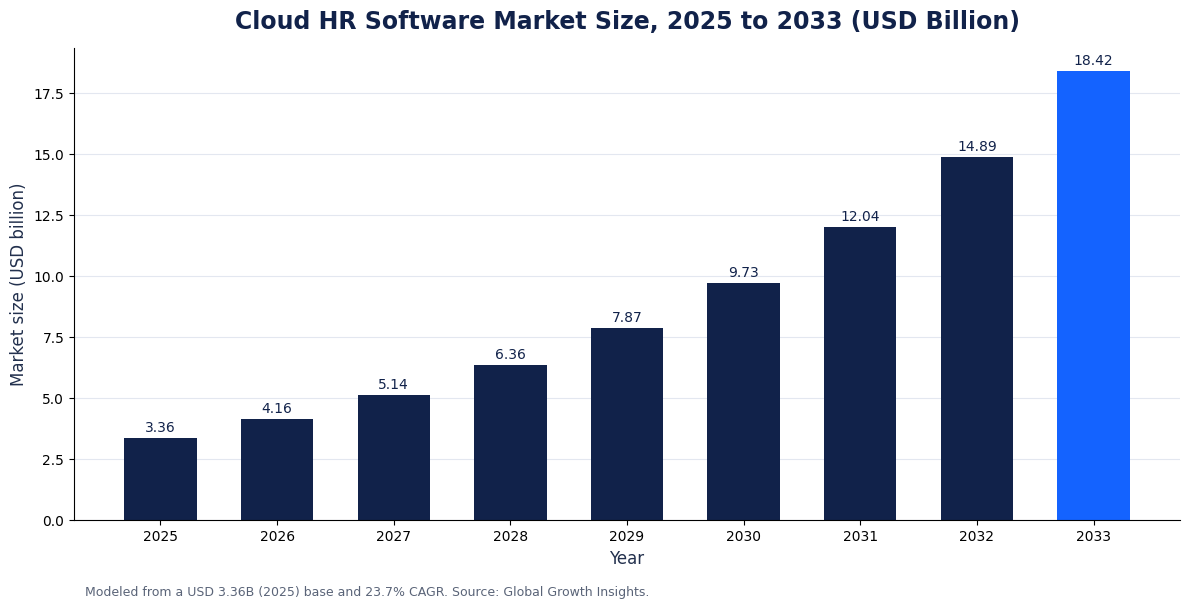
TL;DR: The global cloud HR market size sat near USD 3.36 billion in 2025. Analysts expect it to pass USD 18 billion by 2033. That is growth close to 24% a year. India already runs a billion-dollar HCM market. Bangladesh starts smaller, yet cloud HR spend keeps rising with the wider ICT economy.
The cloud HR market size reached about USD 3.36 billion worldwide in 2025. Forecasts put it above USD 18 billion by 2033. That works out to a compound growth rate near 24% each year. For HR teams in Bangladesh, the exact figure matters less than the direction. Cloud is winning, and the shift is not slowing.
I read through a dozen of these market reports so you do not have to. Below I pull the numbers that actually matter for a South Asian HR buyer. I also flag where the headline figures can mislead you.
Global cloud HR software market, 2025 to 2033
Global HRM market growth to 2030 (Grand View)
Firms running HR on SaaS or hybrid cloud
India HCM market size, 2025 (IMARC)
How big is the cloud HR market size in 2026?
It depends on how you draw the boundary. Research firms count three overlapping things. One is the broad human resource management (HRM) market. Another is HR software. A third is cloud HR software on its own. Each uses a different scope, so the dollar figures differ a lot.
Grand View Research valued the global HRM market at USD 27.51 billion in 2024. It projects USD 60.52 billion by 2030, a 14.4% yearly rate. Software makes up about 67% of that spend. The pure cloud slice is smaller but grows the fastest.
| Market segment | Value (year) | Forecast | CAGR | Source |
|---|---|---|---|---|
| Global HRM market | USD 27.51B (2024) | USD 60.52B by 2030 | 14.4% | Grand View Research |
| Global HR software | USD 23.32B (2025) | USD 66.70B by 2034 | 12.4% | Fortune Business Insights |
| Cloud HR software only | USD 3.36B (2025) | USD 18.45B by 2033 | 23.7% | Global Growth Insights |
| India HCM market | USD 1.04B (2025) | USD 2.94B by 2034 | 11.9% | IMARC Group |
Figures come from different research firms and definitions, so treat them as directional, not exact.
What is driving cloud HR growth?
Four forces push the cloud HR market size upward. First, buyers want AI features without a big capital project. Cloud vendors ship those updates every few weeks. Second, the subscription model spreads cost over time, which suits smaller firms.
Third, remote and hybrid work made a browser-based system the default. Fourth, small and medium firms across Asia are digitizing basic HR for the first time. Together these keep growth in the double digits.
The adoption numbers back this up. Cloud now drives over 60% of new HR license sales, heading toward 80% by 2035. About 69% of organizations run HR on SaaS or hybrid cloud. Deloitte found 74% of firms use or are adopting cloud payroll.
A market growing near 24% a year is not a trend you sit out.
The cloud HR market in South Asia and India
India anchors the region. IMARC Group put the India HCM market at USD 1.04 billion in 2025. It expects USD 2.94 billion by 2034, an 11.9% yearly rate. Fortune Business Insights lands close, near USD 1.10 billion in 2025.
The wider Asia Pacific region led global HCM demand in 2024. It is growing at about 9.2% a year. South Asia sits inside that story. India, Bangladesh, Sri Lanka, and Pakistan all shift HR to the cloud. Each moves at its own pace.
Where does Bangladesh fit in the cloud HR market?
Bangladesh is earlier in the curve, but the base is expanding. Mordor Intelligence sizes the Bangladesh ICT market at USD 8.82 billion in 2025. It projects USD 12.79 billion by 2031, a 6.26% yearly rate. Cloud and SaaS take a rising share of that spend.
Policy helps. The Smart Bangladesh 2041 vision pushes digital adoption across sectors. Local data centres, billing in taka, and hybrid options now ease data-residency worries. Global clouds like Azure and AWS also resell through local partners.
The demand base is real. Bangladesh runs thousands of garment units, retailers, and NGOs that still track staff on paper. Digital payment rules and audit pressure now push them toward proper systems. As these firms adopt HR and attendance tools, most pick cloud first. A server room is simply not an option for a small team.
Here is my contrarian take. The headline global figure is close to useless for a 30-person garment factory in Dhaka. A USD 18 billion market does not pay your salaries or fix your muster roll. What matters is whether the tool bills in taka. It also has to keep working when the internet drops. Study cloud versus on-premise HR software before you read one more forecast.
Cloud vs on-premise: the deployment shift
The move from on-premise to cloud is the real story inside the numbers. A decade ago most HR systems lived on a server in the office. Today the balance has tipped hard toward subscription cloud, and the gap widens each year.
| Deployment signal | Figure | Source |
|---|---|---|
| Cloud share of new HR license sales | Over 60% (toward 80% by 2035) | IndexBox |
| Firms on SaaS or hybrid cloud HR | About 69% | HR technology survey |
| Firms using or adopting cloud payroll | 74% | Deloitte, 2025 |
| Expected HR SaaS or hybrid by end 2027 | 83% | Industry forecast |
For a Bangladeshi buyer, this shift lowers risk. You are no longer picking a niche path. You are joining the mainstream, with more vendors, more integrations, and clearer HR management software features to compare.
What the numbers mean for your HR team
Market size charts are useful only when they change your decision. Here is how I would read them if I ran HR at a growing Dhaka firm.
1. The 24% cloud growth rate means prices and features improve fast. Waiting a year rarely helps you. 2. The on-premise share keeps shrinking, so long server contracts carry more lock-in risk. 3. Local billing and support now exist, so the old excuses have faded.
This is where a local platform earns its place. Tipsoi runs HR, attendance, and payroll from the cloud. It bills in taka. It also supports offline-capable devices for weak-network sites. If you are comparing options, our guide to the best HR software in Bangladesh and our HR software pricing in Bangladesh breakdown are good next reads.
Key Takeaways
- Global cloud HR market size was about USD 3.36 billion in 2025, heading past USD 18 billion by 2033.
- The broad HRM market grows at 14.4% a year to 2030, per Grand View Research.
- India leads South Asia with a USD 1.04 billion HCM market in 2025.
- Bangladesh is earlier, but cloud HR rides a USD 8.82 billion ICT market.
- Cloud already wins most new HR deals, so on-premise carries more risk now.
- For a local buyer, taka billing and offline resilience beat any global chart.
Frequently Asked Questions
What is the cloud HR market size in 2026?
The global cloud HR software market was about USD 3.36 billion in 2025. Through 2026 it grows near 24% a year. That points toward USD 18.45 billion by 2033.
How fast is the cloud HR market growing?
Cloud HR software grows near 23.7% a year. The wider HRM market grows about 14.4% a year to 2030. Cloud outpaces the overall market because buyers keep leaving on-premise systems.
How big is the HR software market in India and South Asia?
IMARC Group sized India’s HCM market at USD 1.04 billion in 2025. It reaches USD 2.94 billion by 2034. Asia Pacific led global HCM demand in 2024 and grows about 9.2% a year.
Is cloud HR software used in Bangladesh?
Yes, and adoption is rising. Bangladesh’s ICT market reached USD 8.82 billion in 2025, with cloud taking a growing share. Local billing, data centres, and the Smart Bangladesh 2041 push all support HR cloud uptake.
Is cloud HR cheaper than on-premise for small firms?
Usually, yes, on upfront cost. Cloud spreads payment across a subscription with no server to buy. Watch the total over three years, since add-ons and per-user fees can grow. Compare the full quote, not the sticker price.
What is the difference between HRM, HCM, and cloud HR software?
HRM and HCM describe the whole field of managing people and payroll. HR software is the tool set. Cloud HR software is that tool set delivered over the internet. You rent it by subscription instead of running a server.
References
- Grand View Research. Human Resource Management Market Size Report, 2030. grandviewresearch.com
- Fortune Business Insights. HR Software Market, 2025. fortunebusinessinsights.com
- IMARC Group. India Human Capital Management Market, 2025. imarcgroup.com
- Mordor Intelligence. Bangladesh ICT Market Analysis, 2025. mordorintelligence.com
- Johnson, R. D., and Diman, K. (2017). An Investigation of the Factors Driving the Adoption of Cloud-Based Human Resource Information Systems. doi.org
- Alam, M. G. R., Masum, A. K. M., and Beh, L.-S. (2016). Critical Factors Influencing Decision to Adopt Human Resource Information System. PLOS ONE. doi.org
- Bondarouk, T., Parry, E., and Furtmueller, E. (2016). Electronic HRM: four decades of research on adoption and consequences. doi.org