

Most HR software implementation failures have nothing to do with the software. They happen because the people, the data, and the local rules were never made ready for it. A 2022 Gartner survey found the average HRIS is used by only 32% of employees, and nearly 1 in 4 organizations say their new HR tech misses adoption expectations entirely.
I work with HR teams putting these systems in, and the pattern repeats. Below are the seven HR software implementation failures I see most often in Bangladesh, what actually causes each one, and the fix that holds up against local constraints: tight budgets, thin technical staffing, load-shedding, and the Bangladesh Labour Act 2006.
An HRIS (Human Resource Information System) is the system of record for employee data: profiles, attendance, leave balances and payroll inputs. An HRMS adds the workflow layer on top of it. For a growing Bangladeshi SME, either one is replacing registers and spreadsheets that stopped scaling a while ago. That is a change to how people work, not a software purchase, and treating it as the latter is where the trouble starts. If you want the vendor-neutral definition, SAP keeps a good primer on what an HRIS is.
What causes HR software implementation failures?
HR software implementation failures fall into three groups: people and process (resistance and training), technical and local (data migration, infrastructure, labour-law fit), and strategic (unclear objectives and the wrong vendor). This table is the whole argument in one place; the sections below go deeper on each.
| Failure | What actually causes it | The fix that works in Bangladesh |
|---|---|---|
| 1. Resistance to change | The rollout is run as a technical upgrade; informal manual rules get standardized away | Change champions per department, map processes before configuring, answer “what’s in it for me” |
| 2. Generic training | One-size-fits-all sessions; staff never learn the system in the context of their own job | Role-based training plus a staffed hypercare desk for the first 30–40 days |
| 3. Dirty data migration | Incomplete or outdated records carried over from spreadsheets, surfacing as payroll errors | Audit and cleanse before migrating; run one full parallel payroll cycle and reconcile to zero |
| 4. Infrastructure reality | Cloud-only design meets load-shedding and unreliable connectivity outside Dhaka | Offline capture with auto-sync, battery-backed devices, UPS budgeted as a line item |
| 5. Labour-law misfit | Foreign defaults for overtime, leave accrual and festival holidays are accepted as-is | Configure to the Bangladesh Labour Act 2006 and audit it during testing, not after go-live |
| 6. Unclear objectives | No definition of success, so scope creeps and budgets stretch | Executive sponsor, a written adoption target in numbers, budget for the hidden costs |
| 7. Wrong vendor | Chosen on demo and price; no guaranteed support after go-live | Due diligence with reference customers and a written SLA covering post-launch support |
People, process, and resistance failures
HR technology projects are still treated as an IT purchase, which skips the organizational shift that actually decides the outcome. SHRM put it plainly in 2025: the biggest challenge in an HR software rollout is not a technical hurdle, it is human behavior.
Failure 1: Insufficient change management and organizational resistance
This failure starts by ignoring the cultural shift a new system forces. Employees, line managers and HR staff resist it, and adoption stays low. The resistance is sharpest when a company is moving off traditional or heavily customized manual processes, which is the norm in many Bangladeshi SMEs.

Resistance spikes when the system standardizes something that was informal. Custom payment rules that only a senior manager fully understands are the classic example: automate them and the exceptions surface as arguments. Research on enterprise systems has described this for years as a dialectic between the system’s logic and how the organization actually works (Robey, Ross & Boudreau, 2002), and it is why configuration cannot start before the real process is documented.
How to avoid it
- Appoint change champions. Find the influential employees in each department and site who can vouch for the system to their peers.
- Communicate both ways. Explain the why in terms of what the employee gets: faster leave approval, an accurate pay slip, no more chasing paperwork. Company benefits do not motivate the person clocking in.
- Map processes before you configure. Document and standardize what exists today, including the informal rules, so automation is not the first time anyone writes them down. Our guide to change management for HR system adoption covers the sequencing, and there is a companion piece on reducing resistance in non-technical teams.
Failure 2: Inadequate and generic user training
Most organizations run “sheep-dip” training: one session, every role, same content. People leave unfamiliar with the screens they will actually use, so they make errors and then avoid the system. PwC’s Julia Lamm named the underlying assumption in SHRM’s 2025 reporting, that staff will simply work the tools out on their own. They do not.
In Bangladesh the complaints I hear most are a confusing interface and weak mobile access, which makes routine tasks such as checking attendance on a phone or applying for leave harder than the paper process it replaced. The Technology Acceptance Model literature is blunt about the consequence: perceived ease of use drives whether the system gets used at all, and training is one of the few levers that moves it (Venkatesh & Bala, 2008).
How to avoid it
- Train by role. HR administrators need configuration and payroll setup; a line manager needs approvals; an employee needs the self-service portal and nothing else.
- Staff a hypercare desk. Name a support contact for the first 30–40 days after launch. The early stumbles are what decide whether people come back to the system in month three.
- Use the language your workforce uses. Materials in English only will quietly exclude part of your floor staff.
Technical, data, and infrastructural HR software implementation failures
These are the failures where Bangladesh differs most from the vendor’s assumptions, and where a globally proven product still lands badly.
Failure 3: Data migration and integrity problems
Nothing destroys trust in a new HRIS faster than dirty data. Inaccurate, incomplete or outdated records get carried across from legacy spreadsheets, and the damage shows up in the one place employees check: their pay.

Miscalculated salaries, bonuses or deductions in the first cycle are not a technical footnote. They are a trust event, and people remember them long after the record is fixed.
How to avoid it
- Audit before you migrate. Verify personal data, joining dates, grades, salary structure and leave balances against source records, and give every field a named owner. We wrote up the mechanics in migrating legacy HR data securely.
- Run one full parallel payroll cycle. Old system and new system, same month, reconciled to zero before you switch off the old one. If the numbers disagree, reconcile the discrepancies before go-live, not after.
Failure 4: Ignoring Bangladesh’s infrastructural realities
A cloud-only HRIS assumes a stable connection and stable power. Outside the main urban centres, neither is a safe assumption. Power cuts are still forcing small manufacturers and rural businesses onto costly diesel generators, and rural areas carry the heavier share of load-shedding. Implementations also routinely forget that the local hardware needs upgrading too.
How to avoid it
- Insist on real offline capability. Attendance and task logging must keep working through an outage and sync automatically when the link returns. This is exactly why Tipsoi’s attendance devices capture locally and sync on reconnect rather than failing closed; whatever you choose, test that behavior before you sign. See how an offline attendance system should behave.
- Budget the hardware. A UPS for the local network and devices with battery backup belong in the project budget as a line item, not as a surprise in month two.
- Pilot outside Dhaka. If you have sites in the districts, prove it there first. A rollout that only works at head office is not a rollout.
Failure 5: Non-compliance with the Bangladesh Labour Act 2006
Compliance is not negotiable, and a foreign vendor’s defaults are not compliant with Bangladeshi law out of the box. This is the failure with legal exposure attached, and it is entirely preventable at configuration time.
| Provision | What the Act requires | The common misconfiguration |
|---|---|---|
| Overtime (Section 108) | Twice the ordinary rate of basic wage | Vendor default of 1.5×, copied from another market |
| Casual leave (Section 115) | 10 days per calendar year on full wages, non-accumulable | Carrying the balance forward into the next year |
| Earned leave (Section 117) | 1 day for every 18 days worked (factory, shop and commercial workers) | A flat annual allocation that ignores days actually worked |
| Festival holidays | Per your establishment’s declared calendar | A fixed global holiday table that never sees Eid |
| Statutory reporting | Formats required by the relevant authorities | No export that matches the mandated format |
How to avoid it
- Configure to the Act, not to the default. Require the vendor to demonstrate each provision above with your own data.
- Audit compliance during testing. Check the payroll and leave modules against the law while you can still change them. Related reading: Labour Act compliance using attendance data, our leave management guide for Bangladesh, and what casual leave actually covers.
Strategic and vendor failures
Failure 6: Unclear objectives and weak project management
Without a written objective, scope creeps, timelines slip and the budget goes. Panorama’s 2026 ERP Report found more than a quarter of organizations exceeded their project budget, with additional technology needs the leading cause; their own explanation is that companies discover fundamental misfits late and then patch them with scope expansion and custom builds.
The subtler version is having no definition of success at all. BCG’s Julie Bedard made the point in SHRM’s reporting that there often is not a clear definition of adoption, or it is not rigorous enough. If you cannot say what good looks like in numbers, you cannot tell whether the project worked. Decades of enterprise-system research land in the same place: clear goals and organizational fit are the factors that separate the successes from the write-offs (Umble, Haft & Umble, 2003; Hong & Kim, 2002).
How to avoid it
- Get an executive sponsor. Someone senior enough to protect the budget and settle cross-department disputes.
- Define adoption as a number. “70% of employees using self-service monthly by month three” is a target. “Better HR” is not.
- Budget the hidden costs. Data cleansing, customization, integration, training and post-launch Application Management Services. Our breakdown of HR software pricing in Bangladesh and the hidden fees in cloud HR pricing are the two worth reading before you sign.
Failure 7: The wrong vendor and no long-term support
Vendors get chosen on a good demo and a low price, without checking the system fits the company’s scale, industry and integration needs. The organizational-fit research above is unambiguous that this is the expensive mistake, not a preference.
Locally, the specific risks are a smaller vendor without the scalability or security posture you will need in three years, and no guaranteed Application Management Services after go-live. Without that support the system stagnates, nobody owns the problems, and staff drift back to spreadsheets.
How to avoid it
- Do real due diligence. Talk to reference customers of your size and industry. Compare the HR software options available in Bangladesh and decide cloud versus on-premise on your constraints, not the brochure.
- Get the SLA in writing. Support response times, monitoring, updates and AMS scope, all post-launch. Ask what a vendor security audit should cover.
- Secure your exit. A clause that gets your data out in a usable format costs nothing to negotiate now and everything to need later.
The adoption gap behind HR software implementation failures
If you only take one number from this article, take this one. Gartner’s 2022 survey found the average HRIS is used by only 32% of employees. The software was bought, configured and launched; roughly two-thirds of the workforce still is not using it.
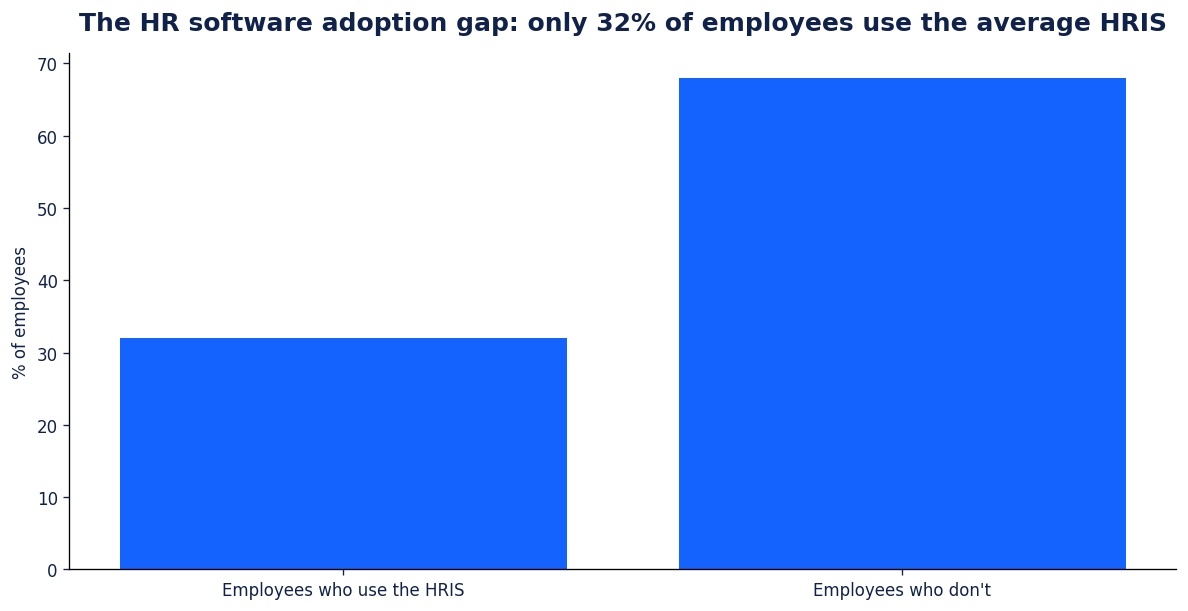
That is what an implementation failure actually looks like in practice. Not a system that crashed, but one nobody opens. Every fix in this article points at the same target: getting that bar higher.
Free HR software implementation checklist for Bangladesh
I built the checklist I wish every team had before kickoff. It covers objectives and scope, data readiness, Bangladesh Labour Act 2006 configuration points, the infrastructure reality check, change management, and the vendor and contract terms to pin down. No form, no email required.
⬇ Download the HR Software Implementation Checklist (Bangladesh) — free XLSX
If you would rather start from the structure than the spreadsheet, we also have a walkthrough on building your own HR system implementation checklist.
Charting a course to HR software success
A successful rollout gives equal weight to three things: people, process and technology. Most failed projects in Bangladesh were strong on the third and absent on the first two.

Locally that means three commitments: prioritize change management so the system reaches a traditional workplace intact, configure compliance to the Bangladesh Labour Act 2006 rather than a vendor default, and design around load-shedding and connectivity instead of hoping. None of it is exotic. It is just the work that gets skipped when a rollout is treated as a purchase.
An HRMS is not a destination. It needs ongoing training, optimization and real post-implementation support to keep returning anything on the investment. Handle the seven failures above deliberately and the odds move firmly in your favour.
Frequently asked questions about HR software implementation failures
Why do HR software implementations fail?
They fail on people, data and local fit rather than on technology. The most common causes are weak change management, generic training, dirty data carried over in migration, infrastructure the system was never designed for, labour-law misconfiguration, unclear objectives, and a vendor chosen without due diligence. Gartner found the average HRIS is used by only 32% of employees, which is the clearest sign the problem is adoption, not features.
What is the biggest cause of HR software implementation failure?
Low adoption driven by poor change management. SHRM reported in 2025 that the biggest challenge in HR technology rollouts is human behavior, not a technical hurdle, and nearly 1 in 4 organizations say their HR tech misses adoption expectations. A system that works perfectly and nobody uses has still failed.
How do I stop payroll errors when migrating to a new HR system?
Audit and cleanse employee data before migration, not after, and give every field a named owner. Then run at least one full parallel payroll cycle where the old and new systems process the same month and reconcile to zero before you retire the old system. Payroll mistakes in month one cost trust that takes far longer to rebuild than the data takes to fix.
Does HR software in Bangladesh need to follow the Bangladesh Labour Act 2006?
Yes, and vendor defaults will not do it for you. The system must calculate overtime at twice the ordinary rate of basic wage (Section 108), allocate 10 non-accumulable days of casual leave per calendar year (Section 115), accrue earned leave at 1 day per 18 days worked for factory, shop and commercial workers (Section 117), handle your declared festival holidays, and export the statutory reporting formats. Audit these during testing rather than after go-live.
Can an HRMS keep working during load-shedding or an internet outage?
Only if you choose one that is built for it. Attendance and task logging should be captured locally during an outage and sync automatically when connectivity returns, and the devices should have battery backup with a UPS on the local network. Test that behavior on a real site before signing, particularly for locations outside Dhaka where load-shedding is heavier.
What is the difference between an HRIS and an HRMS?
An HRIS is the system of record for employee data: profiles, attendance, leave balances and payroll inputs. An HRMS adds the workflow and management layer on top of that record, covering approvals, performance and reporting. In everyday use in Bangladesh the two terms are often used interchangeably, and the same implementation failures apply to both.
References
- Zielinski, D. (2025). The Biggest Reason Why New HR Technology Implementations Fail. SHRM. (Source of the 2022 Gartner 32% HRIS usage figure and the Sapient Insights Group adoption finding.)
- Panorama Consulting Group (2026). The 2026 ERP Report. (Budget overrun findings.)
- Government of Bangladesh. Bangladesh Labour Act, 2006 (via the International Labour Organization).
- Umble, E. J., Haft, R. R., & Umble, M. M. (2003). Enterprise resource planning: Implementation procedures and critical success factors. European Journal of Operational Research, 146(2), 241–257.
- Hong, K.-K., & Kim, Y.-G. (2002). The critical success factors for ERP implementation: an organizational fit perspective. Information & Management, 40(1), 25–40.
- Robey, D., Ross, J. W., & Boudreau, M.-C. (2002). Learning to Implement Enterprise Systems: An Exploratory Study of the Dialectics of Change. Journal of Management Information Systems, 19(1), 17–46.
- Venkatesh, V., & Bala, H. (2008). Technology Acceptance Model 3 and a Research Agenda on Interventions. Decision Sciences, 39(2), 273–315.
- The Business Standard. Power cuts squeeze rural economy as outages disrupt farms, small industries.