
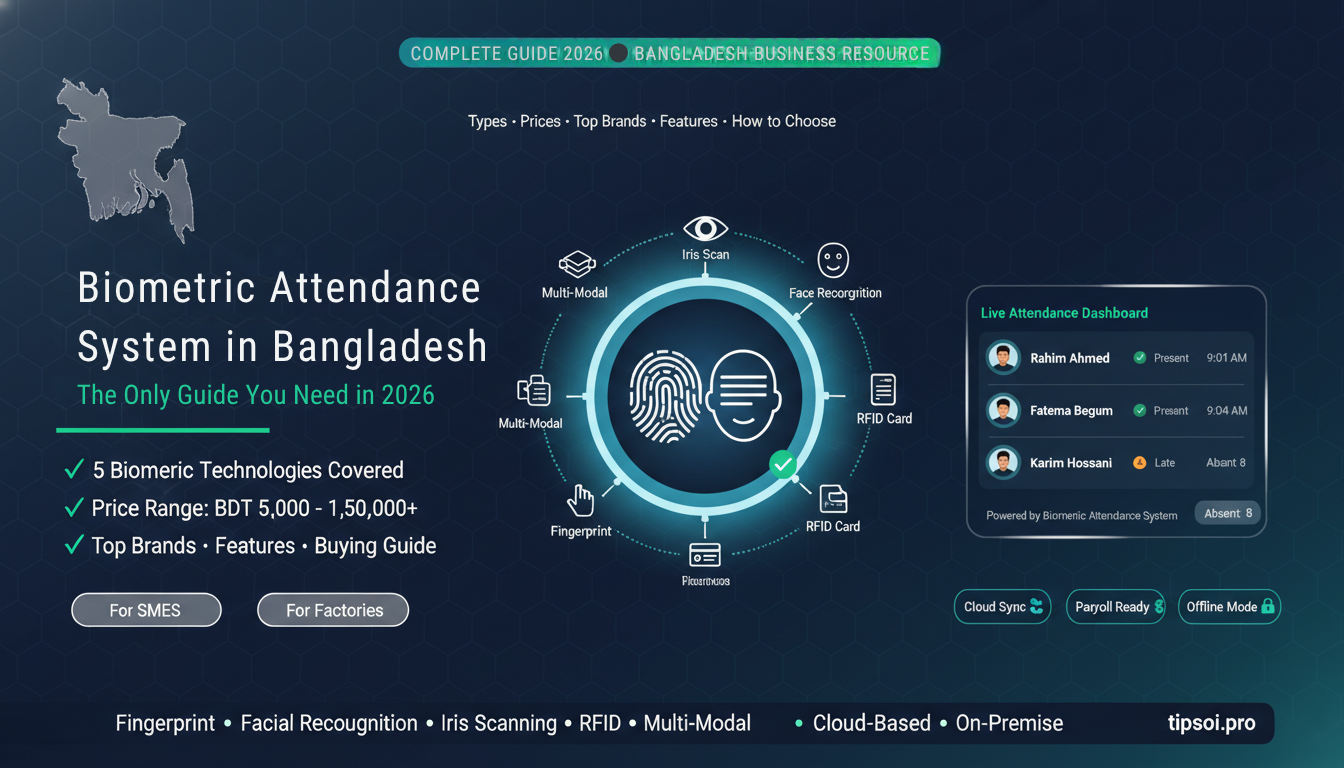
What Is a Biometric Attendance System in Bangladesh
A biometric attendance system is a digital tool that records employee attendance using unique physical or behavioral traits- such as fingerprints, facial features, or iris patterns. Instead of paper registers or ID cards, the system identifies each person automatically and logs their entry and exit time.
These systems are widely used in offices, factories, schools, and hospitals across Bangladesh to eliminate manual errors and prevent attendance fraud.
Learn more about what a Biometric Attendance System is.
Why Biometric Attendance Systems Are Important for Businesses in Bangladesh
Bangladesh has a growing workforce across the garments, manufacturing, corporate, and service sectors. Managing attendance manually across hundreds or thousands of employees creates errors, payroll disputes, and productivity loss.
A biometric attendance system solves these problems by:
- Eliminating proxy attendance (buddy punching)
- Automating payroll calculations
- Providing accurate shift and overtime data
- Reducing HR workload significantly
For businesses operating under Bangladesh’s labor law, accurate time records are also a legal requirement for fair wage calculation.
Overview of Biometric Technologies
Modern biometric attendance systems use several identification technologies:
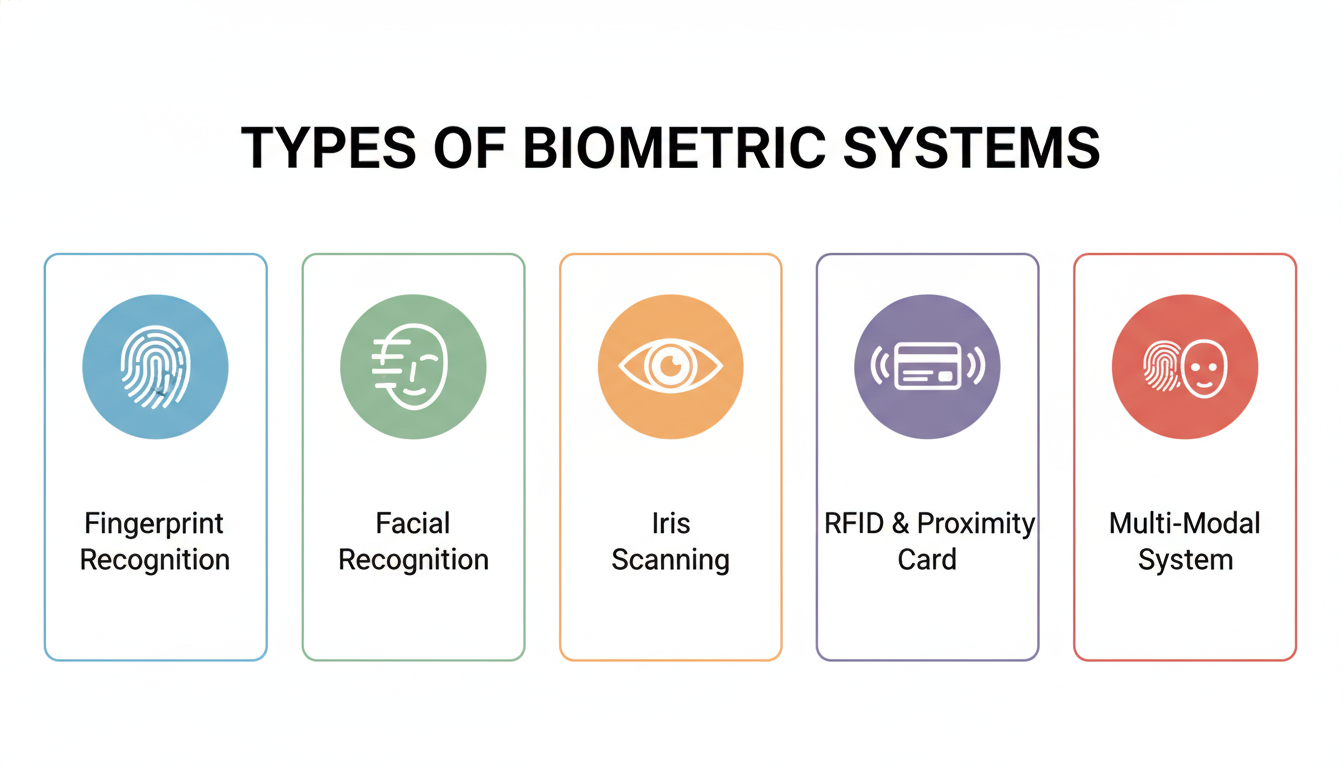
- Fingerprint recognition — most common and affordable
- Facial recognition — contactless and fast
- Iris scanning — highly accurate, used in high-security environments
- RFID/proximity cards — used when biometric enrollment is not feasible
- Multi-modal systems — combine two or more of the above
Each technology serves different environments and security requirements.
Biometric Attendance System Market Overview in Bangladesh
Adoption Trends Across Industries
The biometric attendance system market in Bangladesh has grown rapidly over the past decade. The garment and textile industry was among the first to adopt these systems due to large workforce sizes and strict compliance requirements. Today, adoption spans corporate offices, hospitals, educational institutions, NGOs, and government departments.
Cloud-based solutions and mobile-integrated devices have further accelerated adoption among small and medium businesses.
Demand in Manufacturing and Corporate Sectors
The RMG (Ready-Made Garment) sector, which employs over 4 million workers, relies heavily on biometric systems for shift management, overtime calculation, and compliance reporting. Corporate offices in Dhaka and Chattogram are also investing in advanced facial recognition and cloud-based platforms to manage hybrid workforces.
Demand is also rising in government offices following digital attendance mandates in several public institutions.
Local vs International Vendors in Bangladesh
Both local and international brands operate in the Bangladesh market.
Tipsoi is Bangladesh’s leading local biometric attendance brand, offering devices with Bangla-language interfaces, local payroll compliance features, and fast on-ground support- making it the top choice for businesses that need a solution built specifically for the Bangladesh market.
International brands- ZKTeco, Suprema, Hikvision, Anviz, and Virdi- also serve the mid to high-end segment with a wide range of hardware options.
How Biometric Attendance Systems Work
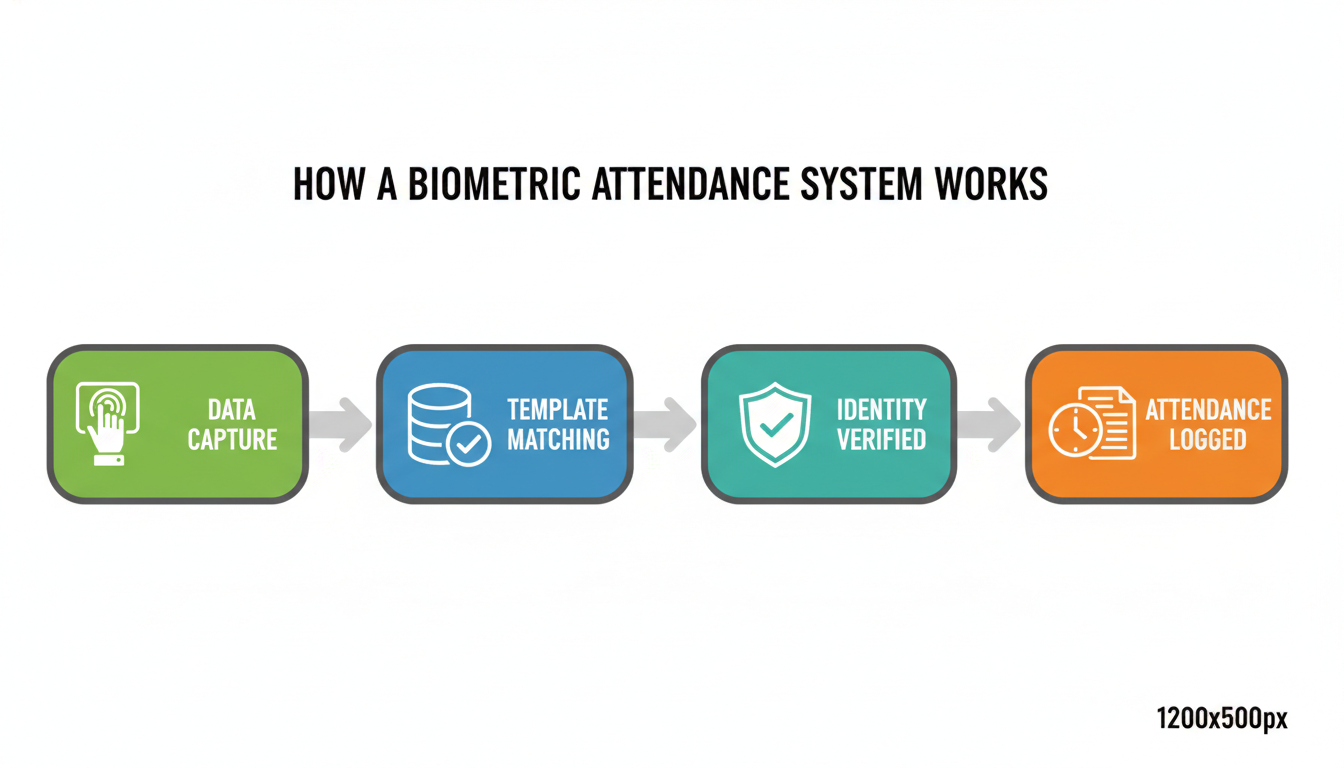
Data Capture and Biometric Identification
When an employee places their finger on the scanner or stands in front of a facial recognition camera, the device captures a biometric sample. This sample is converted into a mathematical template, not an actual image, and stored securely.
Authentication and Verification Process
During each attendance check, the device captures a new sample and compares it to the stored template. If the match score crosses a defined threshold, the system confirms identity and records the timestamp. This process takes less than one second for most modern devices.
Data Storage and Reporting System
Attendance logs are stored either on the device itself, on a local server, or in the cloud. The system generates reports on daily attendance, late arrivals, early exits, absences, and overtime. These reports can be exported and integrated with HR or payroll software automatically.
Types of Biometric Attendance Systems in Bangladesh
Fingerprint Recognition Systems
Fingerprint systems are the most widely used biometric attendance devices in Bangladesh. They are affordable, accurate, and easy to install. Most fingerprint devices can store between 3,000 to 10,000 fingerprint templates and support USB or network connectivity.
They work well in offices and indoor environments, but may face issues in industrial settings where workers have worn or dirty fingertips.
Facial Recognition Systems
Facial recognition attendance systems identify employees by scanning facial geometry. These are fully contactless, making them hygienic and suitable for post-pandemic workplaces. Modern facial recognition devices operate accurately even in varying lighting conditions.
They are gaining rapid adoption in corporate offices, hospitals, and schools in Dhaka and other major cities.
Iris Scanning Systems
Iris scanning offers the highest level of accuracy among all biometric methods. It is used in high-security environments such as government offices, financial institutions, and research facilities. Iris scanners are more expensive than fingerprint or facial recognition devices and are less common in Bangladesh’s general business market.
Learn More about Iris Recognition
RFID and Proximity Card Systems
RFID (Radio Frequency Identification) systems use cards or key fobs instead of biometric data. While not strictly biometric, they are often bundled with biometric devices as a backup method. These are suitable for environments where biometric enrollment is difficult, for example, construction sites or fields where workers change frequently.
Multi-Modal Biometric Systems
Multi-modal systems combine two or more identification methods, such as fingerprint plus facial recognition or RFID plus iris. They provide higher accuracy and redundancy. If one method fails, for example, a damaged fingertip, the system falls back to the second method. These are ideal for large enterprises and high-security facilities.
Explore more- Types of Biometric Attendance Devices Available in Bangladesh
Key Features of Modern Biometric Attendance Systems
Real-Time Attendance Tracking
Modern systems record attendance in real time and update dashboards instantly. HR managers can monitor who is present, absent, or late without waiting for end-of-day reports. Automated alerts can be triggered for absenteeism or unauthorized access.
Cloud and Mobile Accessibility
Cloud-based platforms allow managers to access attendance data from any device and location. Mobile apps let employees view their own attendance records, apply for leave, and receive notifications. This is particularly useful for businesses with multiple branches across Bangladesh.
HR and Payroll Integration
The most valuable feature for businesses is seamless integration with HR and payroll software. Attendance data flows directly into salary calculations, accounting for working hours, overtime, late deductions, and leave balances, eliminating manual data entry.
Offline Functionality and Data Synchronization
In areas with unstable internet, which is common in industrial zones and rural locations in Bangladesh, devices must work offline. Good biometric systems store data locally and sync it to the cloud or server automatically when connectivity is restored.
Security and Anti-Fraud Features
Anti-spoofing technology prevents fake fingerprints or printed photos from fooling the system. Liveness detection is now standard in advanced facial recognition devices. Encrypted data transmission protects employee records from unauthorized access.
Who Needs a Biometric Attendance System
Small and Medium Businesses in Bangladesh
SMEs with 20 to 200 employees benefit greatly from affordable fingerprint or facial recognition devices paired with simple cloud software. The return on investment comes quickly through reduced payroll errors and eliminated manual tracking. Entry-level devices in Bangladesh start from around BDT 5,000 to BDT 12,000, making them accessible for small businesses.
Explore More-
What is a Biometric System for Small Business
Why Small Businesses Need Biometric Attendance Systems
Large Enterprises and Corporate Offices
Large organizations require multi-branch integration, advanced reporting, role-based access control, and payroll system connectivity. Enterprise biometric solutions support thousands of employees across multiple locations with centralized management.
Factories and Manufacturing Industries
Garment factories, food processing plants, and other industrial facilities need rugged devices that work in dusty, humid, or greasy environments. Facial recognition or multi-modal systems are preferred here since fingerprint accuracy drops when workers’ hands are worn or dirty.
Remote and Field Workforce Management
For sales teams, delivery staff, and field workers, mobile-based GPS attendance apps with facial selfie verification provide an effective solution. These systems capture location, time, and face simultaneously, making them suitable for remote workforce management without physical devices.
Benefits of Biometric Attendance Systems
Eliminating Buddy Punching
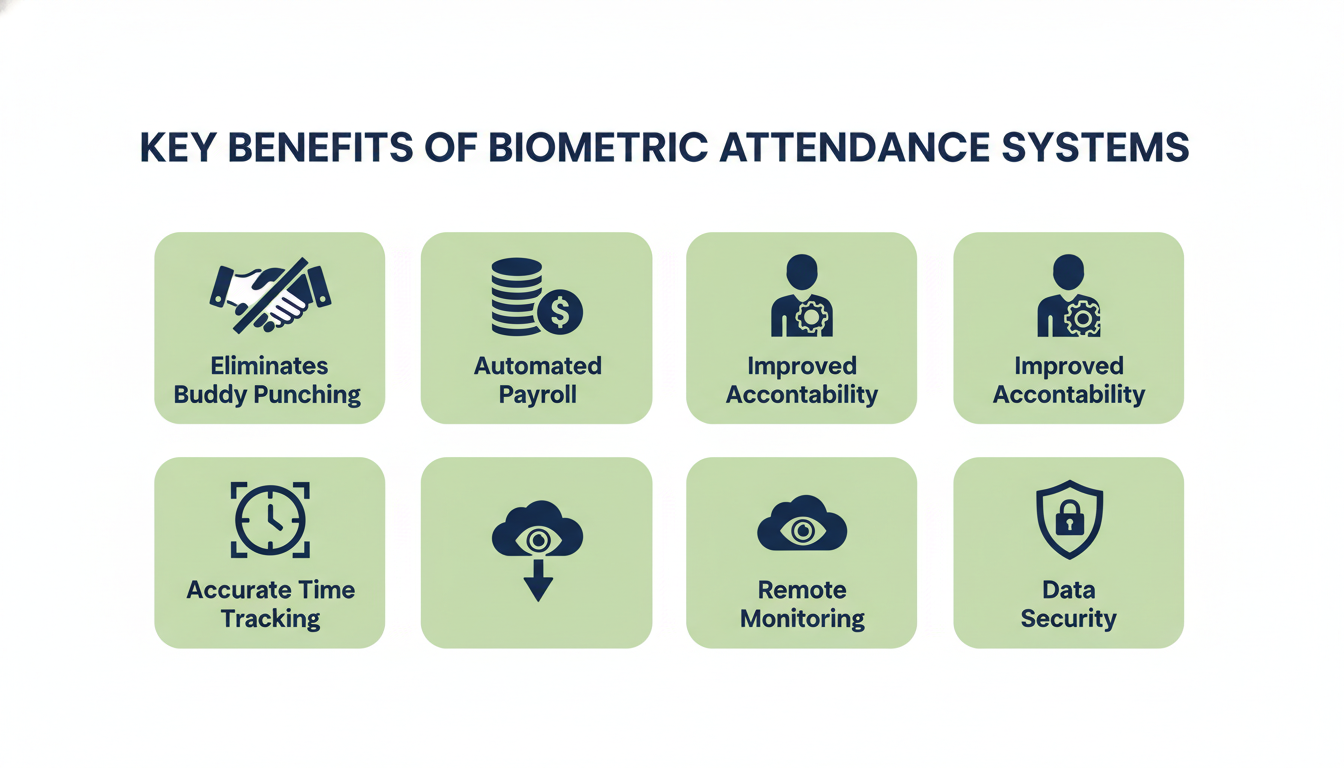
Buddy punching, where one employee marks attendance on behalf of another, is a common problem in Bangladesh workplaces. Biometric systems eliminate this completely since attendance is tied to a unique physical trait that cannot be shared or transferred.
Automated Payroll Processing
When attendance data flows automatically into payroll software, salary processing becomes faster and error-free. Over time, late deductions and leave adjustments are calculated accurately without HR manually reviewing timesheets.
Improved Employee Accountability
Knowing that attendance is tracked with biometric precision encourages employees to follow working hours consistently. Accountability improves naturally without additional supervision.
Accurate Time Tracking and Reporting
Every check-in and check-out is timestamped with precision. Businesses can generate detailed reports on attendance patterns, productivity, and absenteeism trends, data that supports better HR decisions.
Remote Monitoring Capabilities
Cloud-connected systems allow business owners and HR managers to monitor attendance across all branches from a single dashboard. Alerts, reports, and exports are available anytime without being physically present at the office.
Explore more details about the benefits of Biometric Attendance Systems for Small Businesses
Biometric Attendance System Price in Bangladesh (BDT)
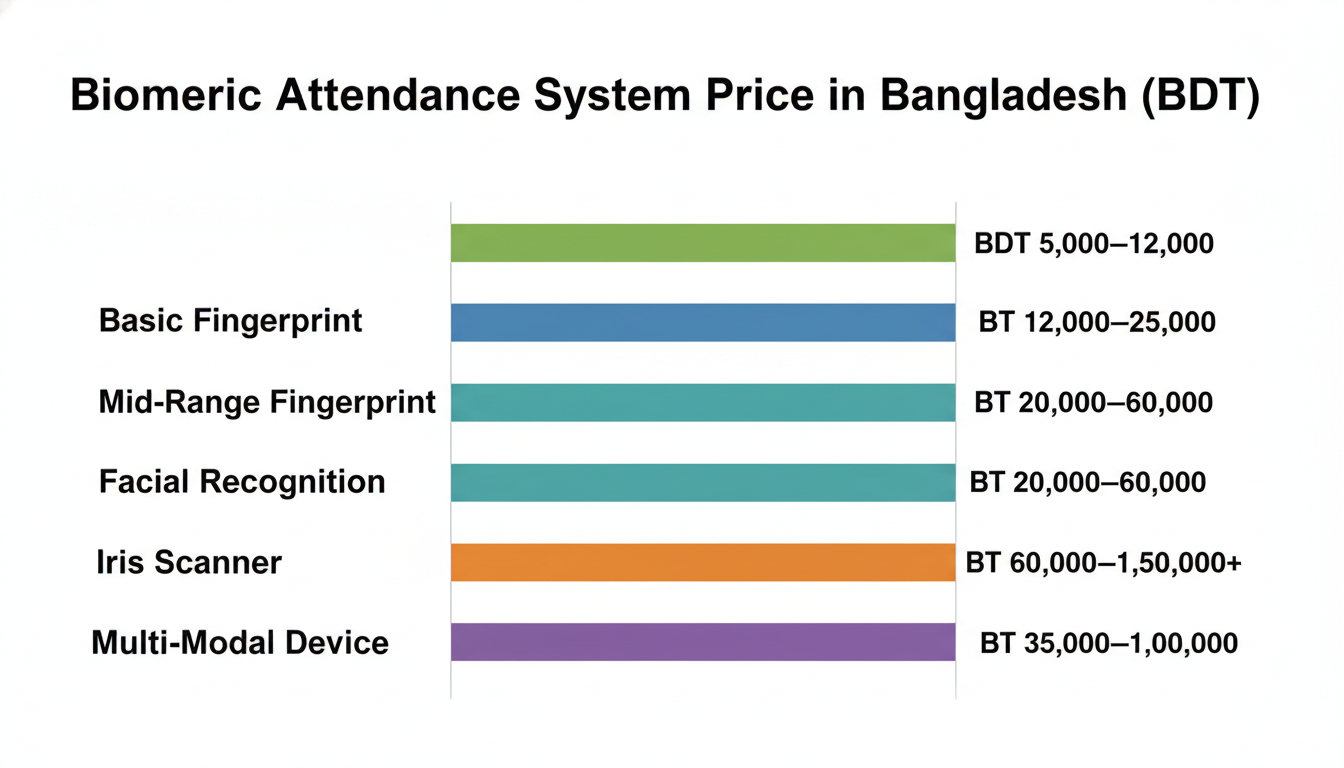
Price Range by Device Type
| Device Type | Price Range (BDT) |
| Basic Fingerprint Device | 5,000 – 12,000 |
| Mid-Range Fingerprint Device | 12,000 – 25,000 |
| Facial Recognition Device | 20,000 – 60,000 |
| Iris Scanner | 60,000 – 1,50,000+ |
| Multi-Modal Device | 35,000 – 1,00,000+ |
Software and Subscription Costs
Cloud-based attendance software typically costs BDT 500 to BDT 3,000 per month, depending on employee count and features. On-premise software is a one-time cost, usually ranging from BDT 15,000 to BDT 80,000, with optional annual maintenance charges.
Some local vendors like Tipsoi include software as part of the device package, reducing the total cost of ownership.
Installation and Maintenance Costs
Professional installation typically costs BDT 2,000 to BDT 8,000 per device, depending on wiring, network configuration, and location. Annual maintenance contracts range from 10% to 15% of the device cost. Businesses with multiple locations should budget for periodic firmware updates and technical support.
Factors Affecting Pricing in Bangladesh
- Brand and origin — international brands cost more than local alternatives
- Technology type — facial recognition costs more than fingerprinting
- User capacity — devices with higher template storage cost more
- Software features — payroll integration, cloud access, and multi-branch support add to the cost
- Vendor support — vendors offering local support and warranties may charge a premium
Top Biometric Attendance Devices and Brands in Bangladesh
Popular Fingerprint Devices
Tipsoi’s fingerprint attendance devices are built for Bangladesh’s business environment, supporting high user capacity, offline functionality, and direct payroll integration. For businesses looking for internationally recognized alternatives, ZKTeco’s F18, F22, and K40 series are widely available through local resellers. Anviz and Suprema also offer fingerprint devices in the mid-range segment.
Leading Facial Recognition Devices
Tipsoi offers facial recognition attendance devices with contactless identification, anti-spoofing features, and native integration with its HR software platform, purpose-built for offices, factories, and institutions in Bangladesh. Among international options, ZKTeco’s SpeedFace series and Hikvision’s DS-K series are also used in the corporate sector.
Hybrid and Multi-Modal Devices
Tipsoi’s multi-modal devices support both fingerprint and facial recognition, making them ideal for factories and large enterprises where a single method may not work for all employees. ZKTeco’s uFace series is a widely available international alternative for hybrid identification needs.
Trusted Brands in the Bangladesh Market
Tipsoi— Best Local Biometric Brand in Bangladesh. Tipsoi is designed specifically for the Bangladesh market. It offers Bangla-language interfaces, localized HR and payroll integration, Bangladesh labor law compliance reporting, and responsive local support. For businesses that want a solution that works out of the box without complex customization, Tipsoi is the strongest choice.
- ZKTeco — most widely distributed internationally, strong local reseller network in Bangladesh
- Hikvision — trusted for integrated security and attendance solutions
- Suprema — premium brand for high-security applications
- Anviz — mid-range devices with solid software support
For smart, locally optimized biometric attendance hardware, explore Tipsoi Smart Attendance Devices.
Best Biometric Attendance Software in Bangladesh
Cloud-Based Attendance Software
Cloud platforms store attendance data on remote servers, accessible from any browser or mobile app. They offer automatic updates, multi-branch management, and no requirement for in-house IT infrastructure. Ideal for businesses that want low setup costs and scalability.
On-Premise Attendance Solutions
On-premise software is installed on a local server within the company’s network. It offers full data control, better performance in low-connectivity areas, and no monthly subscription cost. It requires an internal IT team or vendor support for maintenance.
Features to Compare in Software Platforms
When evaluating attendance software for your Bangladesh business, compare:
- Payroll and HR system integration
- Bangla language support
- Leave and holiday management
- Shift scheduling and rosters
- Mobile app availability
- Multi-branch and department management
- Compliance reports aligned with the Bangladesh labor law
How to Choose the Right Biometric Attendance System in Bangladesh
Key Features to Consider Before Buying
Before purchasing, evaluate device accuracy, user capacity, connectivity options (TCP/IP, Wi-Fi, USB), power backup compatibility, and vendor after-sales support. Ensure the software includes the reporting and integration features your HR team actually uses.
Choosing Based on Business Size
- Under 50 employees — a basic fingerprint device with cloud software is sufficient
- 50 to 500 employees — mid-range device with multi-department reporting and payroll integration
- 500+ employees — enterprise multi-modal system with centralized management and API integration
Industry-Specific Requirements
- Garment factories — rugged, facial recognition, or multi-modal, high user capacity
- Corporate offices — sleek facial recognition with mobile app and cloud access
- Hospitals and clinics — contactless facial recognition, shift management
- Schools — affordable fingerprint with student/staff differentiation
Hardware vs Software Considerations
Many businesses focus only on the device and overlook software capabilities. The hardware captures data; the software makes it useful. Prioritize software that integrates with your existing payroll or ERP system. A cheaper device with powerful software often delivers better value than an expensive device with limited reporting.
Biometric Attendance System vs Other Attendance Methods
Manual Attendance vs Biometric Systems
Manual registers are prone to errors, falsification, and delays. They require HR time to compile and verify. Biometric systems automate the entire process, eliminate errors, and provide instant reports. The efficiency gain pays back the device cost within months for most businesses.
Explore More- Biometric Attendance vs Traditional Time Tracking
RFID vs Biometric Attendance
RFID cards can be shared, lost, or forgotten, which defeats the purpose of accurate attendance tracking. Biometric identification is tied directly to the individual and cannot be delegated. RFID is useful as a backup but should not be the primary method for attendance-critical environments.
Mobile Attendance Apps vs Biometric Devices
Mobile attendance apps with GPS and selfie verification work well for field staff and remote workers. However, for office-based teams, physical biometric devices provide more reliable, tamper-proof data. The best approach for most businesses is a combination of both.
Cloud-Based vs On-Premise Biometric Systems
Advantages of Cloud-Based Systems
- Access from anywhere, any device
- No local server required
- Automatic backups and updates
- Easy to scale with employee growth
- Lower upfront cost
Advantages of On-Premise Systems
- Full control over data
- No recurring subscription fees
- Works without internet dependency
- Better for highly sensitive data environments
- Suitable for areas with poor connectivity in Bangladesh
Which Option Is Better for Bangladesh Businesses
For most small and medium businesses in Bangladesh, cloud-based systems offer the best balance of cost, convenience, and scalability. For large factories in industrial zones with unreliable internet, on-premise systems with offline capability are more appropriate. Many vendors now offer hybrid solutions that work offline and sync to the cloud when connected.
Explore more about- Cloud HR vs On-Premise Total Cost
Implementation Process of Biometric Attendance Systems
Planning and Requirement Analysis
Start by identifying the number of employees, locations, shift patterns, and existing HR software. Define what reports you need and whether payroll integration is required. This planning phase ensures you purchase the right device and software combination from the beginning.
Device Installation and Setup
Install devices at entry and exit points with appropriate power and network connections. Configure IP addresses, time zones, and department/shift settings. Ensure the device is positioned at the correct height and lighting conditions for accurate reading.
Employee Enrollment Process
Each employee must register their biometric data during enrollment. For fingerprint systems, two or three fingers are typically enrolled per person. For facial recognition, the system captures multiple angles. Employee IDs, departments, and shift assignments are linked during enrollment.
Integration with Existing Systems
Connect the biometric device to your attendance software, then integrate the software with your HR or payroll platform. Many modern systems support API integration, enabling automated data transfer without manual exports.
Testing and Deployment
Before full deployment, run a pilot test with a small group of employees. Verify that check-ins are recorded correctly, reports are accurate, and payroll integration is working. Address any issues before rolling out to the entire workforce.
Challenges of Biometric Attendance Systems in Bangladesh
Power and Internet Connectivity Issues
Power outages and unstable internet are real challenges in many parts of Bangladesh, including industrial zones. Devices must have battery backup or UPS support, and software must support offline mode with automatic sync.
Environmental Challenges in Industrial Settings
Dust, humidity, oil, and heat in factories affect fingerprint scanner accuracy. Facial recognition systems handle industrial environments better. Choosing IP-rated devices designed for harsh conditions reduces maintenance issues.
Device Maintenance and Downtime
Biometric devices require regular cleaning, firmware updates, and occasional hardware repairs. Businesses should have a service contract with the vendor and a backup method (such as RFID) for downtime situations.
Data Accuracy and Duplication Issues
Incorrect enrollment, such as registering the same employee twice or enrolling low-quality biometric samples, leads to false rejections and identification errors. Careful enrollment processes and periodic database audits prevent these issues.
Legal and Compliance Considerations in Bangladesh
Employee Data Privacy and Security
Biometric data is sensitive personal information. Businesses in Bangladesh must inform employees about what data is collected, how it is stored, and how long it is retained. Employees should provide consent before enrollment. Storing biometric data without proper security measures creates legal and ethical risks.
Compliance with Labor Laws in Bangladesh
Bangladesh’s Labor Act 2006 and its amendments require employers to maintain accurate records of working hours, overtime, and wages. Biometric attendance systems provide the documentation needed to demonstrate compliance during labor inspections and disputes.
Data Storage and Security Best Practices
- Store biometric templates (not raw images) using encryption
- Restrict access to attendance data by role
- Use secure cloud platforms with ISO 27001 certification or equivalent
- Maintain regular backups
- Define a clear data retention and deletion policy
Future Trends of Biometric Attendance Systems in Bangladesh
Growth of AI-Based Face Recognition
Artificial intelligence is improving facial recognition accuracy significantly. AI-powered systems now identify employees accurately even with masks, glasses, or changed hairstyles. As device costs fall, AI-based face recognition is expected to replace fingerprint as the dominant method in Bangladesh within the next few years.
Increasing Demand for Contactless Systems
Post-COVID awareness has permanently shifted demand toward contactless attendance methods. Facial recognition and iris scanning are seeing higher adoption in offices, hospitals, and schools. This trend is expected to continue as prices become more competitive.
Integration with Advanced HR Technologies
Biometric attendance systems are increasingly integrating with full-suite HR platforms covering recruitment, performance management, and employee self-service portals. In Bangladesh, this trend is most visible in large enterprises and multinational companies. As local HR software matures, SMEs will also benefit from these integrated platforms.
Why Manual and Traditional Attendance Tracking Fails in Bangladeshi Workplaces
Many businesses in Bangladesh still rely on paper registers, punch cards, or spreadsheet-based attendance. These methods break down quickly at scale. Registers are easy to fill in for an absent colleague, punch cards get shared, and manual entry into payroll introduces errors every cycle. For factories running multiple shifts or offices spread across branches, the HR team spends hours each month reconciling numbers that are already wrong by the time they arrive.
The cost is not only administrative time. Inflated hours from buddy punching, unrecorded late arrivals, and disputed overtime all feed straight into payroll, so the business pays for work that never happened. A biometric attendance system removes the gap between what actually happened on the floor and what payroll pays out, because the record is tied to the individual employee and cannot be handed to someone else.
Biometric Attendance Use Cases by Industry in Bangladesh
Different sectors in Bangladesh use biometric attendance to solve different problems. The core technology is the same, but the priority shifts with the working environment.
Garments and Manufacturing
Ready-made garment factories and manufacturing units run large, multi-shift workforces where a few minutes of miscounted time across thousands of workers becomes a serious payroll and compliance issue. Fingerprint and facial recognition devices handle high-volume shift changes quickly and keep an auditable record for labour-law and buyer-compliance reporting.
Retail and Multi-Branch Offices
Retail chains and companies with several branches need one consolidated attendance view rather than separate registers per location. Cloud-based biometric systems sync every branch to a single dashboard, so head office sees real-time presence without collecting sheets from each outlet.
Logistics, Warehouses, and Field Staff
Warehouses and logistics operations often have staff who start shifts at odd hours or work away from a fixed desk. Mobile and app-based biometric check-in, combined with fixed devices at the gate, captures both on-site and field attendance without paperwork.
Construction and Project Sites
Construction and project sites are temporary, dusty, and often without stable power or internet. Rugged devices with offline functionality store punches locally and sync when connectivity returns, so site attendance is captured even in difficult conditions.
Calculating ROI and Total Cost of Ownership
The price of a biometric attendance system is more than the device on the wall. Planning the full cost, and the return against it, helps a business in Bangladesh choose the right option instead of the cheapest one.
Subscription vs One-Time Licensing
Software is usually offered either as a monthly or yearly subscription, or as a one-time perpetual licence. A subscription spreads the cost, includes updates and support, and suits businesses that want predictable operating expenses. A one-time licence has a higher upfront cost but no recurring fee, which can work for organisations that prefer to own the software and manage their own maintenance. Cloud subscriptions also remove the need to run and secure your own server.
Installation, Integration, and Hidden Costs
Beyond hardware and software, budget for device installation, employee enrolment time, and integration with existing HR or payroll systems. These one-time costs are easy to overlook and vary with the number of sites and employees. Asking a vendor for a total figure that includes setup and integration, rather than device price alone, avoids surprises later.
Estimating the Return
The return comes mainly from three places: recovered payroll leakage from eliminating buddy punching and inflated hours, HR time saved by automating attendance-to-payroll, and fewer disputes over pay. A simple way to estimate it is to add the monthly payroll hours currently lost to inaccurate records and the HR hours spent reconciling attendance, then compare that against the system’s monthly cost. For most businesses with regular shift work, the system pays for itself well within the first year.
FAQs About the Biometric Attendance System in Bangladesh
What Is the Best Biometric Attendance System in Bangladesh
For most businesses in Bangladesh, Tipsoi is the best choice. It is the only locally built biometric attendance system with a Bangla interface, Bangladesh-specific payroll compliance, and dedicated local support, giving it a clear advantage over international brands that require additional customization.
For businesses that specifically need internationally certified hardware at various price points, ZKTeco offers the widest device range through local resellers. For high-security applications, Suprema and Virdi remain strong options.
How Much Does a Biometric Attendance System Cost in Bangladesh
A basic fingerprint device starts from BDT 5,000. Mid-range devices with cloud software cost BDT 15,000 to BDT 40,000. Full enterprise solutions with facial recognition, multi-branch management, and payroll integration can cost BDT 1,00,000 or more, depending on scale.
Is Biometric Attendance Safe and Secure
Yes, when implemented correctly. Modern systems store biometric templates in encrypted format, not actual fingerprint images or photos. Data transmission is encrypted, and access is role-restricted. Choosing a reputable vendor with clear data security policies ensures your employee data remains protected.
Can Biometric Systems Work Without Internet
Yes. Most biometric attendance devices store data locally in their internal memory. Cloud-based software platforms are designed to sync data automatically once the internet is restored. This offline capability is essential for industrial areas and remote locations in Bangladesh.
Which Biometric System Is Best for Factories in Bangladesh
For garment factories and manufacturing plants, facial recognition or multi-modal systems are recommended over fingerprint-only devices. Workers in these environments often have worn, oily, or calloused fingertips that reduce fingerprint accuracy. Rugged devices with IP65 or higher ratings, high user capacity, and offline functionality, like those available from Tipsoi, are best suited for factory environments in Bangladesh.