

TL;DR: SME digitization in Bangladesh is still at an early stage. Only 46 percent of firms used computers between 2019 and 2022, and just 7 percent used cloud software. Yet SMEs supply 31 percent of GDP and 78 percent of jobs. The fastest wins come from digitizing one workflow first, usually attendance and payroll.
Most small and medium businesses in Bangladesh still run on paper, and the numbers prove it. World Bank data shows that only 46 percent of firms in Bangladesh used computers between 2019 and 2022. Just 7 percent used cloud computing. That is the honest picture of SME digitization in Bangladesh today. I work with HR teams at growing companies every week, and I see this gap up close. This article lays out the verified rates, why they matter, and the most practical first step for your business.
What do the numbers say about SME digitization in Bangladesh?
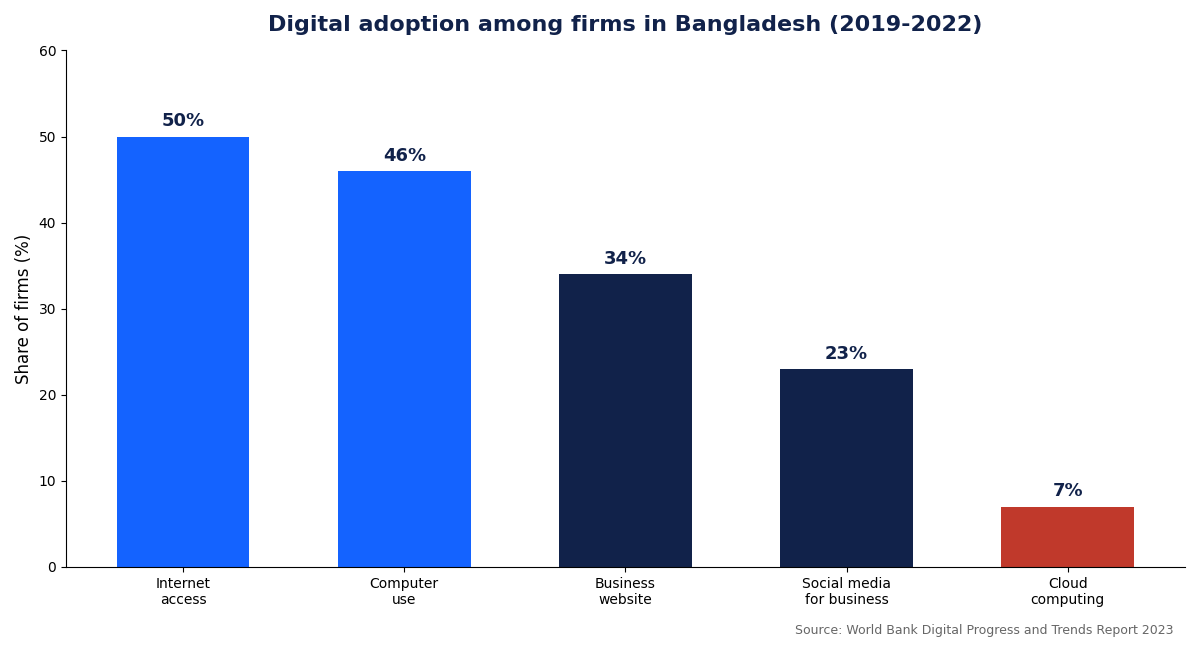
Fewer than half of Bangladeshi firms use a computer for business. The World Bank’s Digital Progress and Trends Report 2023 measured technology use in firms between 2019 and 2022. Bangladesh sat near the bottom of its peer group on every indicator.
| Digital indicator | Share of firms in Bangladesh |
|---|---|
| Internet access | 50% |
| Computer use | 46% |
| Business website | 34% |
| Social media for business | 23% |
| Cloud computing | 7% |
The cloud figure deserves the most attention. Cloud software is what turns a computer into a business system. Payroll, attendance, inventory, and accounting all live there. At 7 percent adoption, the tools that create real productivity gains have barely arrived.
Why do SME digitization rates matter so much for Bangladesh?
Because SMEs are nearly the entire economy. SME Foundation data shows cottage, micro, small, and medium enterprises make up 99.92 percent of all economic units in Bangladesh. They employ around 23.6 million people, which is roughly 78 percent of total employment. They contribute more than 31 percent of GDP.
The sector is also growing fast. The Economic Census 2024 counted about 11.88 million economic units nationwide. That is nearly 50 percent more than a decade earlier. Around 7.4 million of these units sit in rural areas. When a sector this large stays analog, the whole economy pays for it in lost productivity.
99.92%
of economic units are CMSMEs
23.6M
people employed by SMEs
31%+
of GDP comes from SMEs
7%
of firms use cloud software
How does Bangladesh compare with its peers?
The gap is wide and easy to see. In the same World Bank survey window, almost 100 percent of firms in Brazil, Chile, Georgia, India, Korea, Poland, and Vietnam had a computer and an internet connection. Bangladesh managed 46 and 50 percent.
| Indicator | Bangladesh | Peer economies |
|---|---|---|
| Firms with computers (2019-2022) | 46% | Near 100% (India, Vietnam, Brazil, Korea) |
| Firms with internet access | 50% | Near 100% in the same group |
| SME share of GDP | 31%+ | 40-45% in Vietnam |
| Internet reliability | ~7 outages per month | Far fewer in peer markets |
Vietnam is the useful comparison, not Germany. Vietnamese SMEs are 98 percent of businesses and contribute 40 to 45 percent of GDP. They got there by plugging into supply chains and adopting basic digital systems early. Bangladesh has the same entrepreneurial base. What it lacks is adoption.
Bangladesh does not have a technology shortage. It has an adoption gap.
What is holding SME digitization back?
Cost, skills, and infrastructure, in that order. Research on Bangladeshi SMEs keeps finding the same barriers. A 2023 study in Global Business Review found that technological readiness and organizational factors decide whether emerging-market SMEs adopt digital tools [1]. Most local SMEs run on thin margins and see software as an expense, not an investment.
The skills gap compounds the cost problem. Many owners never see a demo of what modern tools do. Outside major cities, digital literacy support is minimal. Then infrastructure adds friction. The World Bank report notes internet service in Bangladesh fails around seven times per month on average. Each outage teaches a business owner to keep the paper register nearby.
Financing is the quiet fourth barrier. New ventures often lack the collateral or records that banks want. Women entrepreneurs received only about 7 percent of CMSME loans disbursed in 2025. A business that cannot borrow rarely buys software. If you are budgeting for your first system, this HR software pricing guide for Bangladesh shows what realistic costs look like.
Where should an SME start digitizing?
Start with one workflow, and make it attendance and payroll. Here is my contrarian take. The standard advice says build a full digital roadmap. I disagree. I have watched SMEs stall because they tried to digitize everything in one quarter. The businesses that succeed pick a single painful process, fix it, and bank the saving.
Attendance and payroll is the right first pick for three reasons. First, the pain is universal. Every SME with staff burns hours on manual registers and salary math. Second, the payback is fast and measurable. Automated attendance data feeds payroll directly and removes dispute hours. Third, it needs no process redesign. Your team clocks in, and the software does the rest.
Our own data backs this up. Companies that automate time tracking see clear gains, which we break down in our guide to employee productivity tracking in Bangladesh. From there, expansion is natural. Leave management, shift scheduling, and payroll follow the same data. If you want to compare entry points, start with the best HR software in Bangladesh roundup.
Does digitization actually pay off for SMEs?
The research says yes, when adoption is real. A 2024 study of Bangladeshi SMEs found digital marketing adoption directly improved sales reach and customer engagement, even for very small firms [2]. A 2022 review of SMEs in emerging economies found that digitally capable firms coped far better during the Covid-19 shock and recovered faster [3].
The pattern repeats across studies. Digital tools do not create value by existing. They create value by replacing slow, error-prone manual work. That is why HR and attendance automation shows returns quickly. It removes daily manual effort rather than adding a new channel to manage. Smaller firms can start light, as we show in our guide to choosing HR software for small businesses in Bangladesh.
How Tipsoi fits into SME digitization in Bangladesh
I will keep this part short and practical. If you run an SME and want the first digital win, here is the path we see work:
- Digitize attendance first. Tipsoi connects biometric devices and mobile check-ins to one cloud dashboard, so the data collects itself.
- Let attendance feed payroll. Verified hours flow straight into salary runs, which ends month-end disputes.
- Add modules as you grow. Leave, shifts, and field-force tracking switch on when you are ready, without new hardware.
- Judge it by the numbers. A good system should pay for itself in recovered admin hours within months.
Tipsoi is built in Bangladesh for exactly this market, including its connectivity realities. That local fit matters more than any feature list.
FAQ: SME digitization in Bangladesh
What percentage of businesses in Bangladesh use digital tools?
Between 2019 and 2022, 46 percent of firms in Bangladesh used computers and 50 percent had internet access. Only 34 percent had a website, 23 percent used social media for business, and 7 percent used cloud computing, according to the World Bank.
How much do SMEs contribute to Bangladesh’s economy?
Cottage, micro, small, and medium enterprises make up 99.92 percent of all economic units in Bangladesh. They employ about 23.6 million people, near 78 percent of total employment, and contribute more than 31 percent of GDP, per SME Foundation data.
Why is digital adoption low among Bangladeshi SMEs?
The main barriers are cost pressure on thin margins, limited digital skills, unreliable infrastructure, and weak access to financing. Internet service fails around seven times per month on average, which pushes owners back toward paper systems.
What should a Bangladeshi SME digitize first?
Attendance and payroll is the most common high-return starting point. The pain is daily, the savings are measurable, and no business process needs redesigning. One workflow done well beats five started and abandoned.
How does Bangladesh compare with Vietnam on SME digitization?
Vietnam’s SMEs are about 98 percent of businesses and contribute 40 to 45 percent of GDP, with near-universal computer and internet use in firms. Bangladesh’s SMEs contribute just over 31 percent of GDP, and fewer than half of firms use computers.
Key takeaways
- Only 46 percent of Bangladeshi firms used computers between 2019 and 2022, and just 7 percent used cloud software.
- SMEs are 99.92 percent of economic units, 78 percent of employment, and over 31 percent of GDP, so the digitization gap is a national productivity problem.
- Peer economies like Vietnam and India reached near-universal firm-level computer and internet use in the same period.
- Cost, skills, infrastructure, and financing are the four barriers that keep SME digitization in Bangladesh slow.
- The proven starting point is one workflow, and attendance plus payroll gives the fastest measurable return.
References
- Shahadat, M. M. H., Nekmahmud, M., Ebrahimi, P., & Fekete-Farkas, M. (2023). Digital Technology Adoption in SMEs: What Technological, Environmental and Organizational Factors Influence in Emerging Countries? Global Business Review. https://doi.org/10.1177/09721509221137199
- Mustaqeem, K. M., & Sarder, M. A. U. (2024). The Impact of Digital Marketing on Small and Medium Enterprises (SMEs) in Bangladesh. International Journal of Research and Scientific Innovation. https://doi.org/10.51244/ijrsi.2024.1109069
- Hossain, M. R., Akhter, F., & Sultana, M. M. (2022). SMEs in Covid-19 Crisis and Combating Strategies: A Systematic Literature Review and A Case from Emerging Economy. Operations Research Perspectives. https://doi.org/10.1016/j.orp.2022.100222
- World Bank findings reported in: Hasan, M. (2024). Bangladesh lags behind peers in digital adoption for business. The Daily Star. Read the report summary
- Mohiuddin, T. (2026). Can SMEs power Bangladesh’s next growth chapter? The Business Standard. Read the article
- UNB (2026). Economic Census 2024 report released: economic units grew nearly 50% in a decade. Read the census summary