

TL;DR: Track six KPIs you can prove before you track twenty you cannot. For Bangladeshi employers that means turnover rate, absenteeism rate, overtime hours, time to hire, cost per hire, and earned leave liability. Every one of them is built from clean attendance data, so fix the data source first.
The KPIs metrics HR manager should track fall into six essentials: employee turnover rate, absenteeism rate, overtime hours per employee, time to hire, cost per hire, and earned leave liability. Those six answer the questions your CEO actually asks. Everything else is a nice-to-have until these are accurate and current.
I have sat in enough Dhaka HR reviews to notice a pattern. The dashboard looks impressive. Then someone asks how absenteeism was calculated, and the room goes quiet. This guide gives you the formulas, the local legal thresholds, and an honest test of whether your numbers can survive that question.
Key stats at a glance
60 hours
Absolute weekly working cap including overtime under the Bangladesh Labour Act, 2006.
4% daily absenteeism
Measured across 60 Bangladeshi garment factories by Menzel and Woodruff.
1 day per 18
Earned leave accrual rate for factory and commercial workers under Section 117.
How many HR KPIs should a manager actually track?
Start with six, and never let a single dashboard grow past eight. Most published lists of KPIs metrics HR manager should track run to twenty or thirty entries. That advice quietly assumes your data is already clean.
Here is my contrarian view. In Bangladesh, the bottleneck is almost never which KPI to choose. It is that the attendance register underneath every KPI is a paper book, an Excel sheet, or a WhatsApp message from a supervisor. You cannot compute an honest absenteeism rate from a register a supervisor filled in on Thursday for the whole week.
A KPI you cannot audit is not a KPI. It is a rumour with a number attached.
Research supports the caution. Marler and Boudreau reviewed the HR analytics evidence base and found it long on enthusiasm, short on proven performance links [1]. McCartney and Fu later explained why. Analytics only moves organisational performance when data quality and the decision process both hold up [2]. Six trustworthy numbers beat thirty decorative ones.
If you are new to the concept itself, our guide to what key performance indicators are covers the fundamentals before you pick your six. Our honest look at the systemic limitations of HR metrics is worth reading alongside it.
Which KPIs metrics HR manager should track in Bangladesh?
The six KPIs metrics HR manager should track below cover retention, cost, compliance, and hiring speed. Each has a formula you can defend in a board meeting. Each is computable from attendance and payroll data you already have, or should have.
| KPI | Formula | Review frequency | Data source |
|---|---|---|---|
| Employee turnover rate | (Separations ÷ Average headcount) × 100 | Monthly and annual | HR records |
| Absenteeism rate | (Absent hours ÷ Scheduled hours) × 100 | Weekly | Attendance system |
| Overtime hours per employee | Total OT hours ÷ Headcount | Weekly | Attendance system |
| Time to hire | Days from job posted to offer accepted | Per requisition | Recruitment log |
| Cost per hire | (Internal + external hiring costs) ÷ Hires | Quarterly | Finance and HR |
| Earned leave liability | Accrued unused leave days × Daily wage | Quarterly | Leave and payroll records |
1. Employee turnover rate
Turnover rate is the percentage of staff who leave over a set period. Divide separations by average headcount, then multiply by 100. Track it monthly, and always segment it.
The aggregate number hides the story. Split it by department, by tenure band, and by first-year hires. New-hire turnover in the first ninety days points at your onboarding, not your salary scale.
Local context matters here. Menzel and Woodruff recorded annual turnover above 30% in their sample of Bangladeshi garment factories [3]. If you run an RMG unit and report 8% turnover, your definition is probably wrong, not your retention.
2. Absenteeism rate
Absenteeism rate is the share of scheduled working hours lost to absence. Divide absent hours by total scheduled hours, then multiply by 100. Use hours, not days, or part-day absences vanish.
The same Bangladeshi factory study found daily absenteeism running at about 4% [3]. That is a useful benchmark for floor-based operations. Pauly and colleagues modelled why the true cost exceeds the wage paid, because output loss depends on how hard the role is to cover [4].
Watch the pattern, not just the level. Monday and post-holiday spikes suggest a scheduling problem. A single line running double the site average suggests a supervisor problem.
3. Overtime hours per employee
Overtime hours per employee is your compliance early-warning system. Total overtime hours divided by headcount, tracked weekly. In Bangladesh this KPI carries legal weight, not just cost weight.
The Bangladesh Labour Act, 2006 sets hard ceilings. Section 100 caps the standard day at eight hours. Section 102 caps the standard week at 48 hours. No week may exceed 60 hours including overtime, and the annual average is capped at 56 [5]. Section 108 sets overtime pay at twice the ordinary basic wage rate.
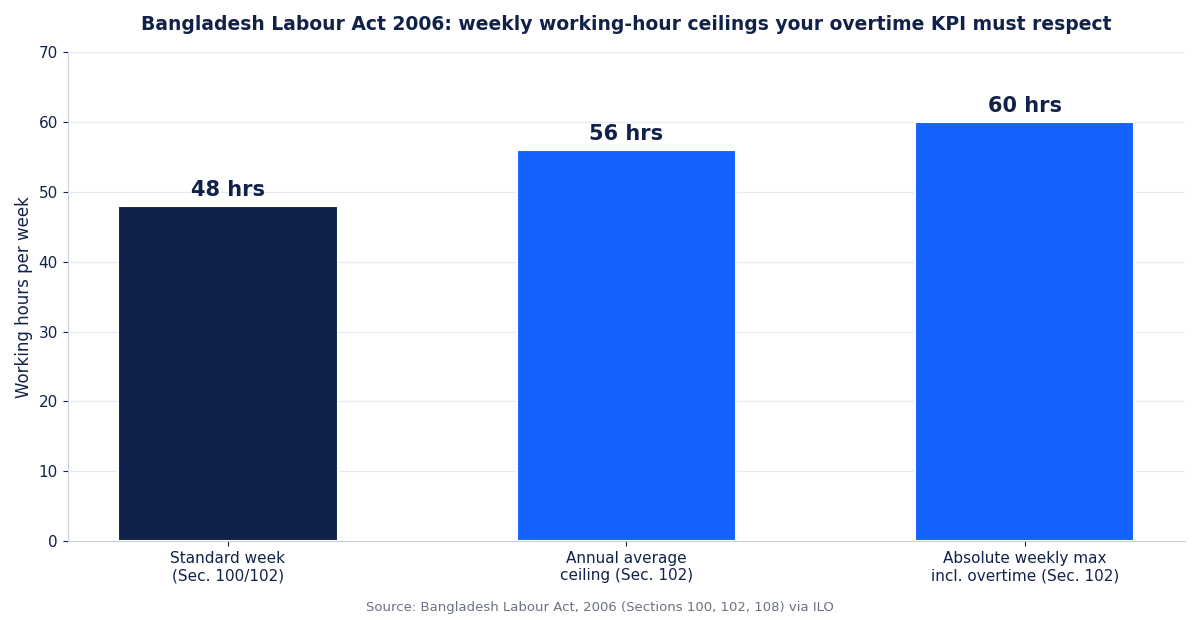
Set your alert threshold below the legal limit. An employee at 58 hours needs intervention this week, not a note in next quarter’s report. Automated employee overtime tracking makes that alert possible without a clerk rechecking every card.
4. Time to hire
Time to hire counts the days between posting a role and the candidate accepting your offer. Measure it per requisition, then take the median across roles. The median resists the one nightmare vacancy that skews the mean.
Long time to hire is rarely a sourcing failure. More often it is an approval queue. Time-stamp each stage, and the delay usually reveals itself in one specific handoff.
5. Cost per hire
Cost per hire adds internal and external recruiting costs, then divides by the number of hires. Include advertising, agency fees, referral bonuses, and the loaded hours your team spends interviewing. Most Bangladeshi SMEs skip the internal hours and understate the figure badly.
Pair this metric with first-year retention. A cheap hire who leaves in four months cost you far more than the invoice suggests.
6. Earned leave liability
Earned leave liability is the money value of leave your staff have accrued but not taken. This is the KPI Bangladeshi finance teams most often discover too late. It is a real balance-sheet obligation.
Section 117 of the Labour Act sets the accrual rate. A worker with one year of continuous service earns one day of paid annual leave per 18 days worked [5]. That rate applies to factory, shop, commercial, and industrial establishments. Unused leave carries forward. Multiply accrued days by daily wage, and review quarterly.
A structured leave management system turns this from an annual audit surprise into a number you already know.
Why do HR KPIs fail in Bangladeshi companies?
They fail at the data layer, not the analysis layer. Every one of the KPIs metrics HR manager should track inherits the quality of the attendance record beneath it. I have reviewed dashboards built on registers that were physically impossible to verify. The maths was fine. The inputs were fiction.
Three failure modes repeat:
- Proxy punching. A colleague signs in for an absent worker, so absenteeism reads artificially low.
- Retrospective entry. Attendance is written up days later from memory, so overtime is rounded rather than recorded.
- Split systems. Attendance lives in one file, leave in another, payroll in a third. No one can reconcile them, so no one tries.
Aral, Brynjolfsson and Wu studied this directly. HR analytics delivers gains mainly alongside the right IT infrastructure and incentives, not on its own [6]. In plain terms, the tool and the data source must arrive together. A dashboard bolted onto a paper register just renders bad data faster.
How do you build a KPI dashboard you can trust?
Work in this order. Each step depends on the one before it.
- Fix the capture point. Move attendance to a device that records the actual person at the actual time. Biometric or face recognition removes proxy punching at source.
- Unify attendance, leave, and payroll. One database means turnover, absenteeism, overtime, and leave liability all reconcile to the same records.
- Automate the six formulas. Manual recalculation guarantees the KPI arrives too late to act on.
- Set thresholds and alerts. Weekly overtime above 55 hours should trigger a notification, well before the statutory 60-hour ceiling.
- Segment every metric. By department, site, and tenure. Aggregates comfort; segments inform.
- Review the definitions quarterly. If two managers define absence differently, your trend line is noise.
This is the sequence we built Tipsoi’s workforce management system around, and it is why we start customers at the device rather than the dashboard. Attendance, leave, overtime, and payroll sit in one place, so the six KPIs compute themselves from records nobody had to retype. If you are still comparing options, our breakdown of HR management software features shows what to demand from any vendor, ours included.
You do not need our software to apply this article. You do need a data source you can audit. That is the whole argument.
Key takeaways
- The KPIs metrics HR manager should track reduce to six: turnover, absenteeism, overtime, time to hire, cost per hire, and earned leave liability.
- Never exceed eight metrics on one dashboard, or focus dissolves.
- Measure absenteeism in hours and turnover by segment, or both mislead you.
- Overtime is a compliance KPI in Bangladesh, with a hard 60-hour weekly ceiling.
- Earned leave accrues at one day per 18 days worked and carries forward as a real liability.
- Data quality decides KPI value. Fix the capture point before buying the dashboard.
Frequently asked questions
What are the most important KPIs metrics HR manager should track first?
Start with turnover rate and absenteeism rate. Both are cheap to compute and expose the largest hidden costs. Add overtime hours next if you operate a factory or field team, because it carries legal exposure under the Bangladesh Labour Act.
How do you calculate employee turnover rate?
Divide the number of separations in a period by the average headcount for that period, then multiply by 100. Average headcount means the start and end headcount averaged. Use the same period length every time, or comparisons break.
What is a good absenteeism rate in Bangladesh?
There is no single official benchmark. Research across 60 Bangladeshi garment factories found daily absenteeism near 4%, which is a reasonable reference point for floor operations. Office environments typically run lower. Compare against your own trend before comparing against anyone else’s.
How many hours of overtime are legal in Bangladesh?
The standard week is 48 hours. Total weekly hours including overtime must not exceed 60, with an annual average capped at 56 hours per week. Overtime is paid at twice the ordinary basic wage rate under Section 108 of the Labour Act, 2006.
Can I track HR KPIs in Excel?
Yes, and many Bangladeshi SMEs do. The limitation is not the formulas, it is the input. If attendance reaches Excel by manual typing, your KPIs inherit every typo and every act of goodwill from a supervisor covering for a friend.
How often should HR KPIs be reviewed?
Review absenteeism and overtime weekly, because both need intervention while the week is still fixable. Review turnover monthly. Review cost per hire and leave liability quarterly. Frequency should match how fast you can actually act.
What is earned leave liability and why does it matter?
It is the monetary value of accrued but unused annual leave. It matters because unused leave carries forward under Section 117 and must eventually be paid or taken. Companies that ignore it face a compounding obligation they never budgeted for.
References
- Marler, J. H. and Boudreau, J. W. (2016). An evidence-based review of HR Analytics. The International Journal of Human Resource Management. https://doi.org/10.1080/09585192.2016.1244699
- McCartney, S. and Fu, N. (2022). Bridging the gap: why, how and when HR analytics can impact organizational performance. Management Decision. https://doi.org/10.1108/MD-12-2020-1581
- Menzel, A. and Woodruff, C. (2021). Gender wage gaps and worker mobility: Evidence from the garment sector in Bangladesh. Labour Economics. https://doi.org/10.1016/j.labeco.2021.102000
- Pauly, M. V., Nicholson, S., Xu, J., Polsky, D., Danzon, P. M., Murray, J. F. and Berger, M. L. (2002). A general model of the impact of absenteeism on employers and employees. Health Economics. https://doi.org/10.1002/hec.648
- International Labour Organization. Bangladesh Labour Act, 2006 (Sections 100, 102, 108, 117). https://www.ilo.org/media/43266/download
- Aral, S., Brynjolfsson, E. and Wu, L. (2012). Three-Way Complementarities: Performance Pay, Human