

TL;DR: An RFID attendance system logs staff in and out when they tap a card on a reader. The card holds an ID number, not a fingerprint. It is fast, cheap and works offline. Its one real weakness is that a card proves the card arrived, not the person.
An RFID attendance system records who came in and when. Staff tap a card instead of signing a register. The card carries a unique number. The reader picks that number up over radio waves. Your attendance software then stamps the time.
I have set these up in factories in Gazipur and in small offices in Dhaka. The technology is not complicated. What trips people up is the card frequency. They choose wrong, then find out a year later.
This guide covers how the cards work and where NFC fits in. It also covers what the technology does well, and where it quietly fails.
Key stats at a glance
What is an RFID attendance system?
An RFID attendance system uses radio frequency identification to read a card without contact. RFID has three parts: a tag, a reader and software.
The tag sits inside the plastic staff card. It has a tiny chip and a coiled antenna. It has no battery.
The reader on the wall pushes out an electromagnetic field. When the card enters that field, the field induces a current in the antenna. That current wakes the chip.
The chip then sends its stored number back as a radio signal. The reader catches it and hands it to the software. The software matches the number to an employee record and writes a timestamp.
That whole exchange takes under a second. For the wider background, we cover what RFID is, its full form and its types separately.
How does the card frequency change what you get?
This is the decision that matters most, and most buyers never get asked about it. RFID is not one technology. It is a family split by radio frequency.
125 kHz low frequency (prox cards)
These are the old white proximity cards. The format dates to around 1990. The card sends a fixed number the moment it enters the field.
There is no encryption and no two-way conversation. The data is the same every single time.
They are cheap and they work. They are also the easiest card in the world to copy.
13.56 MHz high frequency (smart cards)
These are contactless smart cards, such as MIFARE. The card and reader open a short encrypted session using shared keys.
Only after that handshake does the card number move. The session then closes.
These cards can also store data and hold multi-level access permissions. That matters if the same card opens doors as well as marking attendance.
UHF 860 to 960 MHz
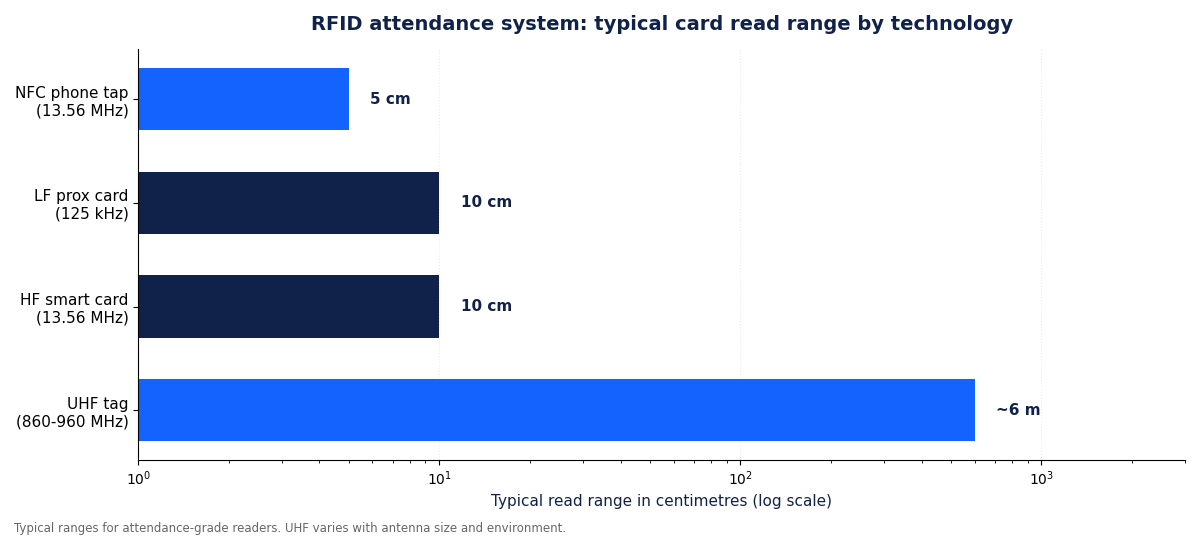
UHF tags read from several metres away. Staff walk through a gate and get logged without stopping.
That sounds attractive for a factory gate at shift change. It also means the reader may log someone walking past the door who never came to work.
RFID vs NFC: what is the actual difference?
People use these words as if they compete. They do not. NFC is a subset of RFID.
NFC runs only at 13.56 MHz. RFID covers low frequency, high frequency and UHF.
The practical gap is range and direction. NFC works at roughly 0 to 5 cm, and realistically under 10 cm. That short range is a security feature, not a limitation.
NFC also talks both ways. That is why a phone can act as the card, or as the reader. A plain RFID tag only answers when asked.
For attendance, this means one thing. If you want staff to tap their phone instead of a card, you need NFC. If you want cards, high frequency RFID is already NFC-compatible hardware.
Card technology compared
| Feature | 125 kHz LF prox | 13.56 MHz HF / NFC | UHF 860 to 960 MHz |
|---|---|---|---|
| Typical read range | 2 to 10 cm | 2 to 10 cm (NFC tap under 5 cm) | Several metres |
| Encryption | None. Fixed ID in clear | Yes. Encrypted session | Varies by tag class |
| Data on card | ID number only | ID plus stored data and permissions | ID, sometimes more |
| Cloning difficulty | Very low | Moderate to high | Moderate |
| Phone can act as card | No | Yes, via NFC | No |
| Best fit | Simple in and out only | Attendance plus door access | Gates, vehicles, assets |
What does an RFID attendance system do well?
Speed at the door. Staff tap and walk. There is no queue at shift change. That queue is the single biggest complaint about fingerprint readers in a 500-worker factory.
It works in bad conditions. Wet hands, dusty hands, cut fingers, mehendi. None of it matters to a card. In a garments unit or a construction site, that is worth a great deal.
Cost per user is low. Cards are cheap to issue and cheap to replace. Adding your 200th worker costs the price of one card.
No biometric data to protect. The card holds a number, not a body measurement. That sidesteps a whole category of employee privacy worry.
It removes the arithmetic. Manual registers create overtime disputes. Under section 108 of the Bangladesh Labour Act 2006, overtime is paid at twice the ordinary basic wage rate. Timestamps settle those arguments before they start. We go deeper in our piece on automating the overtime math.
Where does an RFID attendance system fail?
Here is my contrarian point, stated plainly. A card cannot stop buddy punching. Anyone who tells you it does is selling.
An RFID attendance system authenticates a card. It does not authenticate a person.
If Rahim hands his card to Karim, the system logs Rahim as present. The reader has no way to know. Every card-based system shares this flaw by design.
You may have read that attendance systems cut buddy punching almost to zero. That near total figure belongs to face recognition, not RFID. A face cannot be passed to a colleague. A card can.
The cloning risk is worse than card sharing. Academic work has classified attacks on RFID tags for well over a decade. Cloning, eavesdropping and relay attacks are all documented [2]. Research on MIFARE Classic went further. It showed even encrypted cards could be cloned once the algorithm was reverse-engineered [4].
For 125 kHz prox cards there is no reverse-engineering needed. The card broadcasts a fixed number with no encryption. A cheap handheld copier duplicates it in about two minutes.
So if someone tells you a 125 kHz RFID attendance system is secure, they are selling, not advising.
How to close the gap
You have three practical options.
- Move to 13.56 MHz. Encrypted sessions raise the effort required. This is the minimum I recommend for any new install.
- Add a second factor. Pair the card with a fingerprint or a face check at clock-in. The card identifies, the biometric verifies.
- Add photo capture. The terminal photographs whoever taps. It does not prevent sharing, but it makes it traceable and therefore rare.
If your risk is genuinely high, compare the approaches directly in our guide to RFID vs biometric attendance for Bangladesh businesses.
Who should choose RFID?
An RFID attendance system fits you if speed and volume matter more than identity certainty.
Good fits include garment floors at shift change, schools and colleges, and warehouses. Offices that already issue ID cards for doors also qualify. Research on university deployments found RFID handled bulk attendance faster than manual roll call. It also cut recording errors [1][3].
Poor fits are different. Avoid it where time theft already has a history, or where one substitution matters. Skip it on any site where you cannot control card issuance.
If your cards already open doors, look at how this connects to your wider access control system. One card doing both jobs is cheaper and simpler than two systems.
What to check before you buy
Ask these five questions. The answers separate a good install from a rebuy in eighteen months.
- What frequency are the cards? If the answer is 125 kHz, ask why. If the seller cannot answer at all, walk away.
- Does the terminal work offline? Load shedding and a dropped broadband line should not erase a shift. The device must buffer punches locally and sync later.
- Who owns the data? Confirm you can export raw punch logs, not just tidy reports.
- What happens on a lost card? You need same-day deactivation, not a support ticket.
- Does it feed payroll directly? If someone retypes hours into a spreadsheet, you have not solved the problem. You have moved it.
Point four matters more than people expect. A lost prox card that stays active is an open door with no name on it.
Frequently asked questions
Can an RFID card be copied?
Yes. A 125 kHz prox card can be cloned in about two minutes. The tool is a handheld copier costing roughly $15 to $30. The card sends a fixed, unencrypted ID, so nothing has to be broken. A 13.56 MHz encrypted smart card is much harder. Even so, research has broken some older encrypted formats [4].
Does an RFID attendance system stop buddy punching?
No. It reduces casual time fraud because each card is assigned to one person and every tap is timestamped. It cannot stop a worker handing their card to a colleague. Only a biometric or photo check ties the punch to the human.
Do RFID readers work without internet?
Good ones do. The terminal stores punches in local memory and uploads when the connection returns. Ask for the offline buffer size before you buy. In Bangladesh this is not optional.
What is the difference between RFID and NFC cards?
NFC is one type of RFID, fixed at 13.56 MHz with a range under about 10 cm. RFID is the broader family and includes 125 kHz and UHF. Every NFC card is an RFID card. Most RFID cards are not NFC.
Can staff use a phone instead of a card?
Yes, if your readers are 13.56 MHz and support NFC phone credentials. The phone presents a credential the same way a card does. It also removes the lost-card problem, since people guard phones more carefully than cards.
How long do RFID cards last?
The chip has no battery and does not expire. In practice the plastic fails first, usually from bending or punching a hole for a lanyard. Expect two to four years of daily use.
Is RFID cheaper than fingerprint attendance?
Per user, usually yes, because cards cost little. Over time the gap narrows. Replacement cards, reissues and the cost of unresolved buddy punching all add up.
Key takeaways
- An RFID attendance system reads a number off a card and timestamps it. Under one second per person.
- Frequency is the decision that matters. 125 kHz sends a fixed ID with no encryption and clones easily.
- Choose 13.56 MHz for any new install. It encrypts the session and works with NFC phones.
- NFC is a subset of RFID, not a rival. Short range is deliberate and improves security.
- RFID proves a card arrived, not a person. It does not eliminate buddy punching. That near total elimination belongs to face recognition.
- Pair the card with a fingerprint, face or photo check when identity certainty matters.
- Insist on offline buffering, raw data export, same-day card deactivation and direct payroll feed.
Where Tipsoi fits
We built Tipsoi around the gap described above. Cards are fast, so we support them. Cards are not proof of identity, so we do not pretend otherwise.
Tipsoi terminals accept card, fingerprint and face on the same device. Run cards on the factory floor for speed. Require a face check only where substitution would actually cost you money.
Punches buffer locally through load shedding and sync when the line returns. Hours flow into payroll without anyone retyping them. If you want to see how those pieces fit a wider system, start with the HR software features every Bangladeshi business needs.
References
- Kassim, M., Mazlan, H., Zaini, N. (2012). “Web-based student attendance system using RFID technology.” IEEE Control and System Graduate Research Colloquium. https://doi.org/10.1109/icsgrc.2012.6287164
- Mitrokotsa, A., Rieback, M. R., Tanenbaum, A. S. (2009). “Classifying RFID attacks and defenses.” Information Systems Frontiers. https://doi.org/10.1007/s10796-009-9210-z
- Ula, M., Pratama, A., Asbar, Y. (2021). “A New Model of The Student Attendance Monitoring System Using RFID Technology.” Journal of Physics: Conference Series. https://doi.org/10.1088/1742-6596/1807/1/012026
- Courtois, N. T. (2009). “The Dark Side of Security by Obscurity: Cloning MiFare Classic Rail and Building Passes, Anywhere, Anytime.” SECRYPT 2009. https://doi.org/10.5220/0002238003310338
- Benyó, B., Sódor, B., Doktor, T. (2012). “Student attendance monitoring at the university using NFC.” Wireless Telecommunications Symposium. https://doi.org/10.1109/wts.2012.6266137
- Bangladesh Labour Act, 2006 (section 108, overtime allowance). International Labour Organization. https://www.ilo.org/media/43266/download