

TL;DR: If your HR team is buried in admin, you reclaim the hours by automating attendance, leave, and payroll data entry. Industry studies show HR staff lose 57% to 73% of their working time to routine admin. Move those repetitive tasks to a connected HR system and your people get days back every month for hiring, retention, and compliance.
An HR team buried in admin can reclaim the hours by automating the three tasks that eat the most time: attendance tracking, leave requests, and payroll data entry. That is the short answer. The longer answer is what this guide covers, with real numbers, a manual-versus-automated comparison, and the local rules Bangladeshi HR teams still have to meet.
I have watched capable HR officers spend their best hours keying muster rolls into spreadsheets. The work is necessary. Doing it by hand is not. Below, I break down where the hours go and how to win them back.
57–73%
of HR time lost to admin
Up to 8 hrs
saved per pay cycle
Under 0.5%
payroll error, automated
~4 weeks
a year on manual tasks
Why is your HR team buried in admin?
HR teams get buried because routine record-keeping scales with headcount, but the working day does not. Every new hire adds attendance rows, leave balances, and a payroll line. Done by hand, that load grows month after month.
The size of the problem is well documented. Deloitte research puts the share of HR time spent on administrative work near 57%. A Tissot Editions and PayFit study found 63% of HR professionals give at least half their week to admin. The Center for Effective Organizations logged a figure as high as 73%. Independent benchmarks from APQC confirm admin still dominates most HR functions.
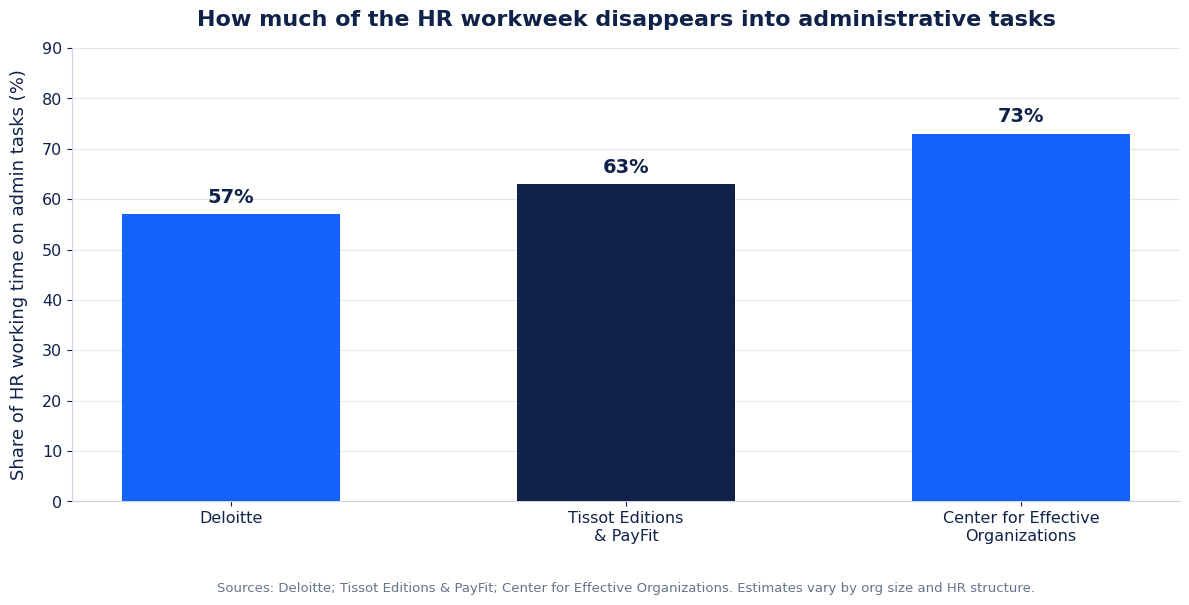
Add it up and HR teams spend nearly four full weeks a year on manual tasks. That is a month of strategy, hiring, and people work traded for data entry. The pattern is not unique to any one country. It is what happens when growth outpaces the tools.
What admin tasks eat the most HR hours?
The heaviest time sinks are attendance, leave management, and payroll, because each repeats every single pay period. The table below shows where the hours go and whether the task can be automated.
| HR admin task | Why it eats hours | Automatable? |
|---|---|---|
| Attendance and time tracking | Daily muster rolls, late marks, and manual corrections | Yes, fully |
| Leave requests and balances | Paper forms, email chains, and manual balance math | Yes, fully |
| Payroll and overtime calculation | Re-keying hours, overtime, and deductions each cycle | Yes, fully |
| Compliance registers | Maintaining attendance, wage, and overtime records by law | Mostly |
| Employee data updates | Address, bank, and role changes across scattered files | Mostly |
| Answering routine queries | Leave balance and payslip questions, one by one | Partly (self-service) |
Notice the pattern. Five of the six tasks are largely automatable. When you move them to software, you do not remove the work. You remove the manual part of it. Connecting your real-time attendance data to payroll is where most teams find their first big win.
How does an HR team buried in admin reclaim hours through automation?
You reclaim the hours by replacing manual data entry with a connected system where attendance feeds leave, and leave feeds payroll automatically. Each lever below removes a repeated task.
Automate attendance capture
Biometric or app-based check-ins record time without a register. The data lands in the system instantly. No one keys a muster roll. Late marks and short leave calculate themselves. This alone clears a daily chore off the HR desk.
Digitise leave requests
Self-service leave lets staff apply from a phone. Balances update automatically. Managers approve in one tap. A proper leave management system ends the paper forms and the balance disputes that follow them.
Connect payroll to attendance
This is the biggest single saver. When verified attendance flows straight into payroll, no one re-enters hours. Overtime calculates from the clock data. Industry analyses show payroll automation can cut processing time by up to 70% and save up to eight hours each pay cycle. You can automate overtime tracking so the math is never in dispute.
Let employees self-serve
Most HR queries are simple. Leave balance, last payslip, remaining allowance. A self-service portal answers these without a human. That reclaims the scattered minutes that quietly fill an HR week.
Every hour your HR team spends on data entry is an hour it does not spend on people.
Manual HR versus automated HR: a side-by-side
Automated HR wins on time, accuracy, and compliance, while manual HR only wins on upfront cost. The comparison makes the trade-off clear.
| Factor | Manual HR | Automated HR |
|---|---|---|
| Payroll processing | 3 to 5 hours per cycle | 1 to 2 hours per cycle |
| Error rate | 4% to 8% of entries | Under 0.5% |
| Attendance record | Manual register, easy to fake | Verified, timestamped |
| Compliance registers | Rebuilt by hand for audits | Generated on demand |
| Scales with headcount | Cost rises with every hire | Marginal cost near zero |
The manual error range is not trivial. Skilled operators still make mistakes on 1% of entries, and 3% to 4% under normal fatigue and time pressure. On payroll, those slips become underpayments, overpayments, and disputes. Automated systems push the error rate under 0.5%.
Here is the contrarian part. Automation does not shrink your HR team. It redeploys it. The goal is not fewer HR people. It is HR people doing fewer forms and more of the work only humans can do.
What does this mean for Bangladeshi HR teams?
For Bangladeshi employers, reclaiming HR hours also lowers legal risk, because the Bangladesh Labour Act requires records you can produce on demand. The rules are specific.
Under the Bangladesh Labour Act, 2006, employers must maintain registers for attendance, wages, overtime, and leave. Wages must be paid within seven working days of the wage period for establishments under 100 workers, and within ten working days for larger ones. Miss a record and an overtime dispute becomes your problem to disprove.
Manual registers make this fragile. A single missing muster roll can sink an audit. Automated records stay complete and timestamped, so a compliance report is a click, not a week of rebuilding files. This is where a full HR software platform for Bangladesh earns its cost, well beyond the hours it saves.
How do you start reclaiming hours this quarter?
Start with the one task that repeats most: attendance, then connect it to payroll. You do not need to digitise everything at once.
Pick the process that hurts the most this month. For most teams that is attendance or payroll. Automate that single flow, measure the hours saved, then move to the next. A staged rollout beats a big-bang switch, and it proves the value fast. Compare options and budgets with a payroll software price guide before you commit.
In my experience, the first connected month is when it clicks. The HR officer who used to key muster rolls spends that week on onboarding instead. That is the whole point of helping an HR team buried in admin reclaim its hours.
Key takeaways
- The problem is measured: HR teams lose 57% to 73% of their time to admin, near four weeks a year.
- Three tasks dominate: attendance, leave, and payroll repeat every cycle and are fully automatable.
- Accuracy jumps: automation cuts payroll error from 4–8% to under 0.5%.
- Compliance gets easier: automated registers meet Bangladesh Labour Act record rules on demand.
- Start small: automate one high-frequency task, connect it to payroll, then expand.
Frequently asked questions
How much time can HR automation actually save?
Most teams reclaim 20 to 50 hours a month once attendance, leave, and payroll are connected. Payroll alone can drop from three to five hours per cycle down to one to two. Over a year that adds up to weeks of recovered time.
Will automating HR admin cost jobs?
No. It changes the work, not the headcount. Staff move from data entry to hiring, retention, and employee support. The routine part disappears, the human part grows.
Is manual HR really that error-prone?
Yes. Skilled operators still make errors on about 1% of manual entries, rising to 3% or 4% under normal pressure. On payroll that error range runs 4% to 8%, which means real pay disputes. Automation cuts it below 0.5%.
What HR task should a small team automate first?
Attendance. It repeats daily and feeds everything downstream. Once attendance is captured automatically, connect it to payroll so hours and overtime never get re-keyed.
Does HR automation help with Bangladesh labour compliance?
Yes. The Bangladesh Labour Act, 2006 requires registers for attendance, wages, overtime, and leave. Automated systems keep these records complete and timestamped, so audit reports are generated in seconds rather than rebuilt by hand.
How do I convince management to invest?
Lead with hours and error costs. Show the four weeks a year lost to manual tasks and the 4% to 8% payroll error range. Then automate one process, measure the saving, and let the first month make the case.